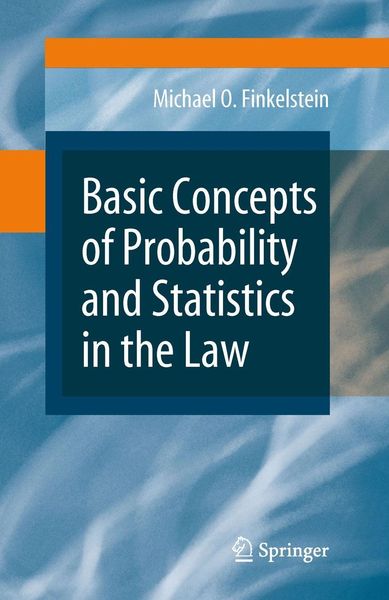
Produktbild: Basic Concepts of Probability and Statistics in the Law

Basic Concepts of Probability and Statistics in the Law

69,54 €

inkl. gesetzl. MwSt.

Beschreibung

Produktdetails

Format

PDF

Kopierschutz

Nein

Family Sharing

Nein

Text-to-Speech

Nein

Erscheinungsdatum

04.06.2009

Verlag

Springer New York

Seitenzahl

174 (Printausgabe)

Dateigröße

1689 KB

Sprache

Englisch

EAN

9780387875019

Beschreibung

Rezension

From the reviews:

“…A ‘shorter and mathematically less challenging’ version of an earlier co-authored book, Statistics for Lawyers. …Full of legal argument and counter-argument forensically dissected by the author. …The book requires concentration but is fun to read. …Presents an excellent treatment of a fascinating field.” (International Statistical Review, 2010, 78, 1, 134-159)

“This work is a good introductional textbook on statistics and probability for lawyers. … The book contains … many examples (sometimes with numerical data and simple calculations) of courts decisions and discussions of real life causes. … Special attention is paid to the statistical meaning of DNA-testing procedures, analysis of epidemiologic data and discrimination causes.” (R. E. Maiboroda, Zentralblatt MATH, Vol. 1173, 2009)

“Basic Concepts of Probability and Statistics in the Law (BCPSL) is an introduction to our discipline for law students and lawyers who want to understand basic statistics and how statistics are used in legal cases. … BCPSL contains some new cases and was a fun and much faster read. … students would enjoy and learn from BCPSL. … a good choice for someone who has already had a basic statistics course or as complementary reading in an introductory course.” (Dalene Stancl, Journal of the American Statistical Association, Vol. 106 (493), March, 2011)

“The author, a lawyer by training, wrote this book as a more accessible … version of his more comprehensive book on the topic, Statistics for Lawyers (2000). This slimmer version of the more comprehensive book makes for a quick, enlightening read. While this book was written primarily for law students, it can be understood by those with formal statistical training who want to understand an area of application of statistical concepts. … statistician or student of statistics would be able to benefit from this book.” (Willis A. Jensen, Technometrics, Vol. 52 (4), November, 2010)

Zitat

From the reviews:
"...A 'shorter and mathematically less challenging' version of an earlier co-authored book, Statistics for Lawyers. ...Full of legal argument and counter-argument forensically dissected by the author. ...The book requires concentration but is fun to read. ...Presents an excellent treatment of a fascinating field." (International Statistical Review, 2010, 78, 1, 134-159)
"This work is a good introductional textbook on statistics and probability for lawyers. ... The book contains ... many examples (sometimes with numerical data and simple calculations) of courts decisions and discussions of real life causes. ... Special attention is paid to the statistical meaning of DNA-testing procedures, analysis of epidemiologic data and discrimination causes." (R. E. Maiboroda, Zentralblatt MATH, Vol. 1173, 2009)
"Basic Concepts of Probability and Statistics in the Law (BCPSL) is an introduction to our discipline for law students and lawyers who want to understand basic statistics and how statistics are used in legal cases. ... BCPSL contains some new cases and was a fun and much faster read. ... students would enjoy and learn from BCPSL. ... a good choice for someone who has already had a basic statistics course or as complementary reading in an introductory course." (Dalene Stancl, Journal of the American Statistical Association, Vol. 106 (493), March, 2011)

Produktdetails

Format

PDF

eBooks im PDF-Format haben eine festgelegte Seitengröße und eignen sich daher nur bedingt zum Lesen auf einem tolino eReader oder Smartphone. Für den vollen Lesegenuss empfehlen wir Ihnen bei PDF-eBooks die Verwendung eines Tablets oder Computers.

Kopierschutz

Nein

Dieses eBook können Sie uneingeschränkt auf allen Geräten der tolino Familie, allen sonstigen eReadern und am PC lesen. Das eBook ist nicht kopiergeschützt und kann ein personalisiertes Wasserzeichen enthalten. Weitere Hinweise zum Lesen von eBooks mit einem personalisierten Wasserzeichen finden Sie unter Hilfe/Downloads.

Family Sharing

Nein

Mit Family Sharing können Sie eBooks innerhalb Ihrer Familie (max. sechs Mitglieder im gleichen Haushalt) teilen. Sie entscheiden selbst, welches Buch Sie mit welchem Familienmitglied teilen möchten. Auch das parallele Lesen durch verschiedene Familienmitglieder ist durch Family Sharing möglich. Um eBooks zu teilen oder geteilt zu bekommen, muss jedes Familienmitglied ein Konto bei Thalia oder einem anderen tolino-Buchhändler haben. Weitere Informationen finden Sie unter Hilfe/Family-Sharing.

Text-to-Speech

Nein

Bedeutet Ihnen Stimme mehr als Text? Mit der Funktion Text-to-Speech können Sie sich im tolino webReader und in der aktuellen Thalia – Lesen & Hören App das eBook vorlesen lassen. Weitere Informationen finden Sie unter Hilfe/Text-to-Speech.

Barrierefreiheit

  • keine Information zur Barrierefreiheit bekannt

Erscheinungsdatum

04.06.2009

Verlag

Springer New York

Seitenzahl

174 (Printausgabe)

Dateigröße

1689 KB

Sprache

Englisch

EAN

9780387875019

Kundinnen und Kunden meinen

0 Bewertungen

Informationen zu Bewertungen

Zur Abgabe einer Bewertung ist eine Anmeldung im Konto notwendig. Die Authentizität der Bewertungen wird von uns nicht überprüft. Wir behalten uns vor, Bewertungstexte, die unseren Richtlinien widersprechen, entsprechend zu kürzen oder zu löschen.

Die Bewertungen sind nach Format, Anzahl Sterne und Datum sortiert.

Verfassen Sie die erste Bewertung zu diesem Artikel

Helfen Sie anderen Kund*innen durch Ihre Meinung

Kundinnen und Kunden meinen

0 Bewertungen filtern

Weitere Artikel finden Sie in

  • Produktbild: Basic Concepts of Probability and Statistics in the Law
  • Probability.- Descriptive Tools.- Compound Events.- Significance.- Random Variables.- Confidence.- Power.- Sampling.- Epidemiology.- Combining the Evidence.- Regression Models.- Regression Models.- Regression Models - Further Considerations.