Band 31
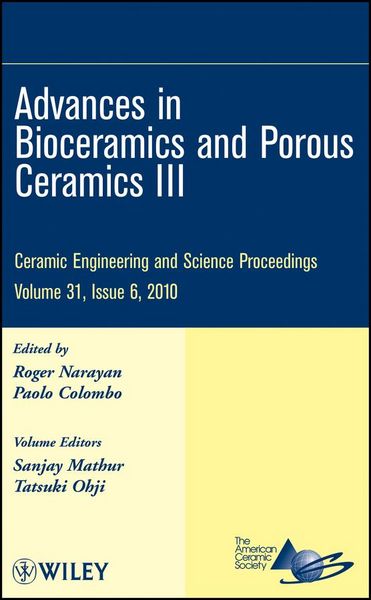
Advances in Bioceramics and Porous Ceramics III, Volume 31, Issue 6
Aus der Reihe
Ceramic Engineering and Science Proceedings
90,99 €
inkl. gesetzl. MwSt.Beschreibung
Produktdetails
Format
Kopierschutz
Ja
Family Sharing
Nein
Text-to-Speech
Nein
Erscheinungsdatum
23.11.2010
Herausgeber
Roger Narayan + weitereVerlag
WileySeitenzahl
188 (Printausgabe)
Dateigröße
13728 KB
Auflage
1. Auflage
Sprache
Englisch
EAN
9780470944011
This issue contains the proceedings of the "Porous Ceramics: Novel Developments and Applications" and "Next Generation Bioceramics" symposia, which were held on January 24-29, 2010 at the Hilton Daytona Beach Resort and the Ocean Center in Daytona Beach, Florida, USA.
The interaction between ceramic materials and living organisms is a leading area of ceramics research. Novel bioceramic materials are being developed that will provide improvements in diagnosis and treatment of medical and dental conditions. In addition, bioinspired ceramics and biomimetic ceramics have generated considerable interest in the scientific community. The "Next Generation Bioceramics" symposium addressed several leading areas related to the development and use of novel bioceramics, including advanced processing of bioceramics; biomineralization and tissue-material interactions; bioinspired and biomimetic ceramics; ceramics for drug delivery; ceramic biosensors; in vitro and in vivo characterization of bioceramics; mechanical properties of bioceramics; and nanostructured bioceramics.
The "Porous Ceramics" symposium aimed to bring together engineers and scientists in the area of ceramic materials containing high volume fractions of porosity, in which the porosity ranged from nano- to millimeters. These materials have attracted significant academic and industrial attention for use in environmental applications, an area where ceramics, particularly porous ones, play a key role because of their suitable properties. Therefore, a significant number of contributions, of which some are present in this volume, was devoted to the fabrication and characterization of porous ceramics for gas purification (e.g., H2 separation and CO2 separation) as well as to particulate filtration (e.g., diesel engine soot).
A leading area of ceramics research involves the development of porous ceramics for medical, dental, and biotechnology applications. For example, porous ceramics are under development for use as bone substitutes because a porous structure may enhance tissue ingrowth. Therefore, tailoring of porosity to give specific characteristics, in terms of the amount of interconnecting cells and of the cell and cell window size is required. A joint session involving participants from bioceramics and porous ceramics symposia was therefore held in order to stimulate discussion and productive interactions between the two scientific communities.
The interaction between ceramic materials and living organisms is a leading area of ceramics research. Novel bioceramic materials are being developed that will provide improvements in diagnosis and treatment of medical and dental conditions. In addition, bioinspired ceramics and biomimetic ceramics have generated considerable interest in the scientific community. The "Next Generation Bioceramics" symposium addressed several leading areas related to the development and use of novel bioceramics, including advanced processing of bioceramics; biomineralization and tissue-material interactions; bioinspired and biomimetic ceramics; ceramics for drug delivery; ceramic biosensors; in vitro and in vivo characterization of bioceramics; mechanical properties of bioceramics; and nanostructured bioceramics.
The "Porous Ceramics" symposium aimed to bring together engineers and scientists in the area of ceramic materials containing high volume fractions of porosity, in which the porosity ranged from nano- to millimeters. These materials have attracted significant academic and industrial attention for use in environmental applications, an area where ceramics, particularly porous ones, play a key role because of their suitable properties. Therefore, a significant number of contributions, of which some are present in this volume, was devoted to the fabrication and characterization of porous ceramics for gas purification (e.g., H2 separation and CO2 separation) as well as to particulate filtration (e.g., diesel engine soot).
A leading area of ceramics research involves the development of porous ceramics for medical, dental, and biotechnology applications. For example, porous ceramics are under development for use as bone substitutes because a porous structure may enhance tissue ingrowth. Therefore, tailoring of porosity to give specific characteristics, in terms of the amount of interconnecting cells and of the cell and cell window size is required. A joint session involving participants from bioceramics and porous ceramics symposia was therefore held in order to stimulate discussion and productive interactions between the two scientific communities.
Noch keine Bewertungen vorhanden
Verfassen Sie die erste Bewertung zu diesem Artikel
Helfen Sie anderen Kundinnen und Kunden durch Ihre Meinung.
Kurze Frage zu unserer Seite
Vielen Dank für Ihr Feedback
Wir nutzen Ihr Feedback, um unsere Produktseiten zu verbessern. Bitte haben Sie Verständnis, dass wir Ihnen keine Rückmeldung geben können. Falls Sie Kontakt mit uns aufnehmen möchten, können Sie sich aber gerne an unseren Kund*innenservice wenden.
zum KundenserviceWeitere Artikel finden Sie in
- eBooks >
- Fachbücher >
- Chemie