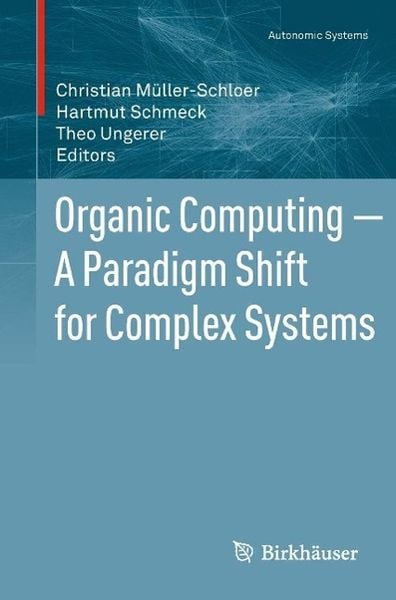
Organic Computing - A Paradigm Shift for Complex Systems
-
- Taschenbuch
- eBook ausgewählt
-
Form:Einzelkauf Download
-
Sprache:Englisch
149,79 €
inkl. gesetzl. MwSt.Beschreibung
Produktdetails
Format
Kopierschutz
Nein
Family Sharing
Nein
Text-to-Speech
Nein
Erscheinungsdatum
29.04.2011
Herausgeber
Christian Müller-Schloer + weitereVerlag
Springer BaselSeitenzahl
627 (Printausgabe)
Dateigröße
23919 KB
Sprache
Englisch
EAN
9783034801300
Organic Computing has emerged as a challenging vision for future information processing systems. Its basis is the insight that we will increasingly be surrounded by and depend on large collections of autonomous systems, which are equipped with sensors and actuators, aware of their environment, communicating freely, and organising themselves in order to perform actions and services required by the users.
These networks of intelligent systems surrounding us open fascinating ap-plication areas and at the same time bear the problem of their controllability. Hence, we have to construct such systems as robust, safe, flexible, and trustworthy as possible. In particular, a strong orientation towards human needs as opposed to a pure implementation of the tech-nologically possible seems absolutely central. The technical systems, which can achieve these goals will have to exhibit life-like or "organic" properties. "Organic Computing Systems" adapt dynamically to their current environmental conditions. In order to cope with unexpected or undesired events they are self-organising, self-configuring, self-optimising, self-healing, self-protecting, self-explaining, and context-aware, while offering complementary interfaces for higher-level directives with respect to the desired behaviour. First steps towards adaptive and self-organising computer systems are being undertaken. Adaptivity, reconfigurability, emergence of new properties, and self-organisation are hot top-ics in a variety of research groups worldwide.
This book summarises the results of a 6-year priority research program (SPP) of the German Research Foundation (DFG) addressing these fundamental challenges in the design of Organic Computing systems. It presents and discusses the theoretical foundations of Organic Computing, basic methods and tools, learningtechniques used in this context, architectural patterns and many applications. The final outlook shows that in the mean-time Organic Computing ideas have spawned a variety of promising new projects.
Noch keine Bewertungen vorhanden
Verfassen Sie die erste Bewertung zu diesem Artikel
Helfen Sie anderen Kundinnen und Kunden durch Ihre Meinung.
Kurze Frage zu unserer Seite
Vielen Dank für Ihr Feedback
Wir nutzen Ihr Feedback, um unsere Produktseiten zu verbessern. Bitte haben Sie Verständnis, dass wir Ihnen keine Rückmeldung geben können. Falls Sie Kontakt mit uns aufnehmen möchten, können Sie sich aber gerne an unseren Kund*innenservice wenden.
zum Kundenservice