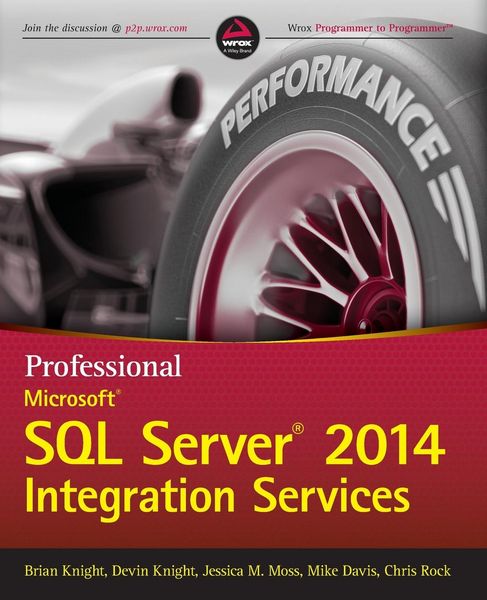
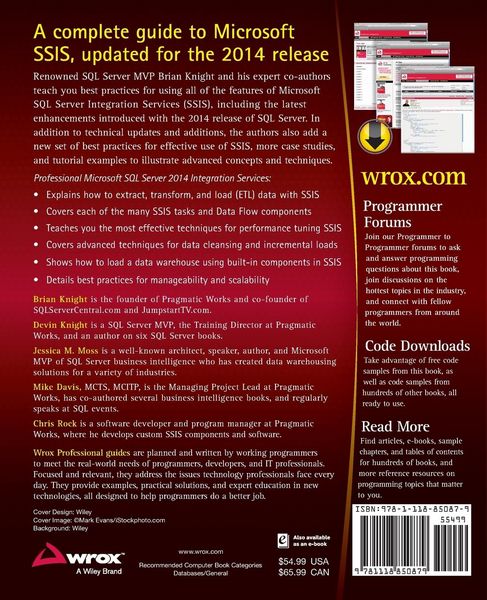
• Produktbild: Professional Microsoft SQL Server 2014 Integration Services
  • Produktbild: Professional Microsoft SQL Server 2014 Integration Services

Professional Microsoft SQL Server 2014 Integration Services

51,99 €

inkl. gesetzl. MwSt., Versandkostenfrei


Beschreibung

Produktdetails

Einband

Taschenbuch

Erscheinungsdatum

21.04.2014

Verlag

John Wiley & Sons

Seitenzahl

912

Maße (L/B/H)

23,3/18,7/4,5 cm

Gewicht

1521 g

Auflage

1. Auflage

Sprache

Englisch

ISBN

978-1-118-85087-9

Beschreibung

Rezension

"This book is suitable for both developers that are new to SSIS development, and experienced developers looking for a more complete understanding. I highly recommend it." (I Programmer, July 2014)

Produktdetails

Einband

Taschenbuch

Erscheinungsdatum

21.04.2014

Verlag

John Wiley & Sons

Seitenzahl

912

Maße (L/B/H)

23,3/18,7/4,5 cm

Gewicht

1521 g

Auflage

1. Auflage

Sprache

Englisch

ISBN

978-1-118-85087-9

Herstelleradresse

Libri GmbH
Europaallee 1
36244 Bad Hersfeld
DE

Email: GPSR Kontakt

Noch keine Bewertungen vorhanden

Verfassen Sie die erste Bewertung zu diesem Artikel

Helfen Sie anderen Kundinnen und Kunden durch Ihre Meinung.

Kundinnen und Kunden meinen

Bewertungen (0)

Die Leseprobe wird geladen.
  • Produktbild: Professional Microsoft SQL Server 2014 Integration Services
  • Produktbild: Professional Microsoft SQL Server 2014 Integration Services
  • Introduction xxvii

    Chapter 1: Welcome to SQL Server Integration Services 1

    SQL Server SSIS Historical Overview 2

    What's New in SSIS 2

    Tools of the Trade 3

    Import and Export Wizard 3

    The SQL Server Data Tools Experience 4

    SSIS Architecture 5

    Packages 5

    Control Flow 5

    Data Flow 9

    Variables 14

    Parameters 14

    Error Handling and Logging 14

    Editions of SQL Server 14

    Summary 15

    Chapter 2: The SSIS Tools 17

    Import and Export Wizard 17

    SQL Server Data Tools 24

    The Solution Explorer Window 26

    The SSIS Toolbox 27

    The Properties Windows 28

    The SSIS Package Designer 28

    Control Flow 29

    Connection Managers 32

    Variables 33

    Data Flow 34

    Parameters 35

    Event Handlers 35

    Package Explorer 36

    Executing a Package 37

    Management Studio 37

    Summary 37

    Chapter 3: SSIS Tasks 39

    SSIS Task Objects 40

    Using the Task Editor 40

    The Task Editor Expressions Tab 41

    Looping and Sequence Tasks 41

    Script Task (.NET) 41

    Analysis Services Tasks 44

    Analysis Services Execute DDL Task 44

    Analysis Services Processing Task 44

    Data Mining Query Task 46

    Data Flow Task 47

    Data Preparation Tasks 48

    Data Profiler 48

    File System Task 50

    Archiving a File 52

    FTP Task 53

    Getting a File Using FTP 54

    Web Service Task 56

    Retrieving Data Using the Web Service Task and XML Source Component 59

    XML Task 62

    Validating an XML File 64

    RDBMS Server Tasks 66

    Bulk Insert Task 66

    Using the Bulk Insert Task 69

    Execute SQL Task 71

    Workflow Tasks 82

    Execute Package Task 82

    Execute Process Task 84

    Message Queue Task 86

    Send Mail Task 87

    WMI Data Reader Task 88

    WMI Event Watcher Task 91

    Polling a Directory for the Delivery of a File 91

    SMO Administration Tasks 92

    Transfer Database Task 93

    Transfer Error Messages Task 94

    Transfer Logins Task 94

    Transfer Master Stored Procedures Task 95

    Transfer Jobs Task 96

    Transfer SQL Server Objects Task 96

    Summary 97

    Chapter 4: The Data Flow 99

    Understanding the Data Flow 99

    Data Viewers 100

    Sources 101

    OLE DB Source 102

    Excel Source 104

    Flat File Source 105

    Raw File Source 110

    XML Source 110

    ADO.NET Source 111

    Destinations 111

    Excel Destination 112

    Flat File Destination 112

    OLE DB Destination 112

    Raw File Destination 113

    Recordset Destination 114

    Data Mining Model Training 114

    DataReader Destination 114

    Dimension and Partition Processing 114

    Common Transformations 115

    Synchronous versus Asynchronous Transformations 115

    Aggregate 115

    Conditional Split 117

    Data Conversion 118

    Derived Column 119

    Lookup 121

    Row Count 121

    Script Component 122

    Slowly Changing Dimension 123

    Sort 123

    Union All 125

    Other Transformations 126

    Audit 126

    Character Map 128

    Copy Column 128

    Data Mining Query 129

    DQS Cleansing 130

    Export Column 130

    Fuzzy Lookup 132

    Fuzzy Grouping 139

    Import Column 143

    Merge 145

    Merge Join 146

    Multicast 146

    OLE DB Command 147

    Percentage and Row Sampling 148

    Pivot Transform 149

    Unpivot 152

    Term Extraction 154

    Term Lookup 158

    Data Flow Example 160

    Summary 164

    Chapter 5: Using Variables, Parameters, and Expressions 165

    Dynamic Package Objects 166

    Variable Overview 166

    Parameter Overview 166

    Expression Overview 167

    Understanding Data Types 168

    SSIS Data Types 168

    Date and Time Type Support 170

    How Wrong Data Types and Sizes Can Affect Performance 171

    Unicode and Non-Unicode Conversion Issues 171

    Casting in SSIS Expressions 173

    Using Variables and Parameters 174

    Defining Variables 174

    Defining Parameters 175

    Variable and Parameter Data Types 176

    Working with Expressions 177

    C#-Like? Close, but Not Completely 178

    The Expression Builder 179

    Syntax Basics 180

    Using Expressions in SSIS Packages 194

    Summary 204

    Chapter 6: Containers 205

    Task Host Containers 205

    Sequence Containers 206

    Groups 207

    For Loop Container 207

    Foreach Loop Container 210

    Foreach File Enumerator Example 211

    Foreach ADO Enumerator Example 213

    Summary 218

    Chapter 7: Joining Data 219

    The Lookup Transformation 220

    Using the Merge Join Transformation 221

    Contrasting SSIS and the Relational Join 222

    Lookup Features 224

    Building the Basic Package 225

    Using a Relational Join in the Source 227

    Using the Merge Join Transformation 230

    Using the Lookup Transformation 235

    Full-Cache Mode 235

    No-Cache Mode 239

    Partial-Cache Mode 240

    Multiple Outputs 243

    Expressionable Properties 246

    Cascaded Lookup Operations 247

    Cache Connection Manager and Cache Transform 249

    Summary 252

    Chapter 8: Creating an End-to-End Package 253

    Basic Transformation Tutorial 253

    Creating Connections 254

    Creating the Control Flow 257

    Creating the Data Flow 257

    Completing the Package 259

    Saving the Package 260

    Executing the Package 260

    Typical Mainframe ETL with Data Scrubbing 261

    Creating the Data Flow 263

    Handling Dirty Data 263

    Finalizing 268

    Handling More Bad Data 269

    Looping and the Dynamic Tasks 271

    Looping 271

    Making the Package Dynamic 272

    Summary 274

    Chapter 9: Scripting in SSIS 275

    Introducing SSIS Scripting 276

    Getting Started in SSIS Scripting 277

    Selecting the Scripting Language 277

    Using the VSTA Scripting IDE 278

    Example: Hello World 279

    Adding Code and Classes 281

    Using Managed Assemblies 282

    Example: Using Custom .NET Assemblies 283

    Using the Script Task 286

    Configuring the Script Task Editor 287

    The Script Task Dts Object 288

    Accessing Variables in the Script Task 289

    Connecting to Data Sources in a Script Task 293

    Raising an Event in a Script Task 303

    Writing a Log Entry in a Script Task 309

    Using the Script Component 310

    Differences from a Script Task 310

    Configuring the Script Component Editor 311

    Accessing Variables in a Script Component 313

    Connecting to Data Sources in a Script Component 314

    Raising Events 314

    Logging 315

    Example: Data Validation 316

    Synchronous versus Asynchronous 324

    Essential Coding, Debugging, and Troubleshooting Techniques 327

    Structured Exception Handling 327

    Script Debugging and Troubleshooting 330

    Summary 333

    Chapter 10: Advanced Data Cleansing in SSIS 335

    Advanced Derived Column Use 336

    Text Parsing Example 338

    Advanced Fuzzy Lookup and Fuzzy Grouping 340

    Fuzzy Lookup 340

    Fuzzy Grouping 347

    DQS Cleansing 350

    Data Quality Services 351

    DQS Cleansing Transformation 355

    Master Data Management 358

    Master Data Services 359

    Summary 362

    Chapter 11: Incremental Loads in SSIS 363

    Control Table Pattern 363

    Querying the Control Table 364

    Querying the Source Table 366

    Updating the Control Table 366

    SQL Server Change Data Capture 367

    Benefits of SQL Server CDC 368

    Preparing CDC 369

    Capture Instance Tables 371

    The CDC API 372

    Using the SSIS CDC Tools 374

    Summary 379

    Chapter 12: Loading a Data Warehouse 381

    Data Profiling 383

    Initial Execution of the Data Profiling Task 383

    Reviewing the Results of the Data Profiling Task 386

    Turning Data Profile Results into Actionable ETL Steps 390

    Data Extraction and Cleansing 391

    Dimension Table Loading 391

    Loading a Simple Dimension Table 392

    Loading a Complex Dimension Table 397

    Considerations and Alternatives to the SCD Transformation 408

    Fact Table Loading 409

    SSAS Processing 421

    Using a Master ETL Package 426

    Summary 428

    Chapter 13: Using the Relational Engine 429

    Data Extraction 430

    SELECT * is Bad 430

    WHERE is Your Friend 432

    Transform during Extract 433

    Many ANDs Make Light Work 437

    SORT in the Database 437

    Modularize 439

    SQL Server Does Text Files Too 440

    Using Set-Based Logic 444

    Data Loading 446

    Database Snapshots 446

    The MERGE Operator 448

    Summary 452

    Chapter 14: Accessing Heterogeneous Data 453

    Excel and Access 455

    64-Bit Support 455

    Working with Excel Files 457

    Working with Access 462

    Importing from Oracle 469

    Oracle Client Setup 469

    Importing Oracle Data 470

    Using XML and Web Services 472

    Configuring the Web Service Task 472

    Working with XML Data as a Source 483

    Flat Files 486

    Loading Flat Files 487

    Extracting Data from Flat Files 489

    ODBC 491

    Other Heterogeneous Sources 494

    Summary 495

    Chapter 15: Reliability and Scalability 497

    Restarting Packages 498

    Simple Control Flow 499

    Containers within Containers and Checkpoints 501

    Variations on a Theme 503

    Inside the Checkpoint File 505

    Package Transactions 507

    Single Package, Single Transaction 508

    Single Package, Multiple Transactions 509

    Two Packages, One Transaction 511

    Single Package Using a Native Transaction in SQL Server 512

    Error Outputs 513

    Scaling Out 516

    Architectural Features 516

    Scaling Out Memory Pressures 517

    Scaling Out by Staging Data 517

    Scaling Out with Parallel Loading 522

    Summary 528

    Chapter 16: Understanding and Tuning the Data Flow Engine 529

    The SSIS Engine 530

    Understanding the SSIS Data Flow and Control Flow 530

    Handling Workflows with the Control Flow 533

    Data Processing in the Data Flow 533

    Memory Buffer Architecture 534

    Types of Transformations 534

    Advanced Data Flow Execution Concepts 543

    SSIS Data Flow Design and Tuning 549

    Data Flow Design Practices 550

    Optimizing Package Processing 555

    Troubleshooting Data Flow Performance Bottlenecks 558

    Pipeline Performance Monitoring 559

    Summary 562

    Chapter 17: SS IS Software Development Life Cycle 563

    Introduction to Software Development Life Cycles 565

    SDLCs: A Brief History 566

    Types of Software Development Life Cycles 566

    Versioning and Source Code Control 567

    Subversion (SVN) 568

    Team Foundation Server, Team System, and SSIS 573

    Summary 590

    Chapter 18: Error and Event Handling 591

    Using Precedence Constraints 592

    Precedence Constraint Basics 592

    Advanced Precedence Constraints and Expressions 593

    Event Handling 601

    Events 602

    Using Event Handlers 603

    Event Handler Inheritance 611

    Breakpoints 612

    Error Rows 616

    Logging 622

    Logging Providers 622

    Log Events 623

    Catalog Logging 627

    Summary 629

    Chapter 19: Programming and Extending SSIS 631

    The Sample Components 632

    Component 1: Source Adapter 632

    Component 2: Transform 633

    Component 3: Destination Adapter 634

    The Pipeline Component Methods 634

    Design-Time Functionality 635

    Runtime 639

    Connection Time 640

    Building the Components 642

    Preparation 642

    Building the Source Component 648

    Building the Transformation Component 660

    Building the Destination Adapter 671

    Using the Components 679

    Installing the Components 679

    Debugging Components 680

    Design Time 680

    Building the Complete Package 682

    Runtime Debugging 682

    Upgrading to SQL Server 2014 687

    Summary 687

    Chapter 20: Adding a User Interface to Your Component 689

    Three Key Steps for Designing the UI: An Overview 690

    Building the User Interface 690

    Adding the Project 691

    Implementing IDtsComponentUI 693

    Setting the UITypeName 697

    Building the Form 699

    Extending the User Interface 704

    Runtime Connections 704

    Component Properties 707

    Handling Errors and Warnings 708

    Column Properties 711

    Other UI Considerations 712

    Summary 712

    Chapter 21: External Management and WMI Task Implementation 715

    External Management of SSIS with Managed Code 716

    Setting Up a Test SSIS Package for Demonstration Purposes 716

    The Managed Object Model Code Library 717

    Catalog Management 718

    Folder Management 719

    Environments 720

    The DTS Runtime Managed Code Library 722

    SSIS Deployment Projects 722

    Parameter Objects 723

    Server Deployment 725

    Executing SSIS Packages Deployed to the SSIS Catalog 726

    Environment References 727

    Package Operations 728

    Application Object Maintenance Operations 729

    Package Operations 729

    Package Monitoring 732

    Project, Folder, and Package Listing 734

    A Package Management Example 735

    Package Log Providers 745

    Specifying Events to Log 747

    Programming to Log Providers 748

    SQL Server 2014 Operation Logs 749

    Package Configurations 751

    Creating a Configuration 752

    Programming the Configuration Object 753

    Configuration Object 754

    Windows Management Instrumentation Tasks 755

    WMI Reader Task Explained 755

    WMI Data Reader Example 756

    WMI Event Watcher Task 762

    WMI Event Watcher Task Example 763

    Summary 766

    Chapter 22: Ad ministering SSIS 767

    Using the SSIS Catalog 768

    Setting the SSIS Catalog Properties 768

    SSISDB 771

    Deployment Models 772

    Project Deployment Model 773

    Package Deployment Model 775

    Using T-SQL with SSIS 781

    Executing Packages 781

    Using Parameters 782

    Querying Tables for Parameter Values 783

    Using Environments 784

    Using Data Taps 789

    Creating a Central SSIS Server 790

    Clustering SSIS 792

    Package Configuration 794

    Command-Line Utilities 798

    DTExec 798

    DTExecUI 799

    DTUtil 804

    Security 806

    Securing the SSIS Catalog 806

    Legacy Security 809

    Scheduling Packages 811

    SQL Server Agent 811

    Proxy Accounts 813

    64-Bit Issues 814

    Monitoring Package Executions 815

    Built-in Reporting 815

    Custom Reporting 819

    Performance Counters 819

    Summary 820

    Appendix A: SS IS Crib Notes 821

    When to Use Control Flow Tasks 821

    When to Use Data Flow Transforms 822

    Common Expressions and Scripts 824

    Appendix B: SS IS Internal Views and Stored Procedures 829

    Views 829

    Stored Procedures 830

    Appendix C: Interviewing for an ETL Developer Position 833

    Questions 833

    Answers 834

    Index 839