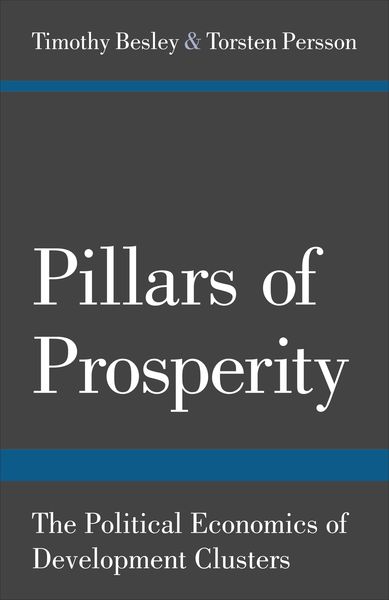
Pillars of Prosperity The Political Economics of Development Clusters
-
- Taschenbuch
- eBook ausgewählt
-
Form:Einzelkauf Download
-
Sprache:Englisch
54,49 €
inkl. gesetzl. MwSt.Beschreibung
Produktdetails
Format
ePUB
Kopierschutz
Nein
Family Sharing
Nein
Text-to-Speech
Ja
Erscheinungsdatum
08.08.2011
Verlag
Lsu PressSeitenzahl
392 (Printausgabe)
Dateigröße
7026 KB
Sprache
Englisch
EAN
9781400840526
How nations can promote peace, prosperity, and stability through cohesive political institutions
"Little else is required to carry a state to the highest degree of opulence from the lowest barbarism, but peace, easy taxes, and a tolerable administration of justice; all the rest being brought about by the natural course of things." So wrote Adam Smith a quarter of a millennium ago. Using the tools of modern political economics and combining economic theory with a bird's-eye view of the data, this book reinterprets Smith's pillars of prosperity to explain the existence of development clusters-places that tend to combine effective state institutions, the absence of political violence, and high per-capita incomes.
To achieve peace, the authors stress the avoidance of repressive government and civil conflict. Easy taxes, they argue, refers not to low taxes, but a tax system with widespread compliance that collects taxes at a reasonable cost from a broad base, like income. And a tolerable administration of justice is about legal infrastructure that can support the enforcement of contracts and property rights in line with the rule of law. The authors show that countries tend to enjoy all three pillars of prosperity when they have evolved cohesive political institutions that promote common interests, guaranteeing the provision of public goods. In line with much historical research, international conflict has also been an important force behind effective states by fostering common interests. The absence of common interests and/or cohesive political institutions can explain the existence of very different development clusters in fragile states that are plagued by poverty, violence, and weak state capacity.
Noch keine Bewertungen vorhanden
Verfassen Sie die erste Bewertung zu diesem Artikel
Helfen Sie anderen Kundinnen und Kunden durch Ihre Meinung.
Kurze Frage zu unserer Seite
Vielen Dank für Ihr Feedback
Wir nutzen Ihr Feedback, um unsere Produktseiten zu verbessern. Bitte haben Sie Verständnis, dass wir Ihnen keine Rückmeldung geben können. Falls Sie Kontakt mit uns aufnehmen möchten, können Sie sich aber gerne an unseren Kund*innenservice wenden.
zum Kundenservice