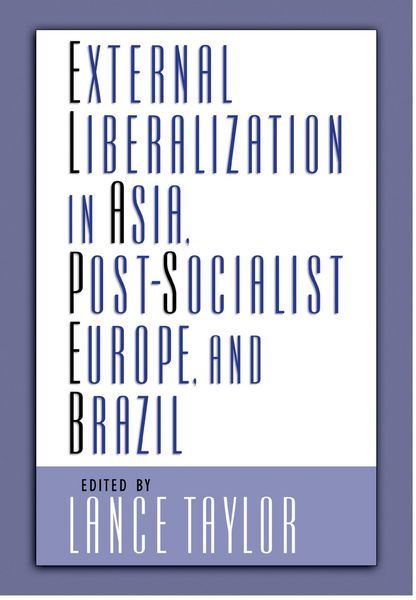
External Liberalization in Asia, Post-Socialist Europe, and Brazil
-
Form:Einzelkauf Download
-
Sprache:Englisch
-
eBook Format:PDF
- PDF 84,49 € ausgewählt
- ePUB 29,49 €
-
Verlag:OUP eBook
- OUP eBook 28,99 €
- OUP eBook 84,49 € ausgewählt
84,49 €
inkl. gesetzl. MwSt.Beschreibung
Produktdetails
Format
Kopierschutz
Ja
Family Sharing
Nein
Text-to-Speech
Nein
Erscheinungsdatum
02.02.2006
Herausgeber
Lance TaylorVerlag
OUP eBookSeitenzahl
(Printausgabe)
Dateigröße
4814 KB
Sprache
Englisch
EAN
9780198040811
This book reviews the experience of 14 countries with external liberalization and related policies, based on papers written by national authors following a common 0000oeconomic methodology. The methodology, the papers' main results, and policy implications are summarized in the introductory chapter.
The book reports on a follow-on project to the country studies presented in Lance Taylor (ed.), External Liberalization, Economic Performance, and Social Policy, OUP, 2001. The new project represents a significant extension of the earlier work in that it focuses principally on formerly socialist European economies (Hungary, Poland, Russia), Asian economies (consistently growing China, India, Singapore, and Vietnam; the 1997-98 crisis victims Indonesia, Korea, Malaysia, and Thailand; and cyclically stagnant Philippines and Turkey). Brazil is also included as an important comparator. Macroeconomics has traditionally been less actively pursued in Asia and the transition economies than, say, in Latin America. The 1997-98 crisis awoke the Asians to the importance of macro, and the present book is in part a response to the development.
A distinguishing feature of the book is the common methodology, which focuses on the mechanisms via which effective demand is generated and the interactions of labor productivity, employment growth, and income distribution. The country papers show clearly how trade and capital account liberalization along with changes in the real exchange rate affected demand, productivity, and employment at the country level. They also trace through shifts in the overall income distribution and the incidence of poverty. The authors of the papers bring a wealth of insight into their thick descriptions à la Clifford Geertz's famous Balinese cockfight about how diverse economies responded to rather similar reform packages and offer lessons about ongoing institutional change. They also suggest policy shifts that may help make economic performance better in the future than it has been in the past.
The book reports on a follow-on project to the country studies presented in Lance Taylor (ed.), External Liberalization, Economic Performance, and Social Policy, OUP, 2001. The new project represents a significant extension of the earlier work in that it focuses principally on formerly socialist European economies (Hungary, Poland, Russia), Asian economies (consistently growing China, India, Singapore, and Vietnam; the 1997-98 crisis victims Indonesia, Korea, Malaysia, and Thailand; and cyclically stagnant Philippines and Turkey). Brazil is also included as an important comparator. Macroeconomics has traditionally been less actively pursued in Asia and the transition economies than, say, in Latin America. The 1997-98 crisis awoke the Asians to the importance of macro, and the present book is in part a response to the development.
A distinguishing feature of the book is the common methodology, which focuses on the mechanisms via which effective demand is generated and the interactions of labor productivity, employment growth, and income distribution. The country papers show clearly how trade and capital account liberalization along with changes in the real exchange rate affected demand, productivity, and employment at the country level. They also trace through shifts in the overall income distribution and the incidence of poverty. The authors of the papers bring a wealth of insight into their thick descriptions à la Clifford Geertz's famous Balinese cockfight about how diverse economies responded to rather similar reform packages and offer lessons about ongoing institutional change. They also suggest policy shifts that may help make economic performance better in the future than it has been in the past.
Noch keine Bewertungen vorhanden
Verfassen Sie die erste Bewertung zu diesem Artikel
Helfen Sie anderen Kundinnen und Kunden durch Ihre Meinung.
Kurze Frage zu unserer Seite
Vielen Dank für Ihr Feedback
Wir nutzen Ihr Feedback, um unsere Produktseiten zu verbessern. Bitte haben Sie Verständnis, dass wir Ihnen keine Rückmeldung geben können. Falls Sie Kontakt mit uns aufnehmen möchten, können Sie sich aber gerne an unseren Kund*innenservice wenden.
zum Kundenservice