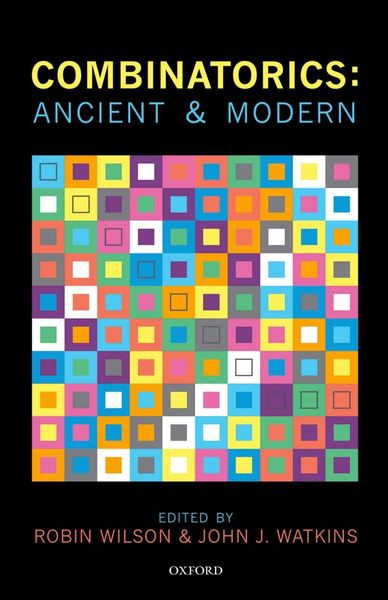
Combinatorics: Ancient & Modern
Aus der Reihe
Very Short Introductions
-
- Hardcover
- Taschenbuch
- eBook ausgewählt
-
Form:Einzelkauf Download
-
Sprache:Englisch
-
eBook Format:ePUB
- PDF 9,49 €
- ePUB 40,99 € ausgewählt
-
Verlag:OUP eBook
- OUP eBook 9,49 €
- OUP eBook 40,99 € ausgewählt
40,99 €
inkl. gesetzl. MwSt.Beschreibung
Produktdetails
Format
ePUB
Kopierschutz
Ja
Family Sharing
Nein
Text-to-Speech
Ja
Erscheinungsdatum
27.06.2013
Herausgeber
Robin Wilson + weitereVerlag
OUP eBookSeitenzahl
(Printausgabe)
Dateigröße
52164 KB
Sprache
Englisch
EAN
9780191630637
Who first presented Pascal's triangle? (It was not Pascal.)
Who first presented Hamiltonian graphs? (It was not Hamilton.)
Who first presented Steiner triple systems? (It was not Steiner.)
The history of mathematics is a well-studied and vibrant area of research, with books and scholarly articles published on various aspects of the subject. Yet, the history of combinatorics seems to have been largely overlooked. This book goes some way to redress this and serves two main purposes: 1) it constitutes the first book-length survey of the history of combinatorics; and 2) it assembles, for the first time in a single source, researches on the history of combinatorics that would otherwise be inaccessible to the general reader. Individual chapters have been contributed by sixteen experts. The book opens with an introduction by Donald E. Knuth to two thousand years of combinatorics. This is followed by seven chapters on early combinatorics, leading from Indian and Chinese writings on permutations to late-Renaissance publications on the arithmetical triangle. The next seven chapters trace the subsequent story, from Euler's contributions to such wide-ranging topics as partitions, polyhedra, and latin squares to the 20th century advances in combinatorial set theory, enumeration, and graph theory. The book concludes with some combinatorial reflections by the distinguished combinatorialist, Peter J. Cameron. This book is not expected to be read from cover to cover, although it can be. Rather, it aims to serve as a valuable resource to a variety of audiences. Combinatorialists with little or no knowledge about the development of their subject will find the historical treatment stimulating. A historian of mathematics will view its assorted surveys as an encouragement for further research in combinatorics. The more general reader will discover an introduction to a fascinating and too little known subject that continues to stimulate and inspire the work of scholars today.
Who first presented Hamiltonian graphs? (It was not Hamilton.)
Who first presented Steiner triple systems? (It was not Steiner.)
The history of mathematics is a well-studied and vibrant area of research, with books and scholarly articles published on various aspects of the subject. Yet, the history of combinatorics seems to have been largely overlooked. This book goes some way to redress this and serves two main purposes: 1) it constitutes the first book-length survey of the history of combinatorics; and 2) it assembles, for the first time in a single source, researches on the history of combinatorics that would otherwise be inaccessible to the general reader. Individual chapters have been contributed by sixteen experts. The book opens with an introduction by Donald E. Knuth to two thousand years of combinatorics. This is followed by seven chapters on early combinatorics, leading from Indian and Chinese writings on permutations to late-Renaissance publications on the arithmetical triangle. The next seven chapters trace the subsequent story, from Euler's contributions to such wide-ranging topics as partitions, polyhedra, and latin squares to the 20th century advances in combinatorial set theory, enumeration, and graph theory. The book concludes with some combinatorial reflections by the distinguished combinatorialist, Peter J. Cameron. This book is not expected to be read from cover to cover, although it can be. Rather, it aims to serve as a valuable resource to a variety of audiences. Combinatorialists with little or no knowledge about the development of their subject will find the historical treatment stimulating. A historian of mathematics will view its assorted surveys as an encouragement for further research in combinatorics. The more general reader will discover an introduction to a fascinating and too little known subject that continues to stimulate and inspire the work of scholars today.
Kundinnen und Kunden meinen
Verfassen Sie die erste Bewertung zu diesem Artikel
Helfen Sie anderen Kund*innen durch Ihre Meinung
Kurze Frage zu unserer Seite
Vielen Dank für Ihr Feedback
Wir nutzen Ihr Feedback, um unsere Produktseiten zu verbessern. Bitte haben Sie Verständnis, dass wir Ihnen keine Rückmeldung geben können. Falls Sie Kontakt mit uns aufnehmen möchten, können Sie sich aber gerne an unseren Kund*innenservice wenden.
zum Kundenservice