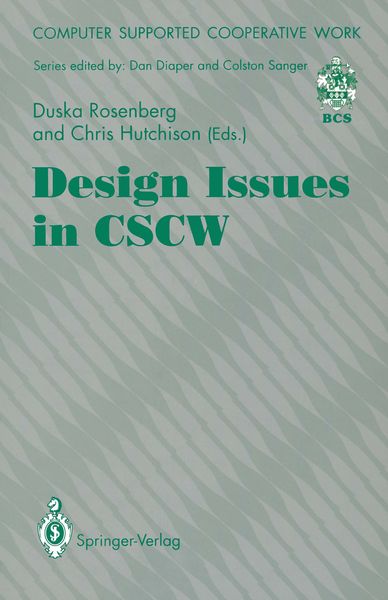
• Produktbild: Design Issues in CSCW
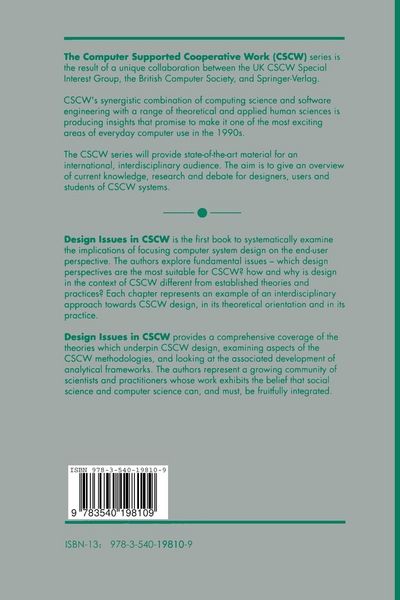
  • Produktbild: Design Issues in CSCW

Design Issues in CSCW

48,99 €

inkl. gesetzl. MwSt., Versandkostenfrei


Beschreibung

Produktdetails

Einband

Taschenbuch

Erscheinungsdatum

30.09.1994

Herausgeber

Duska Rosenberg + weitere

Verlag

Springer Berlin

Seitenzahl

321

Maße (L/B/H)

23,5/15,5/1,9 cm

Gewicht

506 g

Auflage

1st Edition.

Sprache

Englisch

ISBN

978-3-540-19810-9

Beschreibung

Produktdetails

Einband

Taschenbuch

Erscheinungsdatum

30.09.1994

Herausgeber

Verlag

Springer Berlin

Seitenzahl

321

Maße (L/B/H)

23,5/15,5/1,9 cm

Gewicht

506 g

Auflage

1st Edition.

Sprache

Englisch

ISBN

978-3-540-19810-9

Herstelleradresse

Springer Heidelberg
Tiergartenstr. 17
69121 Heidelberg
DE
buchhandel-buch@springer.com

Noch keine Bewertungen vorhanden

Verfassen Sie die erste Bewertung zu diesem Artikel

Helfen Sie anderen Kundinnen und Kunden durch Ihre Meinung.

Kundinnen und Kunden meinen

Bewertungen (0)

  • Produktbild: Design Issues in CSCW
  • Produktbild: Design Issues in CSCW
  • 1 Introduction.- 2 Computer Supported Cooperative Work: A Framework.- 2.1 Introduction.- 2.2 Cooperative Work.- 2.2.1 Cooperation.- 2.2.2 Work.- 2.2.3 Communication through the Artefact.- 2.2.4 Understanding: Soft and Hard Artefacts.- 2.2.5 Deixis.- 2.3 Computer Support: Communication.- 2.3.1 Computer Mediated Communication.- 2.3.2 Anti-CMC.- 2.4 Computerized Artefacts of Work.- 2.5 Non-Computerized Artefacts.- 2.5.1 Prosthesis.- 2.5.2 Implications for Design.- 2.5.3 Success Story: Bar Codes.- 2.6 Summary.- 3 Capturing Interactions: Requirements for CSCW.- 3.1 Design Issues for CSCW.- 3.1.1 The Life-Cycle Framework.- 3.2 Ethnographic Study of Office Work.- 3.3 Case Study of a Technical Publications Unit.- 3.3.1 Organizational Description.- 3.3.2 Authors’ Views on their Work.- 3.3.3 Life History of a Job.- 3.3.4 Job Conditions.- 3.3.5 Interaction Episodes.- 3.4 The Analysis.- 3.4.1 Strategy.- 3.4.2 Classification of Activities.- 3.5 Conclusions.- 3.5.1 What the Authors Want.- 3.5.2 What the Analysis Found.- 3.5.3 In Conclusion.- 4 Situation Theory and the Design of Interactive Information Systems.- 4.1 Introduction.- 4.2 Information.- 4.3 On Mathematics, Metaphor and Design.- 4.4 Situation Theory: A Review.- 4.5 Normative Constraints and Cognition.- 4.6 Information, Situations and Design.- 4.7 Multimedia and Multi-User.- 4.8 The Role of Situation Theory.- 4.9 Conclusion.- 5 Patterns of Language in Organizations: Implications for CSCW.- 5.1 Introduction.- 5.1.1 Aims.- 5.1.2 The Sopwith Case Study.- 5.2 Four Models of Linguistic Support for Collaborative Work.- 5.2.1 Language and Information.- 5.2.2 Sociometric Analysis.- 5.2.3 Style Checkers: Form versus Content.- 5.2.4 Language and Reality: An Overview of Systemic Functional Linguistics.- 5.2.5 Language, Information and Organizations.- 5.3 Conclusions.- Appendix A.- A.1 The Message from Leyland.- A. 2 How the Sunday Times Rewrote It.- Appendix B.- B.1 Alcatraz on the Third Floor or Communications and Information Free of Time and Space (CIFTS!).- 6 Coordination Issues in Tools for CSCW.- 6.1 Introduction.- 6.2 Early Experiences with CSCW.- 6.3 Cognitive Issues in CSCW.- 6.4 Conversation Analysis.- 6.4.1 Turn Management in Conversations.- 6.4.2 An Example of Conversation Analysis.- 6.5 Coordination in CSCW.- 6.6 Studies of Turn Management in CSCW.- 6.7 Discussion.- 6.8 Concluding Remarks.- Appendix A.- A.1 Annotated Bibliography.- 7 Software Engineering Design: A Paradigm Case of Computer Supported Cooperative Working.- 7.1 Introduction.- 7.1.1 What is Design Theory?.- 7.1.2 Is Design a Natural Phenomenon?.- 7.1.3 A View of Design from Cognitive Science.- 7.2 Use of Abstract Representations.- 7.2.1 Implications for Design Methods and Tool Support.- 7.2.2 Philosophical Issues: Are they relevant?.- 7.2.3 The Role of Concepts in Structuring Knowledge.- 7.3 The Design Frameworks Approach.- 7.4 An Approach to Design-for-Reuse.- 7.4.1 Considerations Regarding the Use of Frameworks in Design.- 7.5 Conclusions.- 8 Where Are Designers? Styles of Design Practice, Objects of Design and Views of Users in CSCW.- 8.1 Design as Technique, as Social Function and as Politics.- 8.2 Three Interpretations of the Significance of “Users”.- 8.3 Users as Clients: The “Specify and Deliver” Style.- 8.4 Users as Codesigners: The “Reflect and Reinterpret” Style.- 8.5 Users as Actor-Constructors: The “Enable and Empower” Style.- 8.6 Where are Designers? The Geo-Economic “Location” Problem.- 8.7 Taking Design with Us.- 9 Coping with Complexity and Interference: Design Issues in Multimedia Conferencing Systems.- 9.1 Introduction.- 9.2 The CAR Multimedia Conferencing System.- 9.3 Design Principles.- 9.3.1 WYSIWIS.- 9.3.2 Seamlessness.- 9.4 Design and Usability Issues.- 9.4.1 Screen Clutter.- 9.4.2 Unexpected Events.- 9.4.3 Notification of Events.- 9.4.4 Floor Control.- 9.4.5 Pointers.- 9.5 Discussion: Design Principles for Multimedia Conferencing.- 9.6 Conclusions.- 10 The Role of Replication in the Development of Remote CSCW Systems.- 10.1 Designing for the Future.- 10.1.1 The System Designer as Creative Problem Solver.- 10.1.2 The Difficulty of Exchanging Creation for Facilitation.- 10.1.3 Single-User Product Innovation.- 10.2 Designing for the Present: Replication.- 10.3 An Experiment in Replication.- 10.3.1 The ROCOCO Station.- 10.3.2 User Interface.- 10.4 Evaluating the System.- 10.4.1 The LookingGlass.- 10.4.2 An Investigation of the LookingGlass in Use.- 10.5 Conclusion.- 11 Computer Supported Conflict Management in Design Teams.- 11.1 The Challenge: Supporting Collaboration in Design Groups.- 11.2 Contributions and Limitations of Existing Work.- 11.3 The Design Collaboration Support System.- 11.3.1 Describing Design Actions and Rationale.- 11.3.2 Detecting Conflicts.- 11.3.3 Resolving Conflicts.- 11.4 Evaluation and Future Work.- 12 ShareLib: A Toolkit for CSCW Applications Programming Using X Windows.- 12.1 Introduction.- 12.2 Existing Applications.- 12.3 Other Similar Work.- 12.4 What Programming Support Should Provide.- 12.4.1 Features of CSCW.- 12.4.2 Tailorability.- 12.5 Design of ShareLib: Architecture.- 12.5.1 A New Level of Abstraction.- 12.5.2 Features and Tailorability Provided by the CSCW Layer.- 12.6 Design of ShareLib: Implementation.- 12.6.1 The X Window System.- 12.6.2 ShareLib as a Layer above X Windows.- 12.7 Example Implementation: The Telepointer.- 12.7.1 Writing Xlib Applications.- 12.7.2 The Telepointer Type.- 12.7.3 Initializing the Telepointer.- 12.7.4 Processing Telepointer Events.- 12.7.5 Floor Control.- 12.7.6 Drawing the Telepointer Pixmap.- 12.8 Summary and Further Work.- 13 Adapting a Design History Editor for Concurrent Engineering.- 13.1 Introduction.- 13.1.1 Motivation.- 13.1.2 Starting Point.- 13.1.3 Outline of the DHE Work.- 13.2 Design History Editor.- 13.2.1 Inherent Difficulties with Current Approaches.- 13.2.2 Conventional Logbooks and Hypertext.- 13.2.3 The Impact of Prescription.- 13.3 User Requirements of the Design History Editor.- 13.3.1 Page Emulation.- 13.3.2 Representation of Finer Structure.- 13.3.3 The Lemma.- 13.4 Technology.- 13.4.1 The SMART Frame Server.- 13.4.2 The Blackboard Architecture.- 13.4.3 Managing Knowledge Assets.- 13.4.4 Khoros.- 13.5 Technology Transfer.- 13.6 Concluding Remarks.- 14 “Nouvelle Design”: A Pragmatic Approach to CSCW Systems Building.- 14.1 Introduction.- 14.2 Background.- 14.3 Conversation Analysis.- 14.4 User Centred Design.- 14.5 Requirements Capture ? Structured Observation.- 14.5.1 Basic System Functionality.- 14.5.2 Prototyping.- 14.5.3 Evaluation.- 14.5.4 Subject Selection.- 14.5.6 Types of Data.- 14.6 System Specification ? Analyse Observations.- 14.6.1 Aims of Analysis Phase.- 14.6.2 Data Analysis.- 14.7 Build and Release ? Review, Interpret, Modify.- 14.7.1 Aims of this Phase.- 14.8 Application of the Design Process.- 14.8.1 Programme.- 14.8.2 Evaluation.- 14.9 Summary and Conclusions.- References.- Name Index.