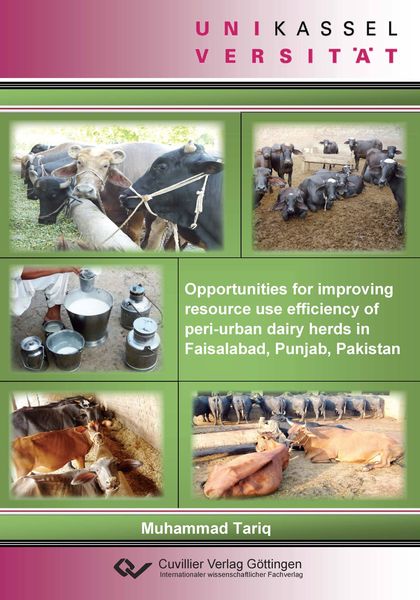
Opportunities for improving resource use efficeincy of peri-urban dairy herds in Faisalabad, Punjab, Pakistan
-
- Taschenbuch ausgewählt
- eBook
-
Sprache:Englisch
16,99 €
UVP
19,00 €
inkl. gesetzl. MwSt.,
Beschreibung
Produktdetails
Einband
Taschenbuch
Erscheinungsdatum
23.09.2013
Verlag
Cuvillier VerlagSeitenzahl
114
Maße (L/B/H)
21/14,8/0,6 cm
Gewicht
159 g
Auflage
1. Auflage
Sprache
Englisch
ISBN
978-3-95404-522-8
Worldwide rapidly increasing urbanization is intensifying the demand for foods, particularly those of animal origin, in the urban centers. Peri-urban dairy production has already a longstanding tradition in Pakistan (chapter 1), but these dairy production systems have their unique characteristics, opportunities and constraints. Although in general they are economically profitable, the profitability varies tremendously between farms. Poor managerial practices, lack of knowledge about balanced feeding and feed scarcity management, poor hygiene in milk production and handling, and unsupervised use of veterinary medicines leading to drug residues in milk are recognized as major technical challenges for peri-urban dairy farmers in Pakistan. Therefore, efforts must be made to improve management practices of peri-urban dairy units in such a way that farm income is increased and product quality and safety is assured. Qualitative and semi-quantitative data obtained from 139 interviews with peri-urban dairy farmers in Faisalabad, Pakistan, was subjected to cluster analysis to identify homogenous groups of farms regarding animal management, milk yields and marketing strategies (chapter 2). Four distinct production systems were identified. Semi-commercial small scale mixed systems (SSM; 31%) combined crop and livestock production, and fodder was primarily produced for own livestock. Semi-commercial small scale dairy producers (SSD; 21.6%) had few buffaloes and cattle and low income. Commercial small scale dairy producers (CSD; 37.4%) were mostly well-off and produced substantial quantities of milk year-round. Commercial large scale dairy farms (CLD; 10%) showed the highest input and output levels. In all systems most of the produced milk was sold (SSM: 69%, SSD: 69%, CSD: 87%; CLD: 94%). Negligence in breeding, wastage of high yielding buffaloes, high costs of feedstuffs, an unfavorable marketing system and lack of a diversified dairy value chain were the main constraints for all production systems. Improving resources use efficiency, especially with respect to animal genetics and nutrition, should encourage these peri-urban dairy farmers to produce more milk for sale, serving both the increasing urban demand and their own income.
Noch keine Bewertungen vorhanden
Verfassen Sie die erste Bewertung zu diesem Artikel
Helfen Sie anderen Kundinnen und Kunden durch Ihre Meinung.
Kurze Frage zu unserer Seite
Vielen Dank für Ihr Feedback
Wir nutzen Ihr Feedback, um unsere Produktseiten zu verbessern. Bitte haben Sie Verständnis, dass wir Ihnen keine Rückmeldung geben können. Falls Sie Kontakt mit uns aufnehmen möchten, können Sie sich aber gerne an unseren Kund*innenservice wenden.
zum Kundenservice