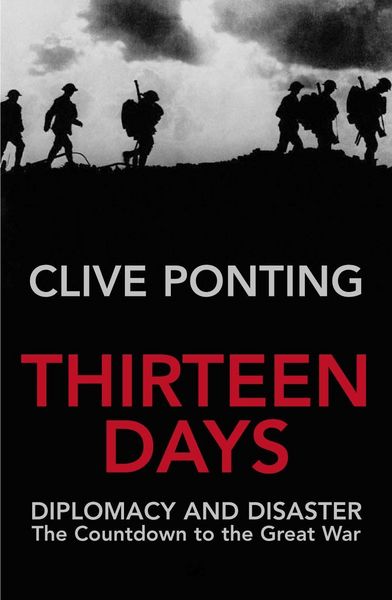
Thirteen Days The Road to the First World War
-
- Taschenbuch
- eBook ausgewählt
-
Form:Einzelkauf Download
-
Sprache:Englisch
14,99 €
inkl. gesetzl. MwSt.Beschreibung
Produktdetails
Format
ePUB
Kopierschutz
Ja
Family Sharing
Nein
Text-to-Speech
Ja
Erscheinungsdatum
15.02.2011
Verlag
VermilionSeitenzahl
384 (Printausgabe)
Dateigröße
1433 KB
Sprache
Englisch
EAN
9781407093154
At the end of WWI, Germany was demonised. The Treaty of Versailles contained a 'war guilt' clause pinning the blame on the aggression of Germany and accusing her of 'supreme offence against international morality'. Thirteen Days rejects this verdict. Clive Ponting has made a thorough study of the incredibly complex diplomatic documents. His interpretation also rejects the thesis that Europe in 1914 had reached such a boiling point that war was bound to erupt and the theory that the origins of the War lay in a mighty arms race. He argues that the War occurred primarily because of the situation in the Balkans, while he gives full weight to Austria-Hungary's desire to cripple Serbia instead of negotiating, and to Russia's militaristic programme of expansion.
Clive Ponting begins with a dramatic recreation of the assassination in Sarajevo on 28 June. He then examines how things spiralled out of control during the weeks that led to war. The tension builds as his story criss-crosses the capital cities of Europe and describes developments day by day, and, latterly, hour by hour.
The First World War destroyed the old Europe. During four years of fighting nearly nine million soldiers were killed and twenty-one million wounded; over ten million civilians died. By the end of the War, three great European empires - Germany, Austria-Hungary and Russia - had disintegrated. Why did the War happen? In 1914, the states of Europe had been at peace for forty years, and every diplomatic dispute had been resolved peacefully.
Thirteen Days describes failures of communication, fateful decisions and escalating military moves; it is an extraordinary narrative of personalities and diplomacy in the dying weeks of an era in which telephone networks were in their infancy and governments relied on telegrams in code and face-to-face meetings of ambassadors.
Noch keine Bewertungen vorhanden
Verfassen Sie die erste Bewertung zu diesem Artikel
Helfen Sie anderen Kundinnen und Kunden durch Ihre Meinung.
Kurze Frage zu unserer Seite
Vielen Dank für Ihr Feedback
Wir nutzen Ihr Feedback, um unsere Produktseiten zu verbessern. Bitte haben Sie Verständnis, dass wir Ihnen keine Rückmeldung geben können. Falls Sie Kontakt mit uns aufnehmen möchten, können Sie sich aber gerne an unseren Kund*innenservice wenden.
zum Kundenservice