• Produktbild: Fundamental Interactions
  • Produktbild: Fundamental Interactions
Band 85

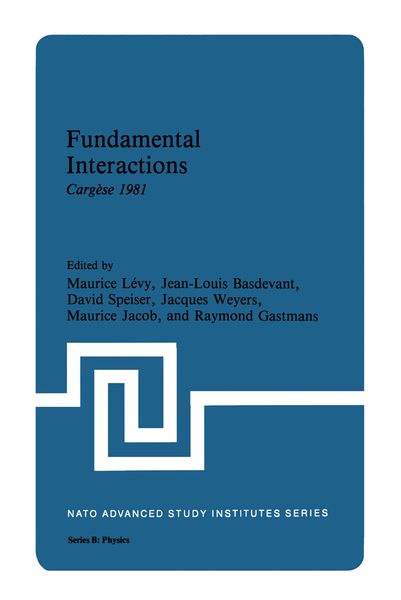
Fundamental Interactions Cargèse 1981

Aus der Reihe NATO Science Series B:

146,99 €

inkl. gesetzl. MwSt., Versandkostenfrei


Beschreibung

Produktdetails

Einband

Taschenbuch

Erscheinungsdatum

04.11.2011

Herausgeber

Jean-Louis Basdevant + weitere

Verlag

Springer Us

Seitenzahl

696

Maße (L/B/H)

25,4/17,8/3,9 cm

Gewicht

1322 g

Auflage

Softcover reprint of the original 1st ed. 1982

Sprache

Englisch

ISBN

978-1-4613-3553-5

Beschreibung

Portrait

Jean-Louis Basdevant is Professor and Chair of the Department of Physics at the Ecole Polytechnique, and Director of Research for the CNRS.

Produktdetails

Einband

Taschenbuch

Erscheinungsdatum

04.11.2011

Herausgeber

Verlag

Springer Us

Seitenzahl

696

Maße (L/B/H)

25,4/17,8/3,9 cm

Gewicht

1322 g

Auflage

Softcover reprint of the original 1st ed. 1982

Sprache

Englisch

ISBN

978-1-4613-3553-5

Herstelleradresse

Springer-Verlag KG
Sachsenplatz 4-6
1201 Wien
AT

Email: GPSR Kontakt

Noch keine Bewertungen vorhanden

Verfassen Sie die erste Bewertung zu diesem Artikel

Helfen Sie anderen Kundinnen und Kunden durch Ihre Meinung.

Kundinnen und Kunden meinen

Bewertungen (0)

  • Produktbild: Fundamental Interactions
  • Produktbild: Fundamental Interactions
  • Functional Methods in Quantum Field Theory.- I. Introduction.- II. Path Integrals.- 1. The classical action.- 2. The Feynman postulates.- 3. Quantum mechanics.- 4. The classical limit.- 5. The Euclidean postulate.- 6. Field theory at finite temperature.- III. Feynman Diagrams.- 1. Graphical representation of the path integral.- 2. Propagators.- 3. Feynman rules.- 4. Diagrammatic evaluation of Gaussian integrals.- 5. The effective potential.- 6. The effective potential at finite temperature.- IV. Fermions.- 1. The Grassmann algebra.- 2. Gaussian integrals and the superdeterminant.- 3. Applications.- V. Ghosts.- 1. Ghost fields and fictitious particles.- 2. Ghost fields in Feynman diagrams.- 3. Ghost counting.- References.- to Electro-Weak Interactions.- I. Introduction.- II. Gauge Invariance.- III. Spontaneous Symmetry Breaking.- 1. Introduction.- 2. Goldstone bosons.- 3. Higgs mechanism.- 4. Pseudo-Goldstone bosons.- IV. The Standard Model.- 1. Couplings.- 2. Gauge boson masses.- V. Anomalies.- VI. Fermi Mass Matrix.- 1. Mixing angles and phases.- 2. Symmetries of Yukawa couplings.- 3. Leptons.- VII. CP.- 1. $$\rm K^O\bar{K}^O$$ system phenomenology.- 2. Models of CP violation.- 3. Neutron electric dipole moment.- 4. Strong CP violation and axion.- VIII. Things to look for.- 1. W, Z bosons.- 2. More gauge bosons.- 3. New fermions.- 4. Higgs bosons.- 5. Rare decay modes.- References.- The Weak Interactions in the Confining Phase.- References.- Heavy Quark Systems.- Electron-Positron Interactions at High Energies.- I. Introduction.- II. PETRA and PEP.- 1. PETRA.- 2. PEP.- III. The structure of Leptons.- IV. Weak Neutral Current Contributions to Lepton Pair Production.- V. Search for new Particles.- 1. Excited leptons.- 2. Search for heavy sequential lepton.- 3. Neutral heavy lepton.- 4. Supersymmetric scalar leptons.- 5. Free quarks.- VI. Jet Formation in e+e? annihilation.- 1. The quark parton model.- 2. Elements of QCD.- 3. QCD modifications to R.- 4. Gluon Bremsstrahlung.- 5. Quantitative comparison of jet production with QCD.- 6. The gluon spin.- 7. Alternative explanations of the three-jet events ?.- 8. The value of ?S and the next to leading order corrections.- 9. Summary of the QCD tests.- VII. Quark and Gluon Fragmentation.- 1. Energy carried by neutrals.- 2. Charged particle multiplicity.- 3. Inclusive particle spectra without particle identification.- 4. Particle separated cross-sections.- 5. The scaled particle cross-sections.- 6. Where are all the baryons from ?.- 7. Gluon fragmentation.- References.- e+e? Collisions at CESR.- I. CESR, CLEO and CUSB.- II. Upsilon bound state spectroscopy and tests of QCD.- 1. Masses and potential models.- 2. Leptonic widths.- 3. Evidence for the decay of the T(ls) into 3 gluons.- 4. Rate for T(ls) decay into 3 gluons.- 5. Particle yields in T(ls) decays.- 6. Hadronic transitions.- III. B Meson Decays and Tests of the standard weak interaction.- 1. Production.- 2. The spectator model.- 3. Leptonic decays.- 4. Neutral currents and other unorthodox B decays models.- 5. Ratio of b ? uW? and b ? cW? rates.- 6. Exclusive B decays.- References.- e+e? Physics at Very Large Energies.- O. Abstract.- I. Introduction.- 1. “Low energy” e+e? phenomenology.- 2. Energy scale to study the weak interaction.- 3. How to get there ?.- II. Interference between electromagnetic and neutral weak currents.- 1. Neutral weak couplings.- 2. Observables of the reaction e+e? ? $$\rm f\bar{f}$$.- 3. Two particular cases.- 4. Examples.- 5. Conclusions.- III. Z° Decays.- 1. Z° production.- 2. Production of new charged leptons.- 3. Production of heavy quarks.- 4. Production of $$v\bar{v}$$ pairs.- 5. Other fundamental objects.- IV. W+W? Production.- 1. Single W production.- 2. W+W? production.- 3. Further tests of gauge couplings.- V. Higgs Bosons.- 1. Minimal model.- 2. Minimal Higgs Production.- 3. More complicated Higgs sector.- 4. Higgs versus hypercolour.- VI. Conclusions.- References.- Theoretical Aspects in Perturbative QCD.- I. Introduction.- II. The LLA and beyond.- III. The Photon Structure Functions.- IV. Prescription and Scale dependence for the running coupling.- V. Spacelike and Timelike Structure Functions beyond LLA.- VI. An Asymptotic Formula for Multiplicities.- VII. The Sudakov Form Factor of Partons.- VIII. Examples of Doubly Logarithmic Effects of Physical Interest.- References.- Dynamical Mass Generation For Quarks and Leptons.- I. Introduction.- II. Technicolour and its Extension.- III. ETC Issues, Answers and Problems.- 1. Isospin violation in the quark and lepton mass matrices.- 2. Hierarchies in the quark and lepton mass matrices.- 3. Vacuum alignment.- 5. Pseudo-Goldstone bosons.- 6. CP.- 7. Flavour changing neutral currents.- IV. Alternatives to ETC ?.- V. Composite Quarks and Leptons.- References.- Quark Confinement and Lepton Liberation in an Anisotropic Space Time.- I. Introduction.- II. Is Hadron Dynamics 2-dimensional ?.- III. The Anisotropic Space-Time.- IV. The Anisotropic Yang-Mills Interactions.- 1. The pure gauge-system.- 2. Introducing Fermionic matter.- 3. The dynamics of the full quantum theory.- V. Quantum Fluctuations and the Role of Chirality.- 1. The survival of colour confinement.- 2. The liberation of leptons.- VI. Gauge Invariance Restored.- 1. The colour interaction.- 2. The chiral interaction.- VII. The Structure of Strong Interactions.- 1. The classical dynamics.- 2. The quantum dynamics.- 3. Why can we use perturbation theory ?.- References.- Physics at Collider Energies.- I. Introduction.- II. Hunting the Weak Vector Bosons.- 1. The Drell-Yan process.- 2. The production of the weak bosons.- 3. Search for Higgs mesons.- 4. Search for quarkonia.- III. The Dominant Hadron Processes.- 1. Overview.- 2. Hadron interactions at ISR energies and their extrapolations.- 3. Some information from cosmic ray results.- 4. The centauro events.- IV. Jet Phenomena.- 1. Large PT production and jets.- 2. Jet yields at collider energy.- 3. Jet yields and weak boson decay.- 4. Heavy quark production.- 5. An intense colour source.- V. Conclusion.- References.- Proton Lifetime Experiments.- I. Theoretical Preamble.- II. The Experimental Problem.- 1. The general idea.- 2. The signal.- 3. Muon background.- 4. Neutrino background.- 5. Other backgrounds.- III. Status of N Decay Studies.- 1. 3 recent results.- 2. Homestake mine.- 3. Case-Western-Irvine.- 4. Kolar Gold field experiment.- IV. The Future.- 1. The very near future.- 2. The more remote future.- V. Other Possibilities Offered by these Set-Ups.- 1. Detection of GUTs monopoles.- 2. Relics.- 3. Neutrino oscillations.- VI. n — $$\rm \bar{n}$$ Oscillations.- References.- Quantum Field Theory and Cosmology.- I. Introduction.- II. The Hot Big Bang Theory.- 1. The cosmological field equations.- 2. The adiabatic expansion.- 3. Successful predictions of the hot big bang theory.- 4. The disease.- III. Entropy Generation.- 1. The exponential expansion.- 2. Quantum creation of Black Holes.- 3. The transition to the adiabatic expansion.- IV. Quantum Gravity.- 1. The rise and fall of a universe.- 2. The structure of quantum gravity.- References.- The Confinement Phenomenon in Quantum Field Theory.- O. Abstract.- I. Introduction.- II. Scalar Field Theory.- III. Bose Condensation.- IV. Goldstone Particles.- V. Higgs Mechanism.- VI. Vortex Tubes.- VII. Dirac’s Magnetic Monopoles.- VIII. Unitary Gauge.- IX. Phantom Solitons.- X. Non-Abelian Gauge Theory.- XI. Unitary Gauge.- XII. A Topological Object.- XIII. The Macroscopic Variables.- XIV. The Dirac Condition in the EM Charge Spectrum.- XV. Oblique Confinement.- XVI. Fermions out of Bosons and vice-versa.- XVII. Other Condensation Modes.- References.- Developments in Particle Physics.- I. The Fermion Family.- II. On Symmetry Breaking.- III. Neutrinos.- 1. Solar neutrino oscillations.- 2. Oscillations of terrestrial neutrinos.- 3. Endpoint experiments.- 4. Double beta decay.- 5. Cosmology missing mass.- IV, Majorons.- V. Axions.- VI. The Future.