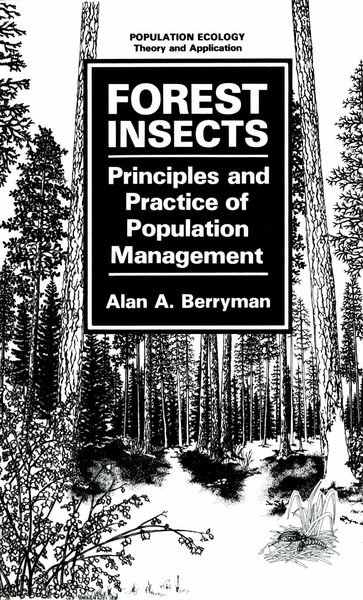
Produktbild: Forest Insects

Forest Insects Principles and Practice of Population Management

Aus der Reihe Population Ecology

97,99 €

inkl. gesetzl. MwSt., Versandkostenfrei


Beschreibung

Produktdetails

Einband

Taschenbuch

Erscheinungsdatum

12.12.2012

Verlag

Springer Us

Seitenzahl

294

Maße (L/B/H)

22,9/15,2/1,7 cm

Gewicht

432 g

Auflage

Softcover reprint of the original 1st ed. 1986

Sprache

Englisch

ISBN

978-1-4684-5082-8

Beschreibung

Produktdetails

Einband

Taschenbuch

Erscheinungsdatum

12.12.2012

Verlag

Springer Us

Seitenzahl

294

Maße (L/B/H)

22,9/15,2/1,7 cm

Gewicht

432 g

Auflage

Softcover reprint of the original 1st ed. 1986

Sprache

Englisch

ISBN

978-1-4684-5082-8

Herstelleradresse

Springer-Verlag KG
Sachsenplatz 4-6
1201 Wien
AT

Email: GPSR Kontakt

Noch keine Bewertungen vorhanden

Verfassen Sie die erste Bewertung zu diesem Artikel

Helfen Sie anderen Kundinnen und Kunden durch Ihre Meinung.

Kundinnen und Kunden meinen

Bewertungen (0)

  • Produktbild: Forest Insects
  • I Insects.- 1 An Introduction to the Insects.- 1.1 External Structure and Function.- 1.2 Internal Structure and Function.- 1.3 Biology and Behavior.- 1.4 Summary.- References and Selected Readings.- 2 Forest Insect Pests.- 2.1 Insects Feeding on Cones and Seeds.- 2.2 Insects Feeding on Buds, Shoots, and Twigs.- 2.3 Insects Feeding on Foliage.- 2.4 Insects Feeding on Trunks.- 2.5 Insects Feeding on Roots.- References and Selected Readings.- I: Insect Exercises.- II Ecology.- 3 Insects in the Forest Environment.- 3.1 Tree Defenses against Insects.- 3.2 Insects and Forest Stability.- 3.3 Insects and Forest Succession.- 3.4 Insects and Forest Productivity.- References and Selected Readings.- 4 Population Dynamics of Forest Insects.- 4.1 Principles of Population Dynamics.- 4.2 Patterns of Dynamic Population Behavior.- 4.3 Classification of Forest Pest Outbreaks.- References and Selected Readings.- 5 Natural Enemies of Forest Insects.- 5.1 Natural Enemy Responses to Prey Density.- 5.2 Vertebrate Predators.- 5.3 Arthropod Predators.- 5.4 Arthropod Parasites.- 5.5 Pathogens.- References and Selected Readings.- II: Ecological Exercises.- III Management.- 6 Monitoring and Forecasting Insect Outbreaks.- 6.1 Extensive Surveys.- 6.2 Intensive Surveys.- 6.3 Damage Forecasts.- References and Selected Readings.- 7 Assessing the Risk of Insect Outbreaks.- 7.1 Risk Assessment Variables.- 7.2 Risk Assessment Methods.- References and Selected Readings.- 8 Prevention of Insect Outbreaks.- 8.1 Silvicultural Practices.- 8.2 Management of Natural Enemies.- References and Selected Readings.- 9 Control of Insect Outbreaks.- 9.1 Principles of Insect Pest Control.- 9.2 Chemical Insecticides.- 9.3 Microbial Insecticides.- 9.4 Behavioral Chemicals.- 9.5 Genetic Manipulation.- 9.6 Physical and Mechanical Methods.- 9.7 Food Removal.- References and Selected Readings.- 10 Pest Management Decisions.- 10.1 Estimating Economic Impacts.- 10.2 Estimating the Costs of Pest Management.- 10.3 Decision-Support Systems.- 10.4 Integrated Pest Management.- References and Selected Readings.- III: Management Exercises.- IV Practice.- 11 The Practice of Forest Insect Management.- 11.1 The Spruce Bark Beetle in Norway.- 11.2 The Douglas-Fir Tussock Moth in Western North America.- 11.3 The European Woodwasp in Australia.- 11.4 Additional Management Problems.- References and Selected Readings.- Epilogue: The Human Influence.- Answers to Exercises.- Author Index.- Taxonomic Index.