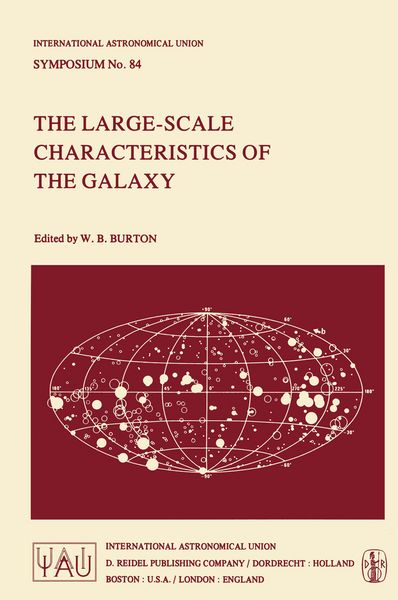
• Produktbild: The Large-Scale Characteristics of the Galaxy
  • Produktbild: The Large-Scale Characteristics of the Galaxy
Band 84

The Large-Scale Characteristics of the Galaxy

48,99 €

inkl. gesetzl. MwSt., Versandkostenfrei


Beschreibung

Produktdetails

Einband

Taschenbuch

Erscheinungsdatum

05.11.2011

Herausgeber

W.B. Burton

Verlag

Springer Netherland

Seitenzahl

632

Maße (L/B/H)

23,5/15,5/3,4 cm

Auflage

Softcover reprint of the original 1st ed. 1979

Sprache

Englisch

ISBN

978-94-009-9505-5

Beschreibung

Produktdetails

Einband

Taschenbuch

Erscheinungsdatum

05.11.2011

Herausgeber

W.B. Burton

Verlag

Springer Netherland

Seitenzahl

632

Maße (L/B/H)

23,5/15,5/3,4 cm

Auflage

Softcover reprint of the original 1st ed. 1979

Sprache

Englisch

ISBN

978-94-009-9505-5

Herstelleradresse

Springer-Verlag GmbH
Tiergartenstr. 17
69121 Heidelberg
DE

Email: ProductSafety@springernature.com

Noch keine Bewertungen vorhanden

Verfassen Sie die erste Bewertung zu diesem Artikel

Helfen Sie anderen Kundinnen und Kunden durch Ihre Meinung.

Kundinnen und Kunden meinen

Bewertungen (0)

  • Produktbild: The Large-Scale Characteristics of the Galaxy
  • Produktbild: The Large-Scale Characteristics of the Galaxy
  • I. Perspective.- Large-scale structure of spiral galaxies: problems old and new.- Disk and spheroidal components of external galaxies: an overview.- II. The Disk Component.- to the session.- The galactic distribution of OH/IR stars.- Giant molecular clouds in the galaxy; distribution, mass, size and age.- An out-of-plane CO survey of the first galactic quadrant.- Radio observations of the galactic plane CH distribution.- HI in the galactic disk.- Optical HII regions.- Radio studies of the distribution of ionized gas.- Line and continuum surveys of the galactic plane with the 100-m telescope.- The distribution of formaldehyde in the galaxy.- Spectral-line sky surveys from the NASA-JPL SETI project.- Galactic dust and extinction.- The distribution of young stars, clusters and cepheids in the Milky Way and M33-a comparison.- Faint optical spiral tracers.- The galactic distribution of 60 young open clusters.- Galactic structure from infrared studies.- Galactic nonthermal radiation. Distribution of SNRs and pulsars.- Pulsars as a galactic population.- Gamma-ray observations and the large-scale structure of the galaxy.- III. Spiral Structure.- The density-wave theory confronted by observations.- A mechanism for the origin and development of spiral arms in a galaxy.- An ejection theory of spiral structure.- On the maintenance of spiral structure.- Unstable spiral modes in the Milky Way system.- Lifetime of density waves and classification of spirals.- On a mechanism that structures galaxies.- Compression of interstellar clouds in spiral density-wave shocks.- The galactic density-wave, molecular clouds and star formation.- Observations of CO in the Perseus arm.- Gaseous response to bar-like distortions.- The four-armed response near the Lindblad resonances in galaxies.- On the use of the WKBJ density-wave theory at the Inner Lindblad Resonance.- IV. Galactic Kinematics and Distances.- The galactic distance scale.- RR Lyrae variables in Baade’s window.- Quantitative classification of the galaxy from new data on the photometric properties of its spheroidal and disk components.- Rotation curves of high-luminosity spiral galaxies and the rotation curve of our galaxy.- Recent evidence on the rotation curve of our galaxy for R > Ro.- The circular velocity at the sun.- The galactic circular velocity near the sun.- Stellar kinematics and interstellar turbulence.- Age variations of the mean angular momentum.- A theory of galactic evolution.- An outward motion of young stars with respect to old stars.- V. Physical Properties of the Interstellar Medium.- to the session.- Energy balance in the interstellar medium.- A statistical study of local interstellar matter based on the Nancay 21-cm absorption survey.- General physical characteristics of the interstellar molecular gas.- Statistical modeling of CO emission in the galaxy.- CO observations of spiral structure and the lifetime of giant molecular clouds.- Implications for star formation in spiral galaxies from observations of nearby molecular clouds complexes.- The coldest molecular gas in our galaxy.- Global physical characteristics of the HI gas.- Large supernova remnants as common features of the disk.- A new class of extraordinary HI shell.- Chemical evolution of the galactic interstellar medium: abundance gradients.- A new look at the galactic magnetic field.- Stability of an interstellar medium with curved magnetic field lines.- VI. The Galactic Nucleus.- to the session.- HI in the inner few kiloparsecs of the galaxy.- The HI structure of the nuclear disk.- Some results from an HI survey of the central region of the galaxy.- Molecules in the inner few kpc of the galaxy.- Carbon monoxide and the 3-kpc arm.- HII regions and star formation in the galactic center.- Infrared observations of the nuclear region.- A study of the galactic center region using Mira variables.- Observations of the near infrared surface brightness distribution of the galaxy.- On the mass density distribution of the inner galaxy.- Dynamical interpretations of the galactic center region.- The basic state of the velocity field in the gas close to the galactic center.- Is there a massive black hole at the galactic center?.- Galactic center pulsar as a test of black hole existence and properties.- VII. Comparisons of our Galaxy with Other Galaxies.- The galactic nucleus compared to those of other galaxies.- Molecular structures of other galaxies compared to that of the galaxy.- HI and continuum structure of external galaxies compared to the situation in the galaxy.- Radial distributions of some constituents in M31, the galaxy and M33.- VIII. The Spheroidal Component.- Theoretical overview: Interactions among the galaxy’s components.- The mass and light distribution of the galaxy: a three-component model.- Galactic mass modeling.- “Three-integral,” collision-free statistical mechanics and stellar systems.- Is there a composition gradient in the halo?.- Gamma-ray evidence for a galactic halo.- SAS-2 gamma ray observations related to a galactic halo.- Cosmic-ray evidence for a halo.- IX. The Galactic Warp.- Observational description of the warp in our galaxy.- Warping and thickness of galactic gas layers.- The persistence of warps.- Theoretical considerations of the warp and thickening.- X. High-Velocity Clouds and the Magellanic Stream.- to the session.- High-velocity clouds: review of observational properties.- The anticenter high-velocity-cloud stream as a galactic phenomenon.- A sensitive high-velocity HI survey.- 21-cm observations of high-velocity clouds.- The Magellanic Stream: observational considerations.- The Magellanic Stream: theoretical considerations.- Intergalactic HI and tidal debris within groups of galaxies.- The Magellanic Stream as a probe of the galactic halo.- The galactic wake model of the Magellanic Stream.- Our galaxy as a member of the Local Group.- XI. Summaries.- Afterthoughts from a theoretical point of view.- The galaxy in perspective — an observer’s synopsis.- A non-establishment view of the Symposium.