
• Produktbild: Contemporary Issues in Biomedical Ethics
  • Produktbild: Contemporary Issues in Biomedical Ethics

Contemporary Issues in Biomedical Ethics

49,99 €

inkl. gesetzl. MwSt., Versandkostenfrei


Beschreibung

Produktdetails

Einband

Taschenbuch

Erscheinungsdatum

13.10.2011

Verlag

Humana Press

Seitenzahl

300

Maße (L/B/H)

23,5/15,5/1,9 cm

Gewicht

511 g

Auflage

1978

Sprache

Englisch

ISBN

978-1-4612-6241-1

Beschreibung

Produktdetails

Einband

Taschenbuch

Erscheinungsdatum

13.10.2011

Verlag

Humana Press

Seitenzahl

300

Maße (L/B/H)

23,5/15,5/1,9 cm

Gewicht

511 g

Auflage

1978

Sprache

Englisch

ISBN

978-1-4612-6241-1

Herstelleradresse

Springer-Verlag GmbH
Tiergartenstr. 17
69121 Heidelberg
DE

Email: ProductSafety@springernature.com

Noch keine Bewertungen vorhanden

Verfassen Sie die erste Bewertung zu diesem Artikel

Helfen Sie anderen Kundinnen und Kunden durch Ihre Meinung.

Kundinnen und Kunden meinen

Bewertungen (0)

  • Produktbild: Contemporary Issues in Biomedical Ethics
  • Produktbild: Contemporary Issues in Biomedical Ethics
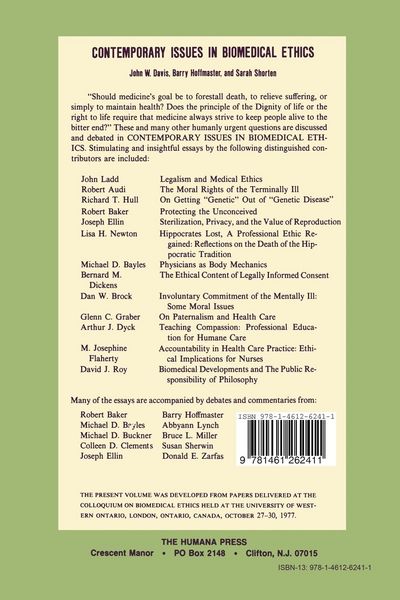
  • I. Rights and Moral Decisions.- 1 Legalism and Medical Ethics.- I. General Remarks on Legalism.- II. The Spell of Legalism.- III. The Utility of Legalism.- IV. The Language of Rights.- V. Morality and the Ethics of Rights.- VI. Another Model: Moral Relationships and Duties.- VII. Responsibilities.- VIII. A Comparison of the Two Models.- IX. The Vindication of Rights.- X. Integrity, Autonomy, and Rights.- 2 Comments on “Legalism and Medical Ethics”.- 3 The Moral Rights of the Terminally I11.- I. Killing and Letting Die.- II. Patients’ Rights Regarding Medical Treatment.- III. Patients’ Rights to Information About Their Condition.- IV. Some Legal Implications.- 4 Comments on “The Moral Rights of the Terminally I11”.- II. Issues in Genetics.- 5 On Getting “Genetic” Out of “Genetic Disease”.- I. Introduction.- II. Etymology of “Genetic Disease”: Some Shifts in Meaning.- III. Criteria for Applying “Genetic Disease”: Some Valua- tional Dimensions.- IV. Uses of “Genetic Disease”: Some Policy Implications.- 6 Protecting the Unconceived.- 7 Comments on “Protecting the Unconceived”: Butchers, Bakers, & Candlestick Makers.- 8 Sterilization, Privacy, and the Value of Reproduction.- I. Introduction.- II. The Importance of Procreation.- III. Procreation and the Right to Privacy.- IV. Sterilization and Possible People.- Acknowledgements.- 9 Comments on “Sterilization, Privacy, and the Value of Reproduction”.- 10 Reply to Buckner.- III. The Role of the Physician.- 11 Hippocrates Lost, A Professional Ethic Regained: Reflections on the Death of the Hippocratic Tradition.- I. The Hippocratic Tradition and the Obligation of Secrecy.- II. Science and Authority.- III. Responsibility in Medicine.- IV. Conclusion.- 12 Comments on “Hippocrates Lost, A Professional Ethic Regained: Reflections on the Death of the Hippocratic Tradition”.- 13 Physicians as Body Mechanics.- I. Why See a Mechanic?.- II. Why Trust a Mechanic?.- 14 Physician as Body Mechanic—Patient as Scrap Metal: What’s Wrong with the Analogy.- I..- II..- 15 Internal or External Physician-Patient Relationships, A Response to Clements.- IV. Informed Consent and Paternalism.- 16 The Ethical Content of Legally Informed Consent.- I. Introduction.- II. The Legal Dynamics of Informed Consent.- III. The Elements of Informed Consent.- IV. The Standard of Informed Consent.- V. The Functions of Informed Consent.- VI. The Effect of Informed Consent.- VII. Dilemmas of Informed Consent.- 17 Comments on “The Ethical Content of Legally Informed Consent”.- I. Perennial Paradox: “The Ethical Nature of the Legal”.- II. Information for Consent: Judging the Doctor’s Judgement.- III. Surrogate Consent: Process and Substance.- 18 Involuntary Commitment of the Mentally 111: Some Moral Issues.- 19 Comments on Brock’s “Involuntary Commitment of the Mentally 111: Some Moral Issues”.- 20 On Paternalism and Health Care.- I. What is Paternalism?.- II. Paternalism in Health Care.- III. The Case Against Paternalism.- IV. The Limits of Autonomy.- 21 Comments on “Paternalism and Health Care”.- I. Defining Paternalism.- II. Justifying Paternalism.- V. Professional Responsibility.- 22 Teaching Compassion: Professional Education for Humane Care.- I. The Nature and Scope of Compassion.- II. Conclusion.- 23 Accountability in Health Care Practice: Ethical Implications for Nurses.- 24 Biomedical Developments and The Public Responsibility of Philosophy.- I. The Argument: An Overview.- II. Biomedicine, Values, and the Reconstruction of Human Nature.- III. Particular Issues as Challenges to Philosophical Reflection.- IV. The Foundation of Ethics as the Public Responsibility of Philosophy.- V. An Ethics Grounded in the Nature of Things.- VI. A Critical Question.- VII. Transcendental Analysis, the a Priori of Communication and the Foundations of a Global Ethics.- VIII. The Paradox.- IX. The Opening Question.- X. The Transformation of Philosophy.- XI. Transcendental Analysis and the Moral Norms Presupposed by Scientific Discourse.- XII. Two Principles as a Foundation for a Global Ethics.- XIII. Conclusion.