
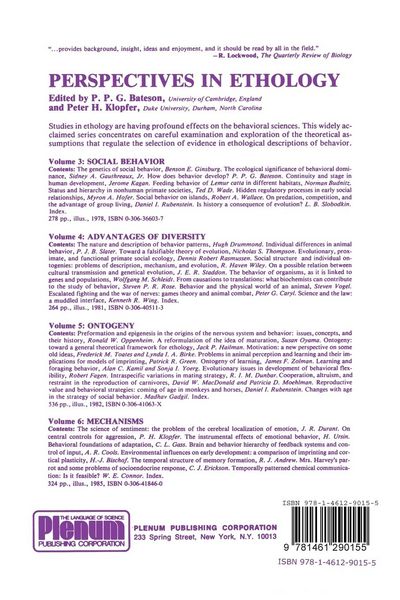
• Produktbild: Perspectives in Ethology
  • Produktbild: Perspectives in Ethology
Band 5

Perspectives in Ethology Volume 7 Alternatives

Aus der Reihe Perspectives in Ethology

48,99 €

inkl. gesetzl. MwSt., Versandkostenfrei


Beschreibung

Produktdetails

Einband

Taschenbuch

Erscheinungsdatum

13.10.2011

Abbildungen

XVI, 282 p.

Verlag

Springer Us

Seitenzahl

282

Maße (L/B/H)

23,5/15,5/1,7 cm

Gewicht

458 g

Auflage

Softcover reprint of the original 1st ed. 1987

Sprache

Englisch

ISBN

978-1-4612-9015-5

Beschreibung

Produktdetails

Einband

Taschenbuch

Erscheinungsdatum

13.10.2011

Abbildungen

XVI, 282 p.

Verlag

Springer Us

Seitenzahl

282

Maße (L/B/H)

23,5/15,5/1,7 cm

Gewicht

458 g

Auflage

Softcover reprint of the original 1st ed. 1987

Sprache

Englisch

ISBN

978-1-4612-9015-5

Herstelleradresse

Springer-Verlag KG
Sachsenplatz 4-6
1201 Wien
AT

Email: ProductSafety@springernature.com

Noch keine Bewertungen vorhanden

Verfassen Sie die erste Bewertung zu diesem Artikel

Helfen Sie anderen Kundinnen und Kunden durch Ihre Meinung.

Kundinnen und Kunden meinen

Bewertungen (0)

  • Produktbild: Perspectives in Ethology
  • Produktbild: Perspectives in Ethology
  • 1 Pattern and Adaptation in Individual Behavioral Differences.- I. Abstract.- II. Introduction.- III. Semantic Issues.- IV. The Occurrence and Form of Individuality.- V. Adaptation and the Process of Differentiation.- VI. Acknowledgments.- VII. References.- 2 Alternative Reproductive Tactics in Birds: Individual Variation in Clutch Size.- I. Abstract.- II. Introduction.- III. Hypotheses to Account for Clutch Size Variation.- IV. Evaluation of the Evidence.- V. Conclusions Regarding the Three Hypotheses.- VI. Discussion.- VII. Acknowledgments.- VIII. References.- 3 Critique of Helping Behavior in Birds: A Departure from Functional Explanations.- I. Abstract.- II. Introduction.- III. Criticisms and Alternatives.- IV. Discussion.- V. Acknowledgments.- VI. References.- 4 On the Evolution of Density-Regulating Behavior.- I. Abstract.- II. Introduction.- III. The Haystack Model.- IV. Breeding Site Limitation.- V. Habitat Selection in the Nonbreeding Season.- VI. Population Dynamics.- VII. Discussion of Model Assumptions.- VIII. Wynne Edwards Theory Reconsidered.- IX. Acknowledgment.- X. References.- 5 The Evolutionary Dynamics of Mixed Mating Systems: On the Adaptive Value of Selfing and Biparental Inbreeding.- I. Abstract.- II. Introduction.- III. Determination of the Adaptive Value of Selfing.- IV. Three Regular Systems of Biparental Inbreeding.- V. Discussion.- VI. Appendix A.- VII. Appendix B.- VIII. Appendix C.- IX. Acknowledgments.- X. References.- 6 The Experience of Experience: An Exogenetic Program for Social Competence.- I. Abstract.- II. Introduction: The Bird of Paradox.- III. Methods of Inquiry: Functional Metrics of Communication.- IV. Male Inheritance: An Embarassment of Riches?.- V. Female Cowbirds: Like Mother, Like Daughter.- VI. Male Modifiability: Behind Closed Doors.- VII. The Female: A Connoisseur of Fine Song.- VIII. Population Comparisons: The Perspective from the Prairie.- IX. General Perspectives: Exogenetic Programs for Development.- X. A Final Perspective: The Cowbird’s Place in Nature’s Gallery.- XI. Acknowledgments.- XII. References.- 7 A Comparative-Developmental Approach to Understanding Imitation.- I. Abstract.- II. Introduction.- III. Baldwin, Morgan, Guillaume, and Piaget on Imitation.- IV. The Definition of “Imitation”.- V. The Levels of Imitation.- VI. Conclusion.- VII. Acknowledgments.- VIII. References.- 8 The Dynamics of Group Behavior.- I. Abstract.- II. Introduction.- III. Investigating Group Behavior: An Example of the Approach.- IV. Extending the Approach.- V. Acknowledgments.- VI. References.- 9 Artificial Design in Natural History: Why it’s so Easy to Understand Animal Behavior.- I. Abstract.- II. Introduction: The Design Argument in Natural Theology.- III. Natural Selection As a Designer.- IV. Artificial Design: Synthesis and Analysis.- V. Apparent Design in Behavior: Optimal Foraging Theory.- VI. Conclusion.- VII. Acknowledgments.- VIII. References.- 10 The Misappropriation of Teleonomy.- I. Abstract.- II. Introduction.- III. Teleonomy As an Antidote to Circular Reasoning.- IV. Psychology and the Concept of Objective Teleology.- V. Biological Interpreters of Teleonomy.- VI. The Appropriate Use for “Teleonomy”.- VII. Acknowledgments.- VIII. References.