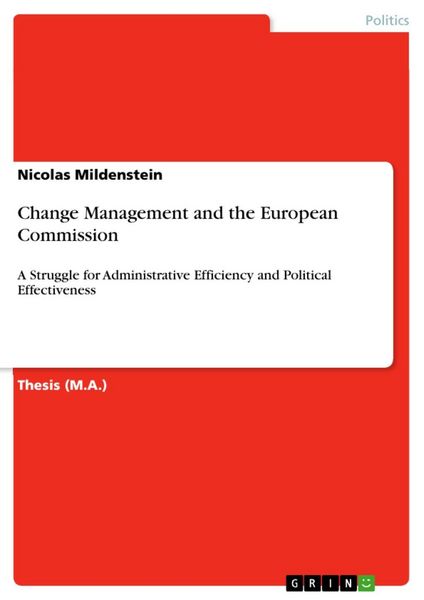
Change Management and the European Commission A Struggle for Administrative Efficiency and Political Effectiveness
-
- Einzelkauf Download ausgewählt
-
Sprache:Englisch
36,99 €
inkl. gesetzl. MwSt.Beschreibung
Produktdetails
Format
ePUB
Kopierschutz
Nein
Family Sharing
Nein
Text-to-Speech
Ja
Erscheinungsdatum
26.03.2010
Verlag
GRINSeitenzahl
98 (Printausgabe)
Dateigröße
2142 KB
Auflage
1. Auflage
Sprache
Englisch
EAN
9783640576982
Thesis (M.A.) from the year 2009 in the subject Politics - Topic: European Union, grade: 1,0, University of Hannover (Institut für Politische Wissenschaft), language: English, abstract: Since the demise of the Santer Commission, internal reform of the European Commission (EC) has received increased academic and political attention. The more recent academic discourse has focused on assessing outcomes of the Kinnock reforms but is marked by divergent approaches and conflicting interpretations. This text proposes to address these issues by embedding the more practical EC Reform discourse within the more abstract Organization Theory (OT) discourse and applying coherent models of organization and change to EC reform.
The first part of the text organizes the OT field within a metatheoretical matrix, proposes coherent models of organization and change, and assesses the dynamics of the management framework market. The second part connects the OT to the EC Reform discourse by analyzing the transfer of management practices from the private to the public sector and by identifying major adoption types across the private-public sector continuum. The third part uses the established models to investigate the change
management history of the European Commission, and systematically relates internal management of change to external political action.
More specifically, the first part argues that the essence of most organization theories and management frameworks can be combined across four different onto-epistemologies. This allows drafting a comprehensive model of organization and change that can accommodate the majority of theoretical perspectives and research questions.
The second part concludes that the transfer of private sector practices has accelerated significantly since the 1980s, mostly as a function of increased environmental pressures on public sector organizations. Since international organizations (incl. the EC) face comparatively low degrees of pressure, they are more likely to be late stage adopters.
The third part confirms the EC as a late stage adopter as major internal reform could be avoided for roughly 20 years until increasing environmental pressures culminated in the Kinnock Reforms in 1999/2000. While the design followed a modern managerial orientation, implementation shifted to a more
traditional focus on control systems. The net result has been a higher degree of overall strategic coherence and control at the expense of some policy initiative at the service level. In future, the EC will have to focus on finding the right balance between continuous systems optimization and organizational development.
The first part of the text organizes the OT field within a metatheoretical matrix, proposes coherent models of organization and change, and assesses the dynamics of the management framework market. The second part connects the OT to the EC Reform discourse by analyzing the transfer of management practices from the private to the public sector and by identifying major adoption types across the private-public sector continuum. The third part uses the established models to investigate the change
management history of the European Commission, and systematically relates internal management of change to external political action.
More specifically, the first part argues that the essence of most organization theories and management frameworks can be combined across four different onto-epistemologies. This allows drafting a comprehensive model of organization and change that can accommodate the majority of theoretical perspectives and research questions.
The second part concludes that the transfer of private sector practices has accelerated significantly since the 1980s, mostly as a function of increased environmental pressures on public sector organizations. Since international organizations (incl. the EC) face comparatively low degrees of pressure, they are more likely to be late stage adopters.
The third part confirms the EC as a late stage adopter as major internal reform could be avoided for roughly 20 years until increasing environmental pressures culminated in the Kinnock Reforms in 1999/2000. While the design followed a modern managerial orientation, implementation shifted to a more
traditional focus on control systems. The net result has been a higher degree of overall strategic coherence and control at the expense of some policy initiative at the service level. In future, the EC will have to focus on finding the right balance between continuous systems optimization and organizational development.
Noch keine Bewertungen vorhanden
Verfassen Sie die erste Bewertung zu diesem Artikel
Helfen Sie anderen Kundinnen und Kunden durch Ihre Meinung.
Kurze Frage zu unserer Seite
Vielen Dank für Ihr Feedback
Wir nutzen Ihr Feedback, um unsere Produktseiten zu verbessern. Bitte haben Sie Verständnis, dass wir Ihnen keine Rückmeldung geben können. Falls Sie Kontakt mit uns aufnehmen möchten, können Sie sich aber gerne an unseren Kund*innenservice wenden.
zum Kundenservice