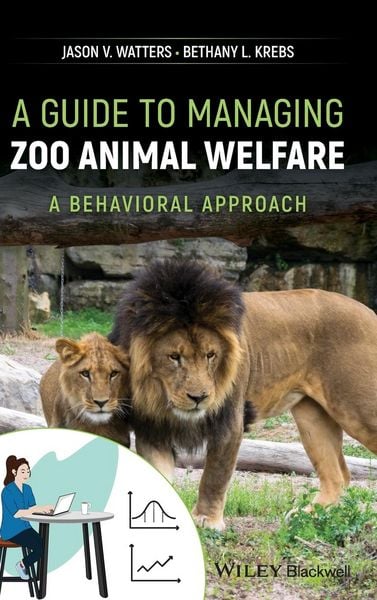
A Guide to Managing Zoo Animal Welfare A Behavioral Approach
59,99 €
inkl. gesetzl. MwSt.,
Beschreibung
Produktdetails
Einband
Gebundene Ausgabe
Erscheinungsdatum
21.02.2025
Verlag
WileySeitenzahl
224
Maße (L/B/H)
23,7/16,1/2 cm
Gewicht
445 g
Sprache
Englisch
ISBN
978-1-118-88480-5
Comprehensive reference detailing behavioral assessment techniques, behavioral approaches, and practical tools for animal welfare across different species
A Guide to Managing Zoo Animal Welfare delivers a step-by-step guide to behavioral assessment approaches, techniques, and tools for animal welfare with an emphasis on animals living in zoos and aquaria. The authors develop a unique "balance-based" approach that can be used to assess and enhance the welfare of a diverse range of species. Backed by extensive scientific literature, this book also provides foundational context to help readers to understand why the authors give these recommendations and guidelines.
This book is divided into three sections. Section I details background concepts and goals, discussing the animal mind through neuroscience, psychology, and behavior, even questioning wild animal behavior's validity as a template for captive animal behavior. Section II details the core behavioral Needs of animals, investigating, acquiring rewards, and exerting control. Section III explains how to practically assess if animals' Needs are met and address deficiencies, covering topics like food, space, and social rewards and methods to make environments dynamic.
A Guide to Managing Zoo Animal Welfare includes information on:
- Proximate and ultimate reasoning for the existence of each of the Needs
- Welfare benefits of meeting the Needs, including positive affect, maintaining homeostasis, passing on genes, and learning through reinforcement
- The highly variable personalities of individual animals and different animal species, as well as why personality is an important facet of animal welfare
- A guide for assessing animal welfare using the Three Needs model
Presenting highly unique insight and a novel approach, A Guide to Managing Zoo Animal Welfare is an essential learning resource for professional animal behaviorists in zoos and aquaria, researchers in animal behavior and animal welfare, and students in veterinary sciences and zoology programs of study.
Noch keine Bewertungen vorhanden
Verfassen Sie die erste Bewertung zu diesem Artikel
Helfen Sie anderen Kundinnen und Kunden durch Ihre Meinung.
Kurze Frage zu unserer Seite
Vielen Dank für Ihr Feedback
Wir nutzen Ihr Feedback, um unsere Produktseiten zu verbessern. Bitte haben Sie Verständnis, dass wir Ihnen keine Rückmeldung geben können. Falls Sie Kontakt mit uns aufnehmen möchten, können Sie sich aber gerne an unseren Kund*innenservice wenden.
zum Kundenservice