• Produktbild: Anoxia
  • Produktbild: Anoxia
Band 21

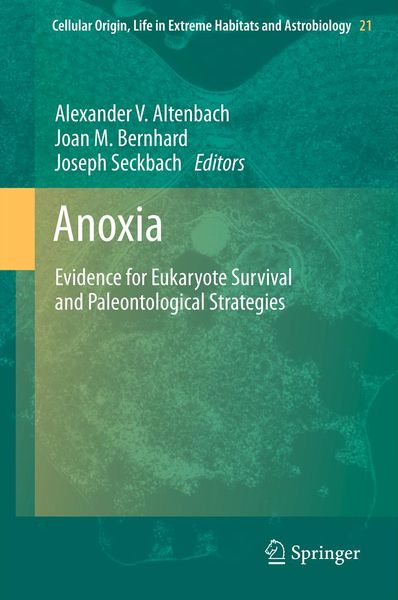
Anoxia Evidence for Eukaryote Survival and Paleontological Strategies

187,99 €

inkl. gesetzl. MwSt., Versandkostenfrei


Beschreibung

Produktdetails

Einband

Taschenbuch

Erscheinungsdatum

30.11.2013

Abbildungen

XXXVI, 648 p.

Herausgeber

Alexander Altenbach + weitere

Verlag

Springer Netherland

Seitenzahl

648

Maße (L/B/H)

23,5/15,5/3,7 cm

Gewicht

1019 g

Auflage

2012

Sprache

Englisch

ISBN

978-94-007-3705-1

Beschreibung

Produktdetails

Einband

Taschenbuch

Erscheinungsdatum

30.11.2013

Abbildungen

XXXVI, 648 p.

Herausgeber

Verlag

Springer Netherland

Seitenzahl

648

Maße (L/B/H)

23,5/15,5/3,7 cm

Gewicht

1019 g

Auflage

2012

Sprache

Englisch

ISBN

978-94-007-3705-1

Herstelleradresse

Springer-Verlag KG
Sachsenplatz 4-6
1201 Wien
AT

Email: GPSR Kontakt

Noch keine Bewertungen vorhanden

Verfassen Sie die erste Bewertung zu diesem Artikel

Helfen Sie anderen Kundinnen und Kunden durch Ihre Meinung.

Kundinnen und Kunden meinen

Bewertungen (0)

  • Produktbild: Anoxia
  • Produktbild: Anoxia

  • Introduction.- Stepping into the book of Eukaryotes and Anoxia.- List of Authors and their Addresses.- List of External Reviewers and Referees.-  Acknowledgment to authors, reviewers and any special people who assisted.-


    PART I: GENERAL INTRODUCTION.- Anaerobic eukaryotes.- Biogeochemical reactions in marine sediments underlying anoxic water bodies.-
     
    Diversity of anaerobic prokaryotes and eukaryotes – breaking long-established dogmas.- PART II: FUNCTIONAL BIOCHEMISTRY.- The biochemical adaptations of mitochondrion-related organelles of parasitic and free-living microbial eukaryotes to low oxygen environments.- Hydrogenosomes and mitosomes: mitochondrial adaptations to life in anaerobic environments.- Adapting to hypoxia: lessons from vascular endothelial growth factor.- PART III: MANAGING ANOXIA.- Magnetotactic protists at the oxic-anoxic transition zones of coastal aquatic environments.- A novel ciliate (Ciliophora: Hypotrichida) isolated from bathyal anoxic sediments.- The wood-eating termite hindgut: diverse cellular symbioses in a microoxic to anoxic environment.- Ecological and experimental exposure of insects to anoxia reveals suprising tolerance.- The unusual response of encysted embryos of the animal extremophile,
    Artemia franciscana
    , to prolonged anoxia.- Survival of tardigrades in extreme environments – a model animal for astrobiology.- Long-term anoxia-tolerance in flowering plants.- PART IV: FORAMINIFERA.- Benthic Foraminifera: inhabitants of low-oxygen environments.- Ecological and biological response of benthic Foraminifera under oxygen-depleted conditions: evidence from laboratory approaches.- The response of benthic Foraminifera to low-oxygen conditions of the Peruvian oxygen minimum zone.- Benthic foraminiferal communities and microhabitat selection on the continental shelf off central Peru.
    -
    PART V: ZONES AND REGIONS.- Living assemblages from the “Dead Zone” and naturally occurring hypoxic zones.- Thereturn of shallow shelf seas as extreme environments: Anoxia and macrofauna reactions in the northern Adriatic Sea.- Meiobenthos of the oxic/anoxic interface in the south-western region of the Black Sea: abundance and taxonomic composition.- The role of eukaryotes in the anaerobic food web of stratified lakes.- The anoxic Framvaren fjord as a model system to study protistan diversity and evolution.- Characterizing an anoxic habitat: sulphur bacteria in a meromictic alpine lake.- Ophel, the newly discovered hypoxic chemolitho-autotrophic groundwater biome - a window to ancient animal life.- Microbial eukaryotes in the marine subsurface?
    -
    PART VI: MODERN ANALOGS AND TEMPLATES FOR EARTH HISTORY.- On the use of stable nitrogen isotopes in present and past anoxic environments.- Carbon and nitrogen isotopic fractionation in Foraminifera: possible signatures from anoxia.- The functionality of pores in benthic Foraminifera in view of bottom water oxygenation. A review.- Anoxia-dysoxia at the sediment-water interface of the southern Tethys in the late Cretaceous: Mishash formation, southern Israel.- Styles of agglutination in benthic Foraminifera from modern Santa Barbara basin sediments and the implications of finding fossil analogs in Devonian and Mississippian black shales.- Did redox conditions trigger test templates in Proterozoic Foraminifera?- The relevance of anoxic and agglutinated benthic Foraminifera to the possible Archean evolution of eukaryotes.- PART VII: FINALS.