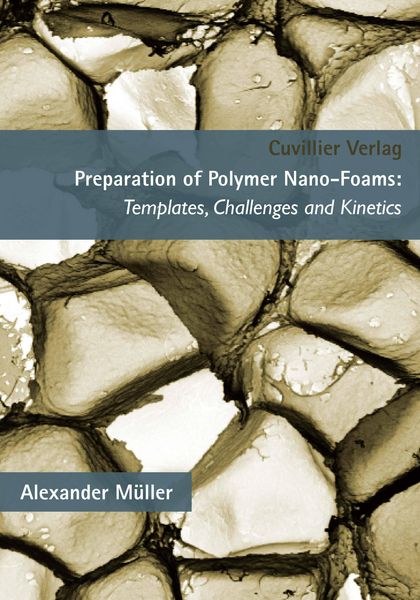
Preparation of Polymer Nano-Foams. Templates, Challenges and Kinetics
-
- Taschenbuch ausgewählt
- eBook
-
Sprache:Englisch
62,99 €
UVP
71,25 €
inkl. gesetzl. MwSt.,
Beschreibung
Produktdetails
Einband
Taschenbuch
Erscheinungsdatum
27.11.2013
Verlag
Cuvillier VerlagSeitenzahl
240
Maße (L/B/H)
24/17/1,4 cm
Gewicht
415 g
Auflage
1. Auflage
Sprache
Englisch
ISBN
978-3-95404-566-2
The current energy debate considerably affects science, economy and politics. A key aspect of this discussion is energy saving by improvement of thermal insulations for buildings. In this regard, nano insulation materials (NIMs) are the insulation materials of the future. If additionally, a pore size reduction to nanoscale results in optical transparency, completely new markets for polymer foams will arise. However, the realization of these high-potential materials is accompanied by many challenges, as for example the extremely high interfacial tension emerging during foaming processes that cause an undesired coarsening of the foam structure. To overcome these challenges, new strategies and templates have to be scientifically developed. Moreover, it is crucial to understand the foaming in detail. In this context the early state of foaming was studied by means of the principle of supercritical microemulsion expansion (POSME). The benefit of using microemulsions containing a super- or near-critical fluid as oil component is the thermodynamic stability at high pressures. This allows a fast repeatability of the expansion process at nanoscale by applying pressure cycles. In combination with a specially designed stroboscopic high pressure cell, the structural processes could be observed by time resolved small angle neutron scattering experiments. It turned out that the addition of a low molecular oil as anti aging agent results in a deceleration of foam coarsening during expansion by more than an order of magnitude. Parallel to these studies, the nanofoams by continuity inversion of dispersions (NF-CID) principle was utilized for the preparation of nanoporous polymeric materials. The significant innovation of the NF-CID principle is the generation of an extremely high number density of propellant pools by a continuity inversion of a CO2-soaked colloidal crystal, i.e. the formerly discrete polymer nanoparticles convert into a homogeneous matrix with nanodisperse fluid inclusions, if the temperature is raised above the glass transition of the respective polymer. Expanding those templates by applying a specific set of parameters led to polymethylmethacrylate and polystyrene nanoporous materials that feature pore sizes smaller than 100 nm.
Noch keine Bewertungen vorhanden
Verfassen Sie die erste Bewertung zu diesem Artikel
Helfen Sie anderen Kundinnen und Kunden durch Ihre Meinung.
Kurze Frage zu unserer Seite
Vielen Dank für Ihr Feedback
Wir nutzen Ihr Feedback, um unsere Produktseiten zu verbessern. Bitte haben Sie Verständnis, dass wir Ihnen keine Rückmeldung geben können. Falls Sie Kontakt mit uns aufnehmen möchten, können Sie sich aber gerne an unseren Kund*innenservice wenden.
zum Kundenservice