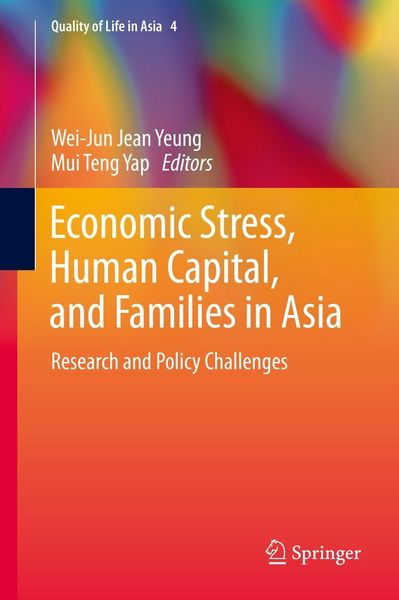
Produktbild: Economic Stress, Human Capital, and Families in Asia
Band 4

Economic Stress, Human Capital, and Families in Asia Research and Policy Challenges

Aus der Reihe Quality of Life in Asia

96,29 €

inkl. gesetzl. MwSt.

Beschreibung

Produktdetails

Format

PDF

Kopierschutz

Nein

Family Sharing

Nein

Text-to-Speech

Nein

Erscheinungsdatum

26.11.2013

Herausgeber

Wei-Jun Jean Yeung + weitere

Verlag

Springer Netherlands

Seitenzahl

270 (Printausgabe)

Dateigröße

3307 KB

Sprache

Englisch

EAN

9789400773868

Beschreibung

Portrait

Professor Yeung is a professor at the Department of Sociology and the Research Leader of the Changing Family in Asia cluster in the Asia Research Institute, National University of Singapore. She is on the editorial board of the Journal of Marriage and Family, and Journal of Family Issues and serves as a member of the board of trustees of the Institute of Southeast Asian Studies. Her research interests include China's family and demographic transition, intergenerational studies, family and children, inequality, and education. Professor Yeung was a co-principal investigator of the Panel Study of Income Dynamics, one of the longest running social science panel surveys. She also served on the committees of the Child Development journal and numerous other journals and scientific review committees. Prof Yeung has received numerous awards, including those from the National Science Foundation, National Institute of Child Health and Human Development, and National Institute on Aging. Her most recent work includes several volumes on economic stress and Asian families, Asian fatherhood, transition to adulthood in Asia, and care in Asia. She is also working on issues related to migration and children's well-being, and racial achievement gap.

Produktdetails

Format

PDF

eBooks im PDF-Format haben eine festgelegte Seitengröße und eignen sich daher nur bedingt zum Lesen auf einem tolino eReader oder Smartphone. Für den vollen Lesegenuss empfehlen wir Ihnen bei PDF-eBooks die Verwendung eines Tablets oder Computers.

Kopierschutz

Nein

Dieses eBook können Sie uneingeschränkt auf allen Geräten der tolino Familie, allen sonstigen eReadern und am PC lesen. Das eBook ist nicht kopiergeschützt und kann ein personalisiertes Wasserzeichen enthalten. Weitere Hinweise zum Lesen von eBooks mit einem personalisierten Wasserzeichen finden Sie unter Hilfe/Downloads.

Family Sharing

Nein

Mit Family Sharing können Sie eBooks innerhalb Ihrer Familie (max. sechs Mitglieder im gleichen Haushalt) teilen. Sie entscheiden selbst, welches Buch Sie mit welchem Familienmitglied teilen möchten. Auch das parallele Lesen durch verschiedene Familienmitglieder ist durch Family Sharing möglich. Um eBooks zu teilen oder geteilt zu bekommen, muss jedes Familienmitglied ein Konto bei Thalia oder einem anderen tolino-Buchhändler haben. Weitere Informationen finden Sie unter Hilfe/Family-Sharing.

Text-to-Speech

Nein

Bedeutet Ihnen Stimme mehr als Text? Mit der Funktion Text-to-Speech können Sie sich im tolino webReader und in der aktuellen Thalia – Lesen & Hören App das eBook vorlesen lassen. Weitere Informationen finden Sie unter Hilfe/Text-to-Speech.

Barrierefreiheit

  • keine Information zur Barrierefreiheit bekannt

Erscheinungsdatum

26.11.2013

Herausgeber

Verlag

Springer Netherlands

Seitenzahl

270 (Printausgabe)

Dateigröße

3307 KB

Sprache

Englisch

EAN

9789400773868

Noch keine Bewertungen vorhanden

Verfassen Sie die erste Bewertung zu diesem Artikel

Helfen Sie anderen Kundinnen und Kunden durch Ihre Meinung.

Kundinnen und Kunden meinen

Bewertungen (0)

Weitere Artikel finden Sie in

  • Produktbild: Economic Stress, Human Capital, and Families in Asia
  • Chapter 1: Introduction: Economic Stress, Human Capital, and Families in Asia: Research and Policy Challenges; Wei-Jun Jean Yeung.- PART I: OVERVIEW.- Chapter 2: Global Financial Crisis and Economic and Social Challenges for Asia and the Pacific; Noeleen Heyzer.- Chapter 3: The Impact of the Economic Crisis on Children in East Asia and the Pacific: A UNICEF Perspective (2009-2010); Samman J. Thapa and Mahesh S. Patel.- Chapter 4: The Long Reach of Early Childhood Poverty; Greg J. Duncan and Katherine Magnuson.- PART II: WOMEN, CHILDREN AND ECONOMIC STRESS.- Chapter 5: The 1997 Economic Crisis and Changes in the Pattern of Achieved Fertility and Ideal Number of Children in Korea; Doo-Sub Kim.- Chapter 6: Abandoned or Abandoning Men: Economic Stress, Gender Relations and Migration of Filipinas to Singapore; Janet M. Arnado.- Chapter 7: Economic Insecurity and Husband-to-Wife Physical Assault in Hong Kong: The Role of Husband's Power Motive; Adam K. L. Cheung and Susanne Y. P. Choi.- PART III: ECONOMIC STRESS AND HEALTH.- Chapter 8: Economic Stress and Health among Rural Chinese Elderly; Wei-Jun Jean Yeung and Zhenhua Xu.- Chapter 9: Poverty, Perceived Economic Strain and Psychological Distress among Thai Older Adults; Kattika Thanakwang.- PART IV: SOCIAL SUPPORT DURING ECONOMIC HARDSHIPS.- Chapter 10: Social Networks and Reduction of Risk in Disasters: An Example of the Wenchuan Earthquake; Zhao Yandong.- Chapter 11: Human and Social Capital Dynamics in Economic Crises - The Impact on Poor Chinese Migrant Children in Hong Kong during the Far East Economic Crisis; Sam Wong.- PART V: ECONOMIC STRESS AND PUBLIC POLICY.- Chapter 12: Conditional Cash Transfers (CCTs): A Child Policy Strategy in Asia; Shirley Gatenio Gabel and Sheila B. Kamerman.- Chapter 13: The Impact of Economic Crises on Health: Past Evidence and Policy Implications for Asia; Kai-Hong Phua and Kai-Lit Phua.- Chapter 14: Policy Responses in an Unstable Globalized Economy: Multi-Stressed Low-Earning Families in Singapore; Irene Y. H. Ng and Kong-Weng Ho.- Chapter 15: Conclusion and Policy Implications; Yap Mui Teng.