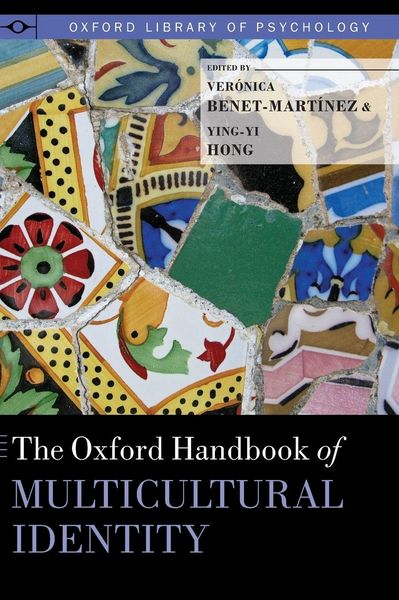
Produktbild: Oxford Handbook of Multicultural Identity

Oxford Handbook of Multicultural Identity Winner of APA Division 52's (International Psychology) 2015 Ursula Gielen Global Psychology Book Award

263,99 €

inkl. gesetzl. MwSt., Versandkostenfrei


Beschreibung

Produktdetails

Einband

Gebundene Ausgabe

Erscheinungsdatum

02.07.2014

Herausgeber

Benet-Martinez Veronica + weitere

Verlag

Oxford University Press

Seitenzahl

560

Maße (L/B/H)

26/18,3/3,4 cm

Gewicht

1157 g

Sprache

Englisch

ISBN

978-0-19-979669-4

Beschreibung

Rezension

This excellent book, written by an international collection of experts, addresses an important topic in a comprehensive manner. The book has definitely fulfilled the purpose for which it is written, and the reader will not be disappointed.' Gary B Kaniuk, Doody's Health Sciences Book Review

Produktdetails

Einband

Gebundene Ausgabe

Erscheinungsdatum

02.07.2014

Herausgeber

Verlag

Oxford University Press

Seitenzahl

560

Maße (L/B/H)

26/18,3/3,4 cm

Gewicht

1157 g

Sprache

Englisch

ISBN

978-0-19-979669-4

Noch keine Bewertungen vorhanden

Verfassen Sie die erste Bewertung zu diesem Artikel

Helfen Sie anderen Kundinnen und Kunden durch Ihre Meinung.

Kundinnen und Kunden meinen

Bewertungen (0)

Die Leseprobe wird geladen.
  • Produktbild: Oxford Handbook of Multicultural Identity
    • Chapter 1: Introduction

    • V. Benet-Martinez and YY. Hong

    • PART I: DEFINITIONAL ISSUES AND BASIC PROCESSES

    • Chapter 2: Dynamic multiculturalism: The interplay of social cognitive, neural, and genetic mechanisms

    • YY. Hong and M. Khei

    • Chapter 3: The bilingual brain: Language, culture, and identity

    • N. Ramirez-Esparza and A. Garcia-Sierra

    • Chapter 4: The identity dynamics of acculturation and multiculturalism

    • S. Schwartz, V. Vignoles, R. Brown, and H. Zagefka

    • PART II: THE SOCIAL-PSYCHOLOGICAL CONTEXT

    • Chapter 5: Multicultural societies

    • J. Berry and D. Sam

    • Chapter 6: The social psychology of multiculturalism: Identity and intergroup relations

    • K. Deaux and M. Verkuyten

    • Chapter 7: Exploring the Identity Autonomy Perspective (IAP): An Integrative theoretical approach to multicultural and multiracial identity

    • D. T. Sanchez, M. J. Shih and L. S. Wilton

    • Chapter 8: Multiple groups, multiple identities, and intersectionality

    • I. H. Settles and N. T. Buchanan

    • Chapter 9: Psychological science of globalization

    • A. K-y Leung, L. Qiu, and C. Chiu

    • PART III: MEASUREMENT and VALIDITY ISSUES

    • Chapter 10: Assessment of psychological acculturation and multiculturalism

    • O. Çelenk and F. Van de Vijver

    • Chapter 11: Implicit multicultural identities

    • T. Devos and T. Vu

    • PART IV: INDIVIDUAL DIFFERENCES

    • Chapter 12: Personality and multicultural effectiveness

    • K. van der Zee and J.P. van Oudenhoven

    • Chapter 13: Variations in multicultural identity: Socio-cognitive processes and Bicultural Identity Integration (BII)

    • CY. Cheng, F. Lee, V. Benet-Martinez, and Q. Huyn

    • Chapter 14: Multiculturalism and adjustment

    • J. Ponterotto and A. Fietzer

    • PART V: DEVELOPMENT, EDUCATION, and COUNSELING

    • Chapter 15: Identity formation in bicultural youth

    • P. Vedder and J. Phinney

    • Chapter 16: Childhood socialization and academic performance of bicultural youth

    • J. Mistry, M. Contreras, and E. Pufall-Jones

    • Chapter 17: Multicultural education and global citizens

    • J. A. Banks

    • Chapter 18: Multicultural counseling and therapy

    • L. Perez-Gualdron and C. Yeh

    • PART VI: APPLIED PERSPECTIVES

    • Chapter 19: Bridging cultural divides: Traversing organizational and psychological perspectives on multiculturalism

    • M.Y. Brannen and F. Lee

    • Chapter 20: Cultural diversity and marketing: The multicultural consumer

    • L. A. Peracchio, M. G. Bublitz, and D. Luna

    • Chapter 21: Policies for managing cultural diversity

    • C. Novoa and F. Moghaddam

    • Chapter 22: Managing identity issues in intercultural conflict communication

    • S. Ting-Toomey