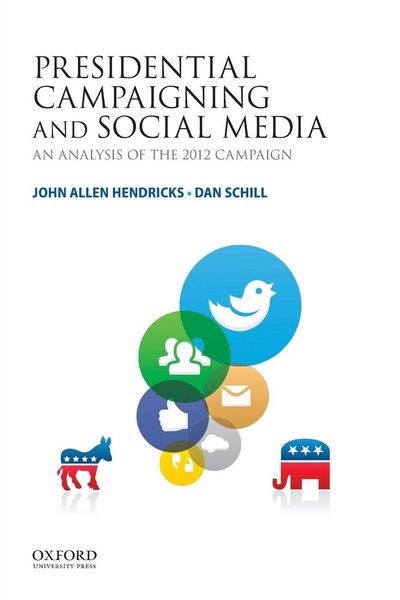
Produktbild: Presidential Campaigning and Social Media

Presidential Campaigning and Social Media An Analysis of the 2012 Campaign

124,99 €

inkl. gesetzl. MwSt., Versandkostenfrei


Beschreibung

Produktdetails

Einband

Taschenbuch

Erscheinungsdatum

01.06.2014

Herausgeber

John Allen Hendricks + weitere

Verlag

Oxford University Press

Seitenzahl

354

Maße (L/B/H)

23,4/15,6/1,9 cm

Gewicht

499 g

Sprache

Englisch

ISBN

978-0-19-935584-6

Beschreibung

Produktdetails

Einband

Taschenbuch

Erscheinungsdatum

01.06.2014

Herausgeber

Verlag

Oxford University Press

Seitenzahl

354

Maße (L/B/H)

23,4/15,6/1,9 cm

Gewicht

499 g

Sprache

Englisch

ISBN

978-0-19-935584-6

Herstelleradresse

Libri GmbH
Europaallee 1
36244 Bad Hersfeld
DE

Email: gpsr@libri.de

Noch keine Bewertungen vorhanden

Verfassen Sie die erste Bewertung zu diesem Artikel

Helfen Sie anderen Kundinnen und Kunden durch Ihre Meinung.

Kundinnen und Kunden meinen

Bewertungen (0)

  • Produktbild: Presidential Campaigning and Social Media
    • I: SOCIAL MEDIA AND POLITICAL COMMUNICATION


    • Chapter 1. "The Presidential Campaign of 2012: New Media Technologies Used to Interact and Engage with the Electorate," John Allen Hendricks and Dan Schill

    • The 2012 Republican Primary and Social Media

    • Social Media Platforms

    • General Election

    • Presidential Campaigning and Social Media

    • Social Media and Changing American Demographics

    • Overview of the Book

    • Chapter 2: "The Evolution of Digital Media Use in Election Campaigns: New Functions and Cumulative Impact," Daniela V. Dimitrova

    • Social Media Growth, Age and Partisanship

    • Characteristics of Digital Media

    • Multiple Opportunities for Political Engagement

    • Lower Cost of Citizen Participation

    • Interactivity

    • Data Tracking and Data Mining

    • Differential Impacts

    • Method

    • Results

    • Discussion

    • Chapter 3: "Creating a Win-Win Situation?: Relationship Cultivation and the Use of Social Media in the 2012 Campaign," Emma Svensson, Spiro Kiousis, and Jesper Stromback

    • The Promise of Digital and Social Media

    • The Philosophy--Mutual Beneficial Value

    • Input--The Willingness to Adopt

    • Outcomes--Long-term Commitment, Trust and Loyalty

    • Maintenance--Strategies for Sustaining and Strengthening the Relationship

    • Method

    • Relationship Cultivation Strategy Measurements

    • Results

    • Different Strategies in Different Channels

    • Helping the Candidate--Different Types of Collaboration

    • Discussion

    • II: SOCIAL MEDIA AND POLITICAL KNOWLEDGE

    • Chapter 4: "Of Networks and Knowledge: Young Adults and the Early 2012 Republican Presidential Primaries and Caucuses," Jody C. Baumgartner, David S. Morris, and Jonathan S. Morris

    • Social Networks and Knowledge

    • Age and Social Network Usage Patterns

    • Social Media Use and Campaign Knowledge: Expectations

    • Method

    • Analysis: Political Use of Social Networking Sites and Political Knowledge

    • Discussion

    • Chapter 5: "Technology Takeover?: Campaign Learning during the 2012 Presidential Election," Terri L. Towner and David A. Dulio

    • Political Knowledge

    • Type of Information Source

    • Research Questions and Hypotheses

    • Method

    • Dependent Variables

    • Control Variables

    • Media Use Variables

    • Testing Procedures

    • Results

    • Discussion

    • Chapter 6: "Don't Push Your Opinions on Me: Young Citizens and Political Etiquette on Facebook," Kjerstin Thorson, Emily K. Vraga, and Neta Kligler-Vilenchik

    • Facebook as a Context for Doing Politics

    • The Research Context

    • Context Collapse and the Networked Audience

    • One Golden Rule

    • Keep Your Opinions to Yourself (Unless they're Funny)

    • Discussion

    • III: SOCIAL MEDIA AND THE PRESIDENTIAL PRIMARY ELECTIONS

    • Chapter 7: "Uses and Gratifications of Following Candidates' Twitter Campaigns during the 2012 U.S. Primaries," Raluca Cozma

    • Political Uses and Gratifications of Social Media

    • The Relationship between Political Attitudes and Uses of Social Media

    • The Effects of Uses and Gratifications

    • Method

    • Measures

    • Results

    • Discussion

    • Chapter 8: "Fitting Social Media into the Media Landscape during a 2012 Republican Primary," Paul Haridakis, Gary Hanson, Mei-Chen Lin, and Jennifer McCullough

    • Media Choice

    • Motives for Using Media for Political Information

    • Perceptions of Media Bias

    • Method

    • Sample

    • Measures

    • Statistical Analysis

    • Results

    • Amount of Media Use

    • Age Differences and Similarities in Motives for Using Media for Political Information

    • Media-Selection Differences among Members of the Major Political Parties

    • Discussion

    • Chapter 9: "Whose States are Winning?: The Adoption and Consequences of Social Media in Political Communication in the American States," Hyun Jung Yun, Cynthia Opheim, and Emily Kay Balanoff

    • Theoretical Underpinnings

    • The Growth of Social Media in Political Campaigns

    • Social Media's Effect on Political Attitudes and Behavior

    • Political Cynicism

    • Political Information Efficacy

    • Social Media, Geography, and Political Ideology

    • Method

    • Sample

    • Variables and Measures

    • Results

    • Political Utilization and Legitimacy of SNSs

    • Political Interests, Information Efficacy, and Cynicism of Political SNS

    • Users

    • Perception and Expression of Political Opinions via SNSs

    • Purpose and Gratification of Political SNS Users

    • Discussion

    • Chapter 10: "YouTube/OurTube/TheirTube: Official and Unofficial Online Campaign Advertising, Negativity, and Popularity,"Jacob Groshek and Stephanie Brookes

    • Social Media, Election Campaigns, and Political Advertising

    • YouTube and the Online Campaign

    • YouTube and Campaign Advertising

    • Methods

    • Official Advertising on YouTube

    • Searching Advertising on YouTube

    • Variable Categories

    • Findings

    • Discussion

    • IV: SOCIAL MEDIA AND THE PRESIDENTIAL GENERAL ELECTION

    • Chapter 11: "The Spirals of Newly Transcending Political Voices: Social Media Purify the Atmosphere of Political Dialogues in Cyberspace," Hyun Jung Yun

    • Theoretical Underpinnings

    • Political Mavericks in Social Media

    • Crosscutting Spirals of Expression in the Political Grounds of Social Media

    • In-Group Identities Embedded in the Spirals of Political Discourse in Cyberspace

    • Method

    • Data and Sample

    • Variables

    • Results

    • Dynamics of Demographics

    • Main Source of Political Information

    • Political Interests and Information Efficacy

    • Political Cynicism: Internal Powerlessness and External Alienation

    • Political Expression

    • Discussion

    • Chapter 12: "Evaluating Textual and Technical Interactivity in Candidate E-mail Messages during the 2012 U.S. Presidential Campaign," Andrew Paul Williams and Roxana Maiorescu

    • Candidate Use of E-mail

    • Interactivity

    • Research Questions

    • Method

    • Sample

    • Categories

    • Coding Process and Reliability

    • Results

    • Discussion

    • Chapter 13:"Social Network Sites and Interactivity: Differential Expression Effects in Campaign 2012," David Lynn Painter, Juliana Fernandes, Jessica Mahone, and Eisa Al Nashmi

    • Theoretical Framework

    • Political Information Efficacy

    • Agenda Building: Salience of the Election

    • Online Information Sources

    • Interactivity

    • Expression Effects

    • Method

    • Participants and Procedure

    • Manipulation

    • Dependent Variables

    • Results

    • Participants and Manipulation Check

    • Main Effects of Information Source

    • Main Effects of Interactivity

    • Interaction Between Online Information Source and Interactivity

    • Discussion

    • V: SOCIAL MEDIA AND VOTER/MEDIA ENGAGEMENT


    • Chapter 14: "Issue Debates in 140 Characters: Online Talk Surrounding the 2012 Debates," Dan Schill and Rita Kirk

    • Twitter Use in the 2012 Election

    • Twitter, Second Screens, and Presidential Debates

    • Method

    • Campaign Twitter Use

    • Source Frame

    • Media Validation Frame

    • Framing Frame

    • Journalist Twitter Use

    • Interpretation Frame

    • Evaluation Frame

    • Citizen Twitter Use

    • Discussion

    • Second Screen

    • Media Convergence

    • Agenda Setting


    • Chapter 15: "Social Media and Voter Behavior during Presidential Campaigns," Monica Ancu

    • What We Know So Far About SNS Users

    • Who Are The Politically Active SNS Users?

    • Do SNS Have Influence On Offline Behavior and Attitudes?

    • What Motivates SNS Users To Engage Politically?

    • Method

    • Sample

    • Measures

    • Results

    • Demographics of Political SNS Users

    • Connection between SNS Behavior and Offline

    • What Brings People to Political SNS

    • Discussion

    • Chapter 16: "Maligned Youth or Political Activists?: Young Citizen Political Engagement using Social Media," Benjamin R. Warner, Joshua Hawthorne, and Sarah Turner McGowen

    • Social Media as a Digital Place for Political Engagement

    • Profiling the Politically Engaged

    • Political Cynicism

    • Political Information Efficacy

    • Political Polarization

    • Method

    • Sample

    • Procedure and Variables

    • Analytic Procedures

    • Results

    • Discussion

    • References

    • Chapter 17: "YouTube and the 2012 Presidential Election: An Examination of how Obama and Romney's Official YouTube Channels were used in Campaign Communication," LaChrystal D. Ricke

    • Politics and Online Video

    • YouTube and Politics

    • Method

    • Findings

    • Obama for America

    • Believe in America

    • Discussion

    • Index