• Produktbild: Probability and Social Science
  • Produktbild: Probability and Social Science
Band 10 - 12%

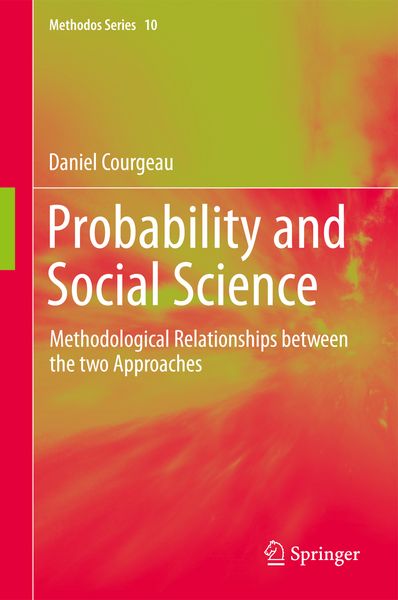
Probability and Social Science Methodological Relationships between the two Approaches

Aus der Reihe Methodos Series
12% sparen

139,99 € UVP 160,49 €

inkl. gesetzl. MwSt., Versandkostenfrei


Beschreibung

Produktdetails

Einband

Taschenbuch

Erscheinungsdatum

16.04.2014

Abbildungen

XXXIV, 310 p.

Verlag

Springer Netherland

Seitenzahl

310

Maße (L/B/H)

23,5/15,5/1,9 cm

Gewicht

522 g

Auflage

1. Auflage

Sprache

Englisch

ISBN

978-94-007-9612-6

Beschreibung

Rezension

Courgeau has written a masterpiece on the co-evolution of probability theory and the social sciences. The co-evolution was not always harmonious and applications of probability theory in the social sciences have sometimes been criticized. Courgeau attributes this to a misunderstanding of the various approaches to probability. Social scientists barely distinguish between these approaches, often assume that probability can only be objective, or interpret the Bayesian approach incorrectly. Courgeau advocates the use of probability concepts in the social sciences because they enable us to formalize the risks and uncertainties that are at the heart of the social sciences. The awareness is growing that we live in a risk society and need to be prepared to make important decisions under conditions of uncertainty and incomplete knowledge. The awareness is also growing that society at large feels the consequences of games of chance some humans and organizations play today. There is no other option than to use the best knowledge on chance mechanisms available to tame uncertainties, even if it requires a fundamental transformation of the social sciences. Anyone concerned about the future of the social sciences should read this important book.

From the book review by Frans Willekens,
Netherlands Interdisciplinary Demographic Institute (NIDI), The Hague, The Netherlands,
published in
European Journal of Population / Revue européenne de Démographie
© Springer Science+Business Media Dordrecht  201310.1007/s10680-013-9285-6

The purpose of this book is to examine historical connections between probability and social science, demography in particular. The Author, Daniel Courgeau, Professor Emeritus at INED, Paris, is a distinguished French demographer, renowned for his pioneering methodological work on event history analysis and multi-level modelling in population studies, and for keen interest inprobability issues. That such a volume was published in the year commemorating the 350th anniversary of both John Graunt’s
Bills of Mortality
, which marks the beginning of modern social sciences, as well as of
Logic, or The Art of Thinking
by Antoine Arnauld and Pierre Nicole, whom the Author sees as precursors of applied probability and statistical decision analysis, is a fine coincidence indeed.

The book is structured into two parts, the first one dealing with the history of probability and its impact on social sciences, and the second one, conversely, with how advances in social sciences influenced the developments of probability theory. These two parts are preceded by a General Introduction to the whole volume, which outlines the history of probability and social sciences, in particular since the 17th century, and provides the reader with a roadmap through the entire book. Each of the two parts has a separate brief introduction and a succinct conclusion; finally, the whole volume ends with a General Conclusion, which is slightly longer and broader in scope. Importantly for readers in a hurry, who nevertheless want to have a flavour of the contents, all the introductions and conclusions together are almost standalone, and enable quick orientation in the main messages.

… In summary, this book is a very welcome compendium on the history and perspectives of probability and social sciences, brought together in one volume, which can be fully recommended especially for academics and doctoral students of quantitative social sciences.

From the book review by Jakub Bijak and Eric Silverman,
University of Southampton
, United Kingdom
, published in
PopulationStudies
, 67(1), 2013,
DOI:

Produktdetails

Einband

Taschenbuch

Erscheinungsdatum

16.04.2014

Abbildungen

XXXIV, 310 p.

Verlag

Springer Netherland

Seitenzahl

310

Maße (L/B/H)

23,5/15,5/1,9 cm

Gewicht

522 g

Auflage

1. Auflage

Sprache

Englisch

ISBN

978-94-007-9612-6

Herstelleradresse

Springer-Verlag GmbH
Tiergartenstr. 17
69121 Heidelberg
DE

Email: ProductSafety@springernature.com

Noch keine Bewertungen vorhanden

Verfassen Sie die erste Bewertung zu diesem Artikel

Helfen Sie anderen Kundinnen und Kunden durch Ihre Meinung.

Kundinnen und Kunden meinen

Bewertungen (0)

  • Produktbild: Probability and Social Science
  • Produktbild: Probability and Social Science

  • General Introduction.- Part 1: From Probability to Social Sciences.- Introduction to Part 1.- Chapter 1: The Objectivist Approach.- Chapter 2: The Epistemic Approach: Subjectivist Interpretation.- Chapter 3: The Epistemic Approach: Logicist Interpretation.- Conclusion of Part 1.- Part II: From Population Sciences to Probability.- Introduction to Part II.- Chapter 4: The Dispersion of Measures in Population Sciences.- Chapter 5: Closer Links between Population Sciences and Probability.- Conclusion of Part II.- General Conclusion.- Glossary.- References.- Subject Index.- Author Index.