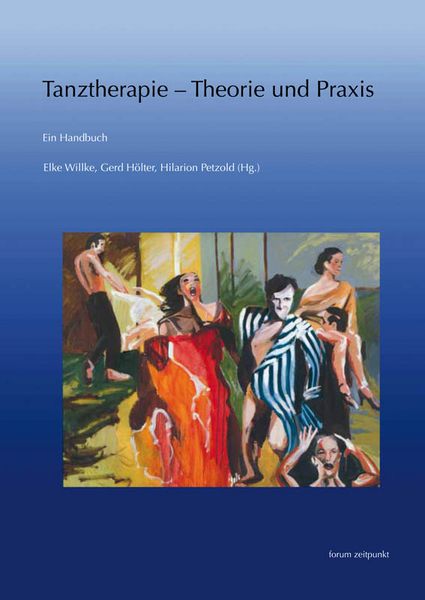
Tanztherapie – Theorie und Praxis Ein Handbuch
-
- Deutsch ausgewählt
34,80 €
inkl. gesetzl. MwSt.,
Beschreibung
Produktdetails
Einband
Taschenbuch
Erscheinungsdatum
09.05.2014
Herausgeber
Elke Willke + weitereVerlag
Reichert, LSeitenzahl
400
Maße (B/H)
17/24 cm
Gewicht
683 g
Farbe
Marine / Graublau
Sprache
Deutsch
ISBN
978-3-95490-001-5
Although this trend is today often considered as being new, it is in fact part of a discourse since the time of the Greek classics on the body/mind relationship in human beings. A practical consequence of this discourse has been that over the course of time numerous body and movement related therapeutic approaches have been developed which are intended to influence the therapeutic process by way of different modes of expression (voice, dance, musical and artistic arrangements) or by way of direct interventions on body and movement expression (voice, dance, musical and artistic arrangements) or by way of direct interventions on body and movement (massage, sport and physiotherapy, gymnastics etc.)
In this context dance therapy is a form of therapeutic intervention with a long tradition and a growing body of evidence. Its origins partly lie in the German movement of expressive dance at the beginning of the 20th century. Later dance therapy developed further mainly in the USA, and today has a distinctly independent profile of its own in the German speaking countries.
The original texts presented in this book document the gradual emergence of this form of therapy over a timespan of more than 70 years, through discourses on theory and in practice with artistic and psychotherapeutic concepts and through scientific studies of body movement.
As introduction Elke Willke presents a general overview over the history and present state of dance therapy in Germany. In the first part of the book, partly through extracts from original texts, a background is provided to a therapeutic explanation of expressive dance (Boas, v. Laban, Wigman) and to the anthropologic interpretation of the phenomena of movement (Buytendijk). Selected texts of the so-called “mothers” of dance therapy are following (Chace, Espenak, Schoop, Whitehouse), all of whom were first of all outstanding and internationally successful dance artists who went on to discover the therapeutic uses and implications of dance. From the mid 1970s dance therapy received a more solid psychotherapeutic foundation through the generation of “daughters”, a group of women who combined an education in dance with certification as psychotherapists (Dosamantes - Alperson, Bernstein, Siegel). Their work is also documented with original texts.
The second part of the volume consists of texts from the beginnings of the establishment of dance therapy in Germany. These texts show the range of applications of this form of therapy, and they discuss a differentiation between dance education as part of a regular curriculum and dance therapy as a form of psychotherapy and healing. Despite all the diversity of today it is worthwhile (and this is confirmed by the abundant demand for a new edition of this book) to remind oneself anew on the basis of original documents of the origin, the background and the concepts of dance therapy, which are still important today, and which continue to have an impact both on theory and practice for present development in the German speaking countries and beyond.
Noch keine Bewertungen vorhanden
Verfassen Sie die erste Bewertung zu diesem Artikel
Helfen Sie anderen Kundinnen und Kunden durch Ihre Meinung.
Kurze Frage zu unserer Seite
Vielen Dank für Ihr Feedback
Wir nutzen Ihr Feedback, um unsere Produktseiten zu verbessern. Bitte haben Sie Verständnis, dass wir Ihnen keine Rückmeldung geben können. Falls Sie Kontakt mit uns aufnehmen möchten, können Sie sich aber gerne an unseren Kund*innenservice wenden.
zum Kundenservice