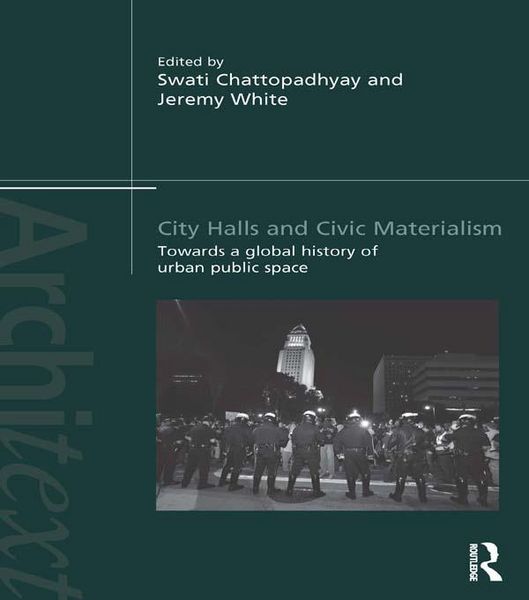
City Halls and Civic Materialism Towards a Global History of Urban Public Space
-
Form:Einzelkauf Download
-
Sprache:Englisch
-
eBook Format:PDF
- ePUB 3 60,49 €
- PDF 60,49 € ausgewählt
60,49 €
inkl. gesetzl. MwSt.Beschreibung
Produktdetails
Format
Kopierschutz
Ja
Family Sharing
Nein
Text-to-Speech
Nein
Erscheinungsdatum
14.03.2014
Herausgeber
Swati Chattopadhyay + weitereVerlag
Taylor & Francis eBooksSeitenzahl
332 (Printausgabe)
Dateigröße
33247 KB
Sprache
Englisch
EAN
9781317802280
The town hall or city hall as a place of local governance is historically related to the founding of cities in medieval Europe. As the space of representative civic authority it aimed to set the terms of public space and engagement with the citizenry. In subsequent centuries, as the idea and built form travelled beyond Europe to become an established institution across the globe, the parameters of civic representation changed and the town hall was forced to negotiate new notions of urbanism and public space.
City Halls and Civic Materialism: Towards a Global History of Urban Public Space utilizes the town hall in its global historical incarnations as bases to probe these changing ideas of urban public space. The essays in this volume provide an analysis of the architecture, iconography, and spatial relations that constitute the town hall to explore its historical ability to accommodate the "public" in different political and social contexts, in Europe, Asia, Australia, Africa and the Americas, as the relation between citizens and civic authority had to be revisited with the universal franchise, under fascism, after the devastation of the world wars, decolonization, and most recently, with the neo-liberal restructuring of cities.
As a global phenomenon, the town hall challenges the idea that nationalism, imperialism, democracy, the idea of citizenship - concepts that frame the relation between the individual and the body politic -- travel the globe in modular forms, or in predictable trajectories from the West to East, North to South. Collectively the essays argue that if the town hall has historically been connected with the articulation of bourgeois civil society, then the town hall as a global spatial type -- architectural space, urban monument, and space of governance -- holds a mirror to the promise and limits of civil society.
Kundinnen und Kunden meinen
Verfassen Sie die erste Bewertung zu diesem Artikel
Helfen Sie anderen Kund*innen durch Ihre Meinung
Kurze Frage zu unserer Seite
Vielen Dank für Ihr Feedback
Wir nutzen Ihr Feedback, um unsere Produktseiten zu verbessern. Bitte haben Sie Verständnis, dass wir Ihnen keine Rückmeldung geben können. Falls Sie Kontakt mit uns aufnehmen möchten, können Sie sich aber gerne an unseren Kund*innenservice wenden.
zum Kundenservice