
Tragedy and the Tragic in German Literature, Art, and Thought
-
- Englisch ausgewählt
178,99 €
inkl. gesetzl. MwSt.,
Beschreibung
Produktdetails
Einband
Gebundene Ausgabe
Erscheinungsdatum
15.12.2014
Herausgeber
Stephen D. Dowden + weitereVerlag
Camden HouseSeitenzahl
382
Maße (L/B/H)
23,5/15,7/2,7 cm
Gewicht
769 g
Sprache
Englisch
ISBN
978-1-57113-585-8
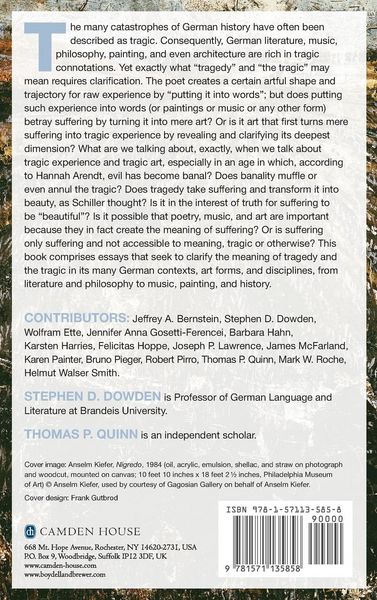
The many catastrophes of German history have often been described as tragic. Consequently, German literature, music, philosophy, painting, and even architecture are rich in tragic connotations. Yet exactly what "tragedy" and "the tragic" may mean requires clarification. The poet creates a certain artful shape and trajectory for raw experience by "putting it into words"; but does putting such experience into words (or paintings or music or any other form) betray suffering by turning it into mere art? Or is it art that first turns mere suffering into tragic experience by revealing and clarifying its deepest dimension? What are we talking about, exactly, when we talk about tragic experience and tragic art, especially in an age in which, according to Hannah Arendt, evil has become banal? Does banality muffle or even annul the tragic? Does tragedy take suffering and transform it into beauty, as Schiller thought? Is it in the interest of truth for suffering to be "beautiful"? Is it possible that poetry, music, and art are important because they in fact create the meaning of suffering? Or is suffering only suffering and not accessible to meaning, tragic or otherwise? This book comprises essays that seek to clarify the meaning of tragedy and the tragic in its many German contexts, art forms, and disciplines, from literature and philosophy to music, painting, and history. CONTRIBUTORS: Jeffrey A. Bernstein, Stephen D. Dowden, Wolfram Ette, Jennifer Anna Gosetti-Ferencei, Barbara Hahn, Karsten Harries, Felicitas Hoppe, Joseph P. Lawrence, James McFarland, Karen Painter, Bruno Pieger, Robert Pirro, Thomas P. Quinn, Mark W. Roche, Helmut Walser Smith. STEPHEN D. DOWDEN is Professor of German language and literature at Brandeis University. THOMAS P. QUINN is an independent scholar.
Kundinnen und Kunden meinen
Verfassen Sie die erste Bewertung zu diesem Artikel
Helfen Sie anderen Kund*innen durch Ihre Meinung
Kurze Frage zu unserer Seite
Vielen Dank für Ihr Feedback
Wir nutzen Ihr Feedback, um unsere Produktseiten zu verbessern. Bitte haben Sie Verständnis, dass wir Ihnen keine Rückmeldung geben können. Falls Sie Kontakt mit uns aufnehmen möchten, können Sie sich aber gerne an unseren Kund*innenservice wenden.
zum Kundenservice