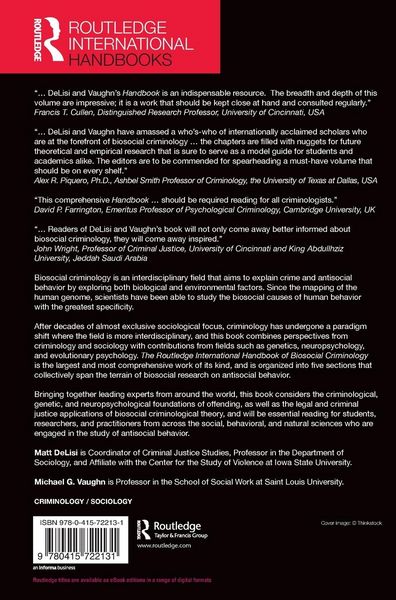
Part I: Criminological Foundations 1. A Unified Theory of Crime and Delinquency: Foundation for a Biosocial Criminology, Cesar Rebellon, J. C. Barnes, and Robert Agnew 2. Biosocial Criminology as a Paradigm Shift, Anna S. Rudo-Hutt, Jill Portnoy, Frances R. Chen, and Adrian Raine 3. An Evolutionary Perspective on Interpersonal Violence: Sex Differences and Personality Links, Peter K. Jonason 4. Key Findings from Biosocial Research and What They Mean for the Future of Criminology, Kevin M. Beaver and Eric J. Connolly 5. Sociobiology of Lethal Violence in Small-Scale Societies, Ryan M. Ellsworth and Robert S. Walker Part II: Genetic Foundations of Antisocial Behavior 6. Genetics Influences on Antisocial Behavior over the Life Course, Catherine Tuvblad 7. Peer Effects and Molecular Genetics in Adolescent Antisocial Behavior, Tina Kretschmer, Jan Kornelis Dijkstra, and René Veenstra 8. Neurogenetics of Antisocial Behavior, Hayley M. Dorfman and Joshua W. Buckholtz 9. Stress and Antisocial Behavior: The Serotonin System, Jamie C. Vaske and Danielle L. Boisvert 10. When Humans Prey on One Another: Understanding the Biosocial Origins of Victimization, Maria Koeppel, Brian B. Boutwell, and J.C. Barnes 11. Behavioral Genetics and Antisocial Spectrum Disorders, Tracy D. Gunter 12. The Warrior Gene: MAOA Genotype and Antisocial Behavior in Males, Nicholas R. Holland and Matt DeLisi 13. New methods in gene-environment interplay: The extended children of twin design, Qiang Fu Part III: Neurological and Neuropsychological Foundations of Antisocial Behavior 14. Neuroimaging and Antisocial Behavior, Robert A. Schug, Gianni G. Geraci, Gabriel Marmolejo, Heather L. McLernon, Leidy S. Partida, and Alexander J. Roberts 15. Neuropsychology of Psychopathic Traits in Children, Alice P. Jones Bartoli and Guilherme W. Wendt 16. The Psychopharmacology of Criminality and Oxytocin Modulation of Social Behavior in Aggressive Individuals, Royce Lee 17. The Neurobiology of Aggression: Looking Underneath the Hood, C. Nathan DeWall and David S. Chester 18. Why Focusing on Nurture Made and Still Makes Sense: The Biosocial Development of Self-Control, Alexander T. Vazsonyi, Joshua W. Roberts, and Li Huang 19. Brain Abnormalities in Psychopathy, Yaling Yang 20. Self-Reported Head Injuries among Delinquent Youth, Brian E. Perron, Michael G. Vaughn, Joseph Ryan, Christopher Salas-Wright, Mary Ruffolo, and Erick Guerrero 21. Executive Functioning, Reward Processing, and Antisocial Behavior in Adolescent Males, Joanne E. Morgan, Katharine L. Bowen, Simon C. Moore, Justin C. Savage, and Stephanie H.M. van Goozen Part IV: Biosocial Mechanisms of Antisocial Conditions and Antisocial Behavior 22. Temperament as a Biosocial Construct for Understanding Antisocial Behavior, Matt DeLisi and Michael G. Vaughn 23. Why DRD4? An Evolutionary-Informed Model of DRD4 and Antisocial Behavior, Julia Dmitrieva and Emma Espel 24. Biosocial Foundations of Externalizing Behaviors, Lisabeth F. DiLalla and Kyle Bersted 25. The Biological Etiology of Psychopathy, Rheanna J. Remmel and Andrea L. Glenn 26. Development of Aggression and Violence from Infancy to Adulthood: A Biopsychosocial Perspective, Stéphane Paquin, Eric Lacourse, and Isabelle Ouellet-Morin 27. Childhood Maltreatment: An Environmental Pathogen?, Melissa Jonson-Reid and Charlotte Bright 28. Early Dispositional Risks for Conduct Problems and Gene-Environment Interplay, Christopher J. Trentacosta and Benjamin D. Goodlett 29. Blackout: The Traumatic Brain Injury Association with Career Criminality Withstands Powerful Confounds, Monic P. Behnken, Matt DeLisi, Chad R. Trulson, and Michael G. Vaughn 30. Social Stress and the Gene-Environment Influences on Crime and Delinquency, D. Anne Winiarski, Erica L. Smearman, and Patricia A. Brennan 31. Understanding Families from a Biosocial Perspective, John Paul Wright, Jamie Newsome, and Michelle Coyne Part V. Legal and Criminal Justice Applications 32. Intelligence as the quintessential biosocial variable: An examination of etiological factors and associations with criminal offending and criminal justice processing, Joseph L. Nedelec, Joseph A. Schwartz, and Eric J. Connolly 33. Brain Development and Risk Taking During Adolescence: Implications for Prevention of Antisocial Behavior, Daniel Romer and Atika Khurana 34. Offender Rehabilitation from a Maturation/Biosocial Perspective, Michael Rocque and Brandon C. Welsh 35. Antisocial Cognition and Criminal Thinking: Theoretical Interpretations and Biosocial Implications, Glenn D. Walters 36. Sexual Homicide: A Clinical and Investigative Analysis, Stacey L. Shipley and Bruce A. Arrigo 37. Neuroethics of Criminal Responsibility: Mental Disorders Influencing Behavior, Gerben Meynen 38. Alcohol and Drug Misuse as a Biosocial Source of Crime, Christopher P. Salas-Wright and Jelena Todic 39. Empathy, Crime, and Justice, Chad Posick, Michael Rocque, and Matt DeLisi 40. Family Intervention and Their Biosocial Bases, Brandy R. Maynard and Matthew Larson 41. Action-Reaction? Forensic Awareness Analysis and Forensic Awareness in Sexual Homicide, Eric Beauregard and Melissa Martineau 42. Prison as an Environmental Pathogen, Sytske Besemer and Joseph Murray 43. Biosocial Criminology: The Future is Here, Michael G. Vaughn and Matt DeLisi.