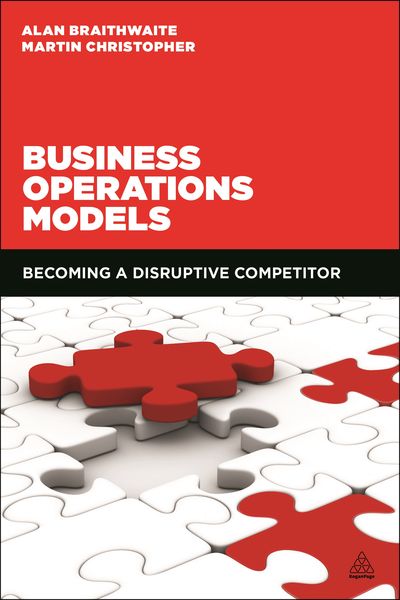
Business Operations Models Becoming a Disruptive Competitor
-
- Hardcover
- Taschenbuch ausgewählt
- eBook
-
Sprache:Englisch
56,99 €
inkl. gesetzl. MwSt.,
Beschreibung
Produktdetails
Einband
Taschenbuch
Erscheinungsdatum
03.05.2015
Verlag
Kogan Page LtdSeitenzahl
264
Maße (L/B/H)
23,4/15,6/1,5 cm
Gewicht
400 g
Auflage
1
Sprache
Englisch
ISBN
978-0-7494-7331-0
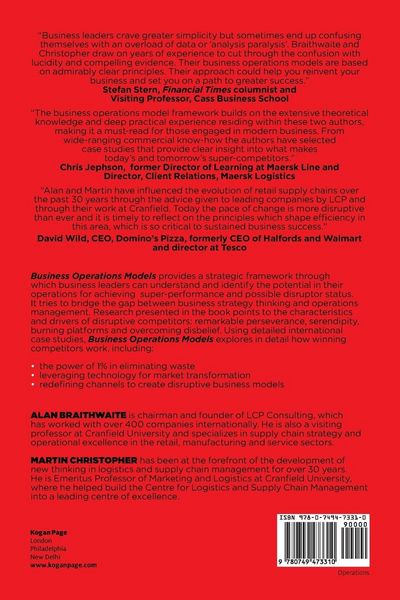
Recognising that operations management needs to be more strategic,
Business Operations Models
is a revolutionary new title that looks at the interrelationship of operations management and strategy.
In
Business Operations Models
, Martin Christopher and Alan Braithwaite identify the characteristics of market-leading businesses that have transformed their markets and delivered super performance for their stakeholders. It points to the theory gap between strategic thinking and operations and how many high-performing businesses arrive at their new operating models as much by chance as judgement. Unpacking those observations leads to some clearly defined features of winning competitors, including eliminating waste, leveraging technology, and utilising transformative business models.
Business Operations Models offers a framework for achieving super performance and understanding when and how a company may be able to leverage its capabilities to outperform.
The book provides detailed international case studies that illustrate how the principles work in practice, including Apple, Dell, Amazon, John Lewis, Southwest Airlines, Aldi, Toyota and many others.
Noch keine Bewertungen vorhanden
Verfassen Sie die erste Bewertung zu diesem Artikel
Helfen Sie anderen Kundinnen und Kunden durch Ihre Meinung.
Kurze Frage zu unserer Seite
Vielen Dank für Ihr Feedback
Wir nutzen Ihr Feedback, um unsere Produktseiten zu verbessern. Bitte haben Sie Verständnis, dass wir Ihnen keine Rückmeldung geben können. Falls Sie Kontakt mit uns aufnehmen möchten, können Sie sich aber gerne an unseren Kund*innenservice wenden.
zum Kundenservice