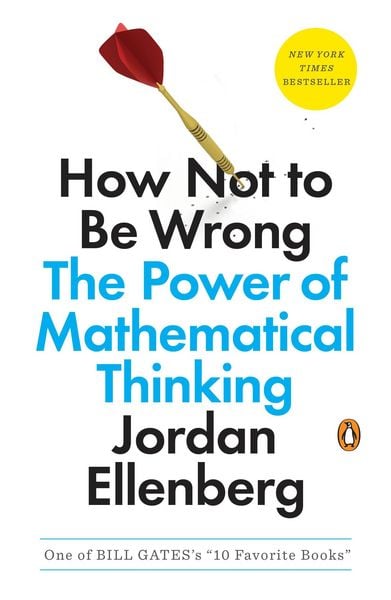
How Not to Be Wrong The Power of Mathematical Thinking
-
- Taschenbuch ausgewählt
- eBook
-
Zustand:Neu
- Neu 11,99 € ausgewählt
- Gebraucht, sehr gut 7,50 €
-
Sprache:Englisch
-
Verlag:Penguin LLC US
- Penguin LLC US 11,99 € ausgewählt
- Penguin Books Ltd 15,49 €
11,99 €
UVP
13,50 €
inkl. gesetzl. MwSt.,
Beschreibung
Produktdetails
Verkaufsrang
25187
Einband
Taschenbuch
Erscheinungsdatum
26.05.2015
Verlag
Penguin LLC USSeitenzahl
480
Maße (L/B/H)
21,2/14,1/3,2 cm
Gewicht
374 g
Sprache
Englisch
ISBN
978-0-14-312753-6
The Freakonomics of math—a math-world superstar unveils the hidden beauty and logic of the world and puts its power in our hands
The math we learn in school can seem like a dull set of rules, laid down by the ancients and not to be questioned. In How Not to Be Wrong, Jordan Ellenberg shows us how terribly limiting this view is: Math isn’t confined to abstract incidents that never occur in real life, but rather touches everything we do—the whole world is shot through with it.
Math allows us to see the hidden structures underneath the messy and chaotic surface of our world. It’s a science of not being wrong, hammered out by centuries of hard work and argument. Armed with the tools of mathematics, we can see through to the true meaning of information we take for granted: How early should you get to the airport? What does “public opinion” really represent? Why do tall parents have shorter children? Who really won Florida in 2000? And how likely are you, really, to develop cancer?
How Not to Be Wrong presents the surprising revelations behind all of these questions and many more, using the mathematician’s method of analyzing life and exposing the hard-won insights of the academic community to the layman—minus the jargon. Ellenberg chases mathematical threads through a vast range of time and space, from the everyday to the cosmic, encountering, among other things, baseball, Reaganomics, daring lottery schemes, Voltaire, the replicability crisis in psychology, Italian Renaissance painting, artificial languages, the development of non-Euclidean geometry, the coming obesity apocalypse, Antonin Scalia’s views on crime and punishment, the psychology of slime molds, what Facebook can and can’t figure out about you, and the existence of God.
Ellenberg pulls from history as well as from the latest theoretical developments to provide those not trained in math with the knowledge they need. Math, as Ellenberg says, is “an atomic-powered prosthesis that you attach to your common sense, vastly multiplying its reach and strength.” With the tools of mathematics in hand, you can understand the world in a deeper, more meaningful way. How Not to Be Wrong will show you how.
Kundinnen und Kunden meinen
Verfassen Sie die erste Bewertung zu diesem Artikel
Helfen Sie anderen Kund*innen durch Ihre Meinung
Kurze Frage zu unserer Seite
Vielen Dank für Ihr Feedback
Wir nutzen Ihr Feedback, um unsere Produktseiten zu verbessern. Bitte haben Sie Verständnis, dass wir Ihnen keine Rückmeldung geben können. Falls Sie Kontakt mit uns aufnehmen möchten, können Sie sich aber gerne an unseren Kund*innenservice wenden.
zum Kundenservice