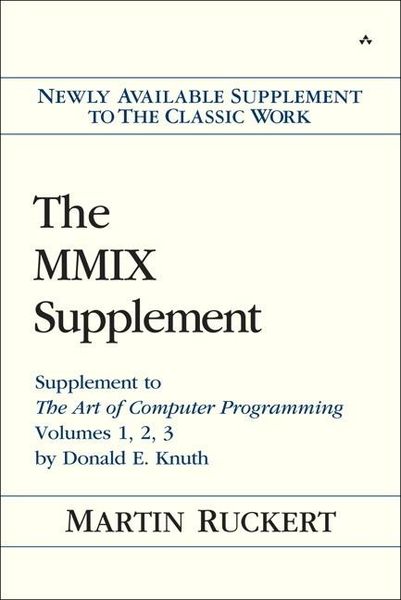
The MMIX Supplement Supplement to the Art of Computer Programming Volumes 1, 2, 3 by Donald E. Knuth
-
- Taschenbuch ausgewählt
- eBook
-
Sprache:Englisch
33,99 €
inkl. gesetzl. MwSt.,
Beschreibung
Produktdetails
Einband
Taschenbuch
Erscheinungsdatum
16.02.2015
Verlag
Pearson AcademicSeitenzahl
224
Maße (L/B/H)
24,1/16,1/1,7 cm
Gewicht
350 g
Sprache
Englisch
ISBN
978-0-13-399231-1
The MMIX Supplement: Supplement to The Art of Computer ProgrammingVolumes 1, 2, 3 by Donald E. Knuth
"I encourage serious programmers everywhere to sharpen their skills by devouring this book."
-Donald E. Knuth
In the first edition of Volume 1 of The Art of Computer Programming, Donald E. Knuth introduced the MIX computer and its machine language: a teaching tool that powerfully illuminated the inner workings of the algorithms he documents. Later, with the publication of his Fascicle 1, Knuth introduced MMIX: a modern, 64-bit RISC replacement to the now-obsolete MIX. Now, with Knuth's guidance and approval, Martin Ruckert has rewritten all MIX example programs from Knuth's Volumes 1-3 for MMIX, thus completing this MMIX update to the original classic.
Building on contributions from the international MMIXmasters volunteer group, Ruckert fully addresses MMIX basic concepts, information structures, random numbers, arithmetic, sorting, and searching. In the preparation of this supplement, about 15,000 lines of MMIX code were written and checked for correctness; over a thousand test cases were written and executed to ensure the code is of the highest possible quality.
The MMIX Supplement should be read side by side with The Art of Computer Programming, Volumes 1-3, and Knuth's Fascicle 1, which introduces the MMIX computer, its design, and its machine language. Throughout, this supplement contains convenient page references to corresponding coverage in the original volumes. To further simplify the transition to MMIX, Ruckert stayed as close as possible to the original-preserving programming style, analysis techniques, and even wording, while highlighting differences where appropriate. The resulting text will serve as a bridge to the future, helping readers apply Knuth's insights in modern environments, until his revised, "ultimate" edition of The Art of Computer Programming is available.
From Donald E. Knuth's Foreword:
"I am thrilled to see the present book by Martin Ruckert: It is jam-packed with goodies from which an extraordinary amount can be learned. Martin has not merely transcribed my early programs for MIX and recast them in a modern idiom. He has penetrated to their essence and rendered them anew with elegance and good taste. His carefully checked code represents a significant contribution to the art of pedagogy as well as to the art of programming."
Dr. Martin Ruckert maintains the MMIX home page at mmix.cs.hm.edu. He is professor of mathematics and computer science at Munich University of Applied Sciences in Munich, Germany.
Noch keine Bewertungen vorhanden
Verfassen Sie die erste Bewertung zu diesem Artikel
Helfen Sie anderen Kundinnen und Kunden durch Ihre Meinung.
Kurze Frage zu unserer Seite
Vielen Dank für Ihr Feedback
Wir nutzen Ihr Feedback, um unsere Produktseiten zu verbessern. Bitte haben Sie Verständnis, dass wir Ihnen keine Rückmeldung geben können. Falls Sie Kontakt mit uns aufnehmen möchten, können Sie sich aber gerne an unseren Kund*innenservice wenden.
zum Kundenservice