• Produktbild: Holodomor and Gorta Mór
  • Produktbild: Holodomor and Gorta Mór

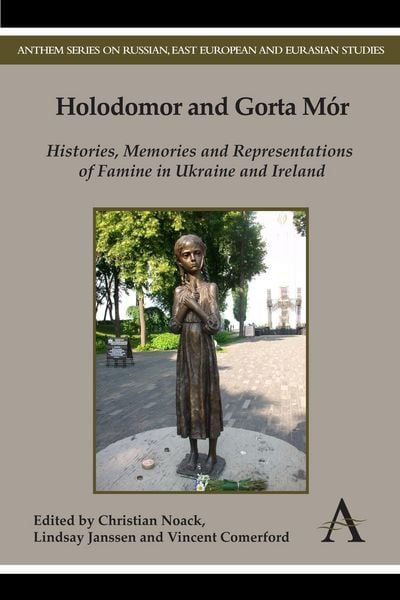
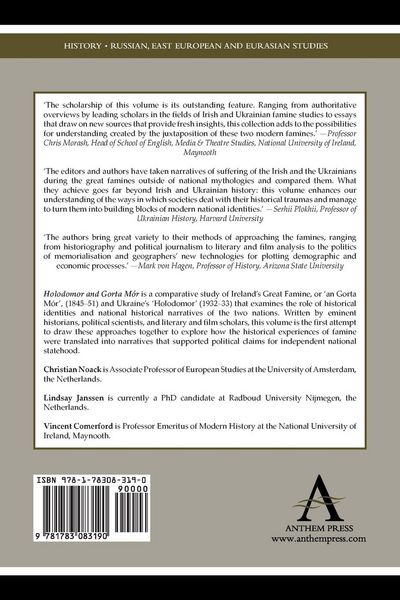
Holodomor and Gorta Mór Histories, Memories and Representations of Famine in Ukraine and Ireland

57,99 €

inkl. gesetzl. MwSt., Versandkostenfrei


Beschreibung

Produktdetails

Einband

Taschenbuch

Erscheinungsdatum

01.10.2014

Herausgeber

Noack Christian + weitere

Verlag

Ingram Publishers Services

Seitenzahl

288

Maße (L/B/H)

22,9/15,2/1,8 cm

Gewicht

454 g

Sprache

Englisch

ISBN

978-1-78308-319-0

Beschreibung

Produktdetails

Einband

Taschenbuch

Erscheinungsdatum

01.10.2014

Herausgeber

Verlag

Ingram Publishers Services

Seitenzahl

288

Maße (L/B/H)

22,9/15,2/1,8 cm

Gewicht

454 g

Sprache

Englisch

ISBN

978-1-78308-319-0

Herstelleradresse

Libri GmbH
Europaallee 1
36244 Bad Hersfeld
DE

Email: gpsr@libri.de

Kundinnen und Kunden meinen

0 Bewertungen

Informationen zu Bewertungen

Zur Abgabe einer Bewertung ist eine Anmeldung im Konto notwendig. Die Authentizität der Bewertungen wird von uns nicht überprüft. Wir behalten uns vor, Bewertungstexte, die unseren Richtlinien widersprechen, entsprechend zu kürzen oder zu löschen.

Die Bewertungen sind nach Format, Anzahl Sterne und Datum sortiert.

Verfassen Sie die erste Bewertung zu diesem Artikel

Helfen Sie anderen Kund*innen durch Ihre Meinung

Kundinnen und Kunden meinen

0 Bewertungen filtern

  • Produktbild: Holodomor and Gorta Mór
  • Produktbild: Holodomor and Gorta Mór
  • List of Figures; Acknowledgements; Introduction: ‘Holodomor and Gorta Mór: Histories, Memories and Representations of Famine in Ukraine and Ireland’ – Christian Noack, Lindsay Janssen and Vincent Comerford; PART I: HISTORIES, HISTORIOGRAPHY AND POLITICS: Chapter 1: ‘Holodomor in Ukraine 1932–1933: An Interpretation of Facts’ – Stanislav V. Kulchytskyi (Translated from Russian by Christian Noack); Chapter 2: ‘Ethnic Issues in the Famine of 1932–1933 in Ukraine’ – David R. Marples; Chapter 3: ‘Grievance, Scourge or Shame? The Complexity of Attitudes to Ireland’s Great Famine’ – Vincent Comerford; PART II: PUBLIC COMMEMORATION: Chapter 4: ‘History and National Identity Construction: The Great Famine in Irish and Ukrainian History Textbooks’ – Jan Germen Janmaat; Chapter 5: ‘Teaching Hunger: The Great Irish Famine Curriculum in New York State Schools’ – Maureen O. Murphy; Chapter 6: ‘Remembering Famine Orphans: The Transmission of Famine Memory between Ireland and Quebec’ – Jason King; Chapter 7: ‘The Irish Famine and Commemorative Culture’ – Emily Mark-FitzGerald; PART III: TRAUMA AND VICTIMISATION: Chapter 8: ‘Holodomor and the Politics of Memory in Ukraine after Independence’ – Heorhiy Kasianov (Translated from Russian by Christian Noack); Chapter 9: ‘The Great Irish Famine in Stories for Children in the Closing Decades of the Twentieth Century’ – Celia Keenan; Chapter 10: ‘Collective Trauma in a Feature Film: “Golod-33” as One-of-a-Kind’ – Olga Papash (Translated from Russian by Christian Noack); PART IV: NEW SOURCES AND NEW APPROACHES TO THE IRISH AND UKRAINIAN FAMINES: Chapter 11: ‘In Search of New Sources: Polish Diplomatic and Intelligence Reports on the Holodomor’ – Jan Jacek Bruski (Translated from Polish by Alicja Waligóra-Zblewska and Christian Noack); Chapter 12: ‘Oral History, Oral Tradition and the Great Famine’ – Maura Cronin; Chapter 13: ‘Mapping Population Change in Ireland 1841–1851: Quantitative Analysis Using Historical GIS’ – Mary Kelly, A. Stewart Fotheringham and Martin Charltoni; Index