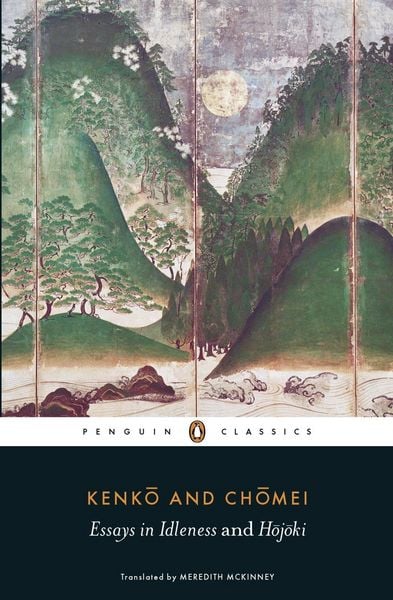
Essays in Idleness and Hojoki
-
- Hardcover
- Taschenbuch
- eBook ausgewählt
-
Form:Einzelkauf Download
-
Sprache:Englisch
9,49 €
inkl. gesetzl. MwSt.Beschreibung
Produktdetails
Format
ePUB
Kopierschutz
Ja
Family Sharing
Nein
Text-to-Speech
Ja
Erscheinungsdatum
05.12.2013
Verlag
Penguin Books LtdSeitenzahl
224 (Printausgabe)
Dateigröße
1111 KB
Übersetzt von
Meredith Mckinney + weitere
Sprache
Englisch
EAN
9780141957876
These two works on life's fleeting pleasures are by Buddhist monks from medieval Japan, but each shows a different world-view. In the short memoir Hôjôki, Chômei recounts his decision to withdraw from worldly affairs and live as a hermit in a tiny hut in the mountains, contemplating the impermanence of human existence. Kenko, however, displays a fascination with more earthy matters in his collection of anecdotes, advice and observations. From ribald stories of drunken monks to aching nostalgia for the fading traditions of the Japanese court, Essays in Idleness is a constantly surprising work that ranges across the spectrum of human experience.
Meredith McKinney's excellent new translation also includes notes and an introduction exploring the spiritual and historical background of the works.
Chômei was born into a family of Shinto priests in around 1155, at at time when the stable world of the court was rapidly breaking up. He became an important though minor poet of his day, and at the age of fifty, withdrew from the world to become a tonsured monk. He died in around 1216.
Kenkô was born around 1283 in Kyoto. He probably became a monk in his late twenties, and was also noted as a calligrapher. Today he is remembered for his wise and witty aphorisms, 'Essays in Idleness'.
Meredith McKinney, who has also translated Sei Shonagon's The Pillow Book for Penguin Classics, is a translator of both contemporary and classical Japanese literature. She lived in Japan for twenty years and is currently a visitng fellow at the Australian National University in Canberra.
'[Essays in Idleness is] a most delightful book, and one that has served as a model of Japanese style and taste since the 17th century. These cameo-like vignettes reflect the importance of the little, fleeting futile things, and each essay is Kenko himself' Asian Student
Noch keine Bewertungen vorhanden
Verfassen Sie die erste Bewertung zu diesem Artikel
Helfen Sie anderen Kundinnen und Kunden durch Ihre Meinung.
Kurze Frage zu unserer Seite
Vielen Dank für Ihr Feedback
Wir nutzen Ihr Feedback, um unsere Produktseiten zu verbessern. Bitte haben Sie Verständnis, dass wir Ihnen keine Rückmeldung geben können. Falls Sie Kontakt mit uns aufnehmen möchten, können Sie sich aber gerne an unseren Kund*innenservice wenden.
zum Kundenservice