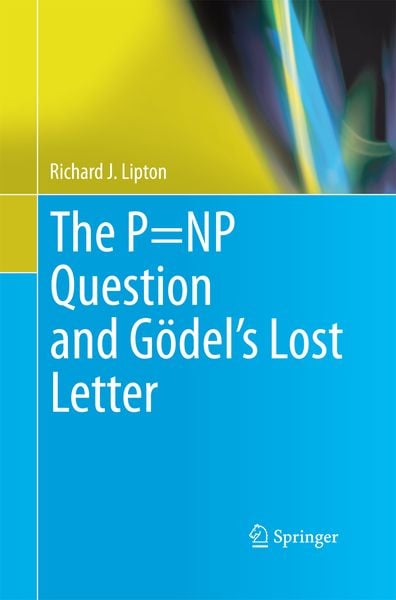
Produktbild: The P=NP Question and Gödel’s Lost Letter

The P=NP Question and Gödel’s Lost Letter

97,99 €

inkl. gesetzl. MwSt., Versandkostenfrei


Beschreibung

Produktdetails

Einband

Taschenbuch

Erscheinungsdatum

20.10.2014

Verlag

Springer Us

Seitenzahl

239

Maße (L/B/H)

23,5/15,5/1,5 cm

Gewicht

394 g

Auflage

2010

Sprache

Englisch

ISBN

978-1-4899-9272-7

Beschreibung

Rezension

“This book is a thoroughly enjoyable read because of
the great balance between anecdotes, presentations of ‘nice’ problems and
algorithms and their solutions and proofs, ‘hard mathematics,’ and musings on
how to approach mathematical problems. After having read the book, most readers
with a background in complexity theory will most likely be unable to resist
immediately working on at least one of the many open problems presented in the
book.” (Till Tantau, Mathematical Reviews, October, 2015)

“This book … collects and edits the highlights from Lipton’s ongoing blog, rounded out by cross-references and a useful index and bibliography. … the book offers a different experience and a framed portrait of the state of the art. … Summing Up: Recommended. All levels/libraries.” (D. V. Feldman, Choice, Vol. 48 (9), May, 2011)

“The P=NP question is certainly one of the most important problems in mathematics and computer science (CS). What makes this book unique and delightful is that it gives proper weight to the question rather than the technicalities. Each chapter is based on one of Lipton’s blog posts, and readers can jump from chapter to chapter to find his beautifully written thoughts and insights. … In fact, anyone who is highly motivated by this interesting subject that relates science with reality should read it.” (Hector Zenil, ACM Computing Reviews, March, 2011)

“This book collects some entries of the author’s blog on G
ö
del’s lost letter and P = NP … . It is an enjoyable and lively introduction to some impressive achievements in the field of complexity theory.” (Thierry Coquand, Zentralblatt MATH, Vol. 1215, 2011)

Produktdetails

Einband

Taschenbuch

Erscheinungsdatum

20.10.2014

Verlag

Springer Us

Seitenzahl

239

Maße (L/B/H)

23,5/15,5/1,5 cm

Gewicht

394 g

Auflage

2010

Sprache

Englisch

ISBN

978-1-4899-9272-7

Herstelleradresse

Springer-Verlag KG
Sachsenplatz 4-6
1201 Wien
AT

Email: ProductSafety@springernature.com

Kundinnen und Kunden meinen

0 Bewertungen

Informationen zu Bewertungen

Zur Abgabe einer Bewertung ist eine Anmeldung im Konto notwendig. Die Authentizität der Bewertungen wird von uns nicht überprüft. Wir behalten uns vor, Bewertungstexte, die unseren Richtlinien widersprechen, entsprechend zu kürzen oder zu löschen.

Die Bewertungen sind nach Format, Anzahl Sterne und Datum sortiert.

Verfassen Sie die erste Bewertung zu diesem Artikel

Helfen Sie anderen Kund*innen durch Ihre Meinung

Kundinnen und Kunden meinen

0 Bewertungen filtern

  • Produktbild: The P=NP Question and Gödel’s Lost Letter
  • A Prologue.- A Walk In the Snow.- On the P=NP Question.- Algorithms: Tiny Yet Powerful.- Is P=NP Well Posed?.- What Would You Bet?.- What Happens When P=NP Is Resolved?.- NP Too Big or P Too Small?.- How To Solve P=NP?.- Why Believe P Not Equal To NP?.- A Nightmare About SAT.- Bait and Switch.- Who’s Afraid of Natural Proofs?.- An Approach To P=NP.- Is SAT Easy?.- SAT is Not Too Easy.- Ramsey’s Theorem and NP.- Can They Do That?.- Rabin Flips a Coin.- A Proof We All Missed.- Barrington Gets Simple.- Exponential Algorithms.- An EXPSPACE Lower Bound.- Randomness has Unbounded Power.- Counting Cycles and Logspace.- Ron Graham Gives a Talk.- An Approximate Counting Method.- Easy and Hard Sums.- How To Avoid O-Abuse.- How Good is The Worst Case Model?.- Savitch’s Theorem.- Adaptive Sampling and Timed Adversaries.- On The Intersection of Finite Automata.- Where are the Movies?.- On Integer Factoring.- Factoring and Factorials.- BDD’s.- Factoring and Fermat.- On Mathematics.- A Curious Algorithm.- Edit Distance.- Protocols.- Erd?s and the Quantum Method.- Amplifiers.- Amplifying on the PCR Amplifier.- Mathematical Embarrassments.- Mathematical Diseases.- Mathematical Surprises.- Erratum.