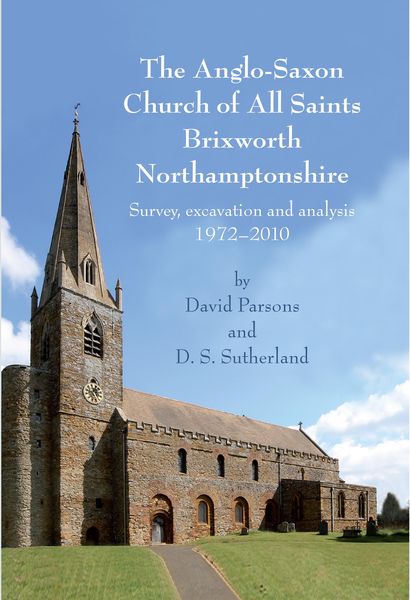
Anglo-Saxon Church of All Saints, Brixworth, Northamptonshire Survey, Excavation and Analysis, 1972-2010
-
- Einzelkauf Download ausgewählt
-
Sprache:Englisch
-
eBook Format:ePUB
- PDF 66,49 €
- ePUB 66,49 € ausgewählt
66,49 €
inkl. gesetzl. MwSt.Beschreibung
Produktdetails
Format
ePUB
Kopierschutz
Ja
Family Sharing
Ja
Text-to-Speech
Ja
Erscheinungsdatum
31.05.2013
Verlag
Oxbow BooksSeitenzahl
336 (Printausgabe)
Dateigröße
66512 KB
Sprache
Englisch
EAN
9781842179369
All Saints' Church, Brixworth lies 7 miles north of Northampton. The core of the church is Anglo-Saxon and the research published here provides an unprecedented account of one of the most important buildings of its period surviving in England. The building of the main body of the church was towards the end of the 8th century, with a western tower, stair turret and polygonal apse added before the end of the 9th. Major modifications were made during the early and later medieval periods.
From the early 19th century the church attracted much antiquarian interest, especially by topographical draughtsmen, whose drawings are crucial to its understanding before major restoration. Reverend Charles Frederick Watkins (Vicar, 1832-1871) made a particular study of the church fabric and identified both surviving and demolished Anglo-Saxon structures. Restoration under his direction reversed most of the medieval changes he recognised within the standing fabric, leaving the church with much the same appearance as it has today.
The Brixworth Archaeological Research Committee, founded in 1972, embarked on an in-depth archaeological and historical study of All Saints'. Limited excavation revealed evidence for the former extent of the cemetery and examined remains of the early structures to the north of the church, including one whose foundations cut a ditch containing 8th-century material. The later 8th-century date for the foundation of the church was confirmed by radiocarbon dates from charcoal extracted from construction mortar in the church fabric. A complete stone-by-stone survey of the standing fabric, accompanied by petrological identifications, has led to a refined appraisal of the construction sequence and the identification of 'exotic' stone types and Roman bricks reused from earlier buildings up to 40 km distant.
The archaeological, geological and laboratory findings presented here have been amplified by contextual studies placing the church against its archaeological, architectural, liturgical and historical background, with detailed comparisons with standing and excavated buildings of similar age in north Europe and Italy.
From the early 19th century the church attracted much antiquarian interest, especially by topographical draughtsmen, whose drawings are crucial to its understanding before major restoration. Reverend Charles Frederick Watkins (Vicar, 1832-1871) made a particular study of the church fabric and identified both surviving and demolished Anglo-Saxon structures. Restoration under his direction reversed most of the medieval changes he recognised within the standing fabric, leaving the church with much the same appearance as it has today.
The Brixworth Archaeological Research Committee, founded in 1972, embarked on an in-depth archaeological and historical study of All Saints'. Limited excavation revealed evidence for the former extent of the cemetery and examined remains of the early structures to the north of the church, including one whose foundations cut a ditch containing 8th-century material. The later 8th-century date for the foundation of the church was confirmed by radiocarbon dates from charcoal extracted from construction mortar in the church fabric. A complete stone-by-stone survey of the standing fabric, accompanied by petrological identifications, has led to a refined appraisal of the construction sequence and the identification of 'exotic' stone types and Roman bricks reused from earlier buildings up to 40 km distant.
The archaeological, geological and laboratory findings presented here have been amplified by contextual studies placing the church against its archaeological, architectural, liturgical and historical background, with detailed comparisons with standing and excavated buildings of similar age in north Europe and Italy.
Kundinnen und Kunden meinen
Verfassen Sie die erste Bewertung zu diesem Artikel
Helfen Sie anderen Kund*innen durch Ihre Meinung
Kurze Frage zu unserer Seite
Vielen Dank für Ihr Feedback
Wir nutzen Ihr Feedback, um unsere Produktseiten zu verbessern. Bitte haben Sie Verständnis, dass wir Ihnen keine Rückmeldung geben können. Falls Sie Kontakt mit uns aufnehmen möchten, können Sie sich aber gerne an unseren Kund*innenservice wenden.
zum Kundenservice