• Produktbild: Alien Gene Transfer in Crop Plants, Volume 2
  • Produktbild: Alien Gene Transfer in Crop Plants, Volume 2

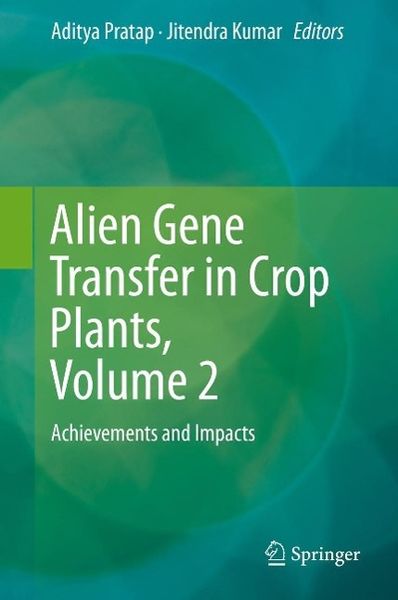
Alien Gene Transfer in Crop Plants, Volume 2 Achievements and Impacts

106,99 €

inkl. gesetzl. MwSt.

Beschreibung

Produktdetails

Format

PDF

Kopierschutz

Nein

Family Sharing

Nein

Text-to-Speech

Nein

Erscheinungsdatum

03.02.2014

Herausgeber

Aditya Pratap + weitere

Verlag

Springer New York

Seitenzahl

424 (Printausgabe)

Dateigröße

7700 KB

Sprache

Englisch

EAN

9781461495727

Beschreibung

Portrait

Pratap Dr. Aditya Pratap, born on October 18, 1976, is currently working as a Senior Scientist (Plant Breeding) in the Crop Improvement Division, Indian Institute of Pulses Research, Kanpur. He obtained his Master's and Ph.D. degrees in Plant Breeding and Genetics from CSK Himachal Pradesh Agricultural University, Palampur, INDIA in 1999 and 2003. Holding a brilliant academic and service record, he has been associated with crop research since last ten years and has worked on genetic improvement of crop plants including wheat, triticale, rapeseed-mustard, chickpea and Vigna species and has been instrumental in development of haploidy breeding protocol in cereals through chromosome elimination technique. He has been associated with the development and release of five crop varieties including two in rapeseed-mustard (RSPT2 and RSPR03), two in green gram (IPM 02-14 and IPM 02-3) and one in facultative winter wheat (Him Pratham) and registered two extra early maturing greengram genotypes (IPM 205-7 and IPM 409-4) while a few other varieties are in pipeline. His research interests include distant hybridization, doubled haploidy breeding, plant tissue culture, and molecular breeding. To his credit, he has about 100 publications which include research papers published in high impact Journals, technical bulletins, as well as reviews/chapters for best international publishers including Springer, Academic Press, CABI and CRC. He has published three books entitled, "Haploidy breeding in Triticale and triticale x wheat hybrids: Comparison of Anther Culture and Chromosome Elimination Techniques" by Lambert Academic Publishing, Germany, "Biology and Breeding of Food Legumes" published by CAB International, Oxfordshire, UK, and "Alien Gene Transfer in Crop Plants" by Springer NY. He is also a recipient of the prestigious Norman E. Borlaug International Agricultural Science and Technology Fellowship. He is an acknowledged speaker and has several awards to his credit.Kumar Dr. Jitendra Kumar, born in 1973, is presently working as Senior Scientist in the Division of Crop Improvement at Indian Institute of Pluses research, Kanpur. He has an excellent research career throughout. He secured Gold Medal during masters programme and pursued his Ph.D. in Genetics & Plant Breeding from G. B. Pant University of Agriculture & Technology, Pantnagar, India. He was awarded CSIR-Research Associateship during 2003-2005 for postdoctoral studies at the Institute of Integrative Medicine, Jammu (India). He has more than 12 years research experience in genetic improvement using both conventional and molecular marker assisted breeding approaches on various crops including medicinal and aromatic, cereal and pulse crops. During this period, he undertook study tours in Austria, Syria and Bangladesh. His research interests include conventional and molecular breeding, QTL analysis and marker assisted selection for crop improvement. He has about 80 publications including research articles in reputed national and international journals, reviews, book chapters, popular articles, meeting reports, bulletins, etc. He has also co-edited two books entitled, "Biology and Breeding of Food Legumes" published by CAB International, Oxfordshire, UK, and "Alien Gene Transfer in Crop Plants" by Springer NY. He has been associated with development of a high yielding variety (IPL 316) of lentil and several others are in pipeline. His current priorities include involvement of molecular marker technology in conventional lentil breeding programme for making genetic improvement towards the biotic and abiotic stresses.

Produktdetails

Format

PDF

eBooks im PDF-Format haben eine festgelegte Seitengröße und eignen sich daher nur bedingt zum Lesen auf einem tolino eReader oder Smartphone. Für den vollen Lesegenuss empfehlen wir Ihnen bei PDF-eBooks die Verwendung eines Tablets oder Computers.

Kopierschutz

Nein

Dieses eBook können Sie uneingeschränkt auf allen Geräten der tolino Familie, allen sonstigen eReadern und am PC lesen. Das eBook ist nicht kopiergeschützt und kann ein personalisiertes Wasserzeichen enthalten. Weitere Hinweise zum Lesen von eBooks mit einem personalisierten Wasserzeichen finden Sie unter Hilfe/Downloads.

Family Sharing

Nein

Mit Family Sharing können Sie eBooks innerhalb Ihrer Familie (max. sechs Mitglieder im gleichen Haushalt) teilen. Sie entscheiden selbst, welches Buch Sie mit welchem Familienmitglied teilen möchten. Auch das parallele Lesen durch verschiedene Familienmitglieder ist durch Family Sharing möglich. Um eBooks zu teilen oder geteilt zu bekommen, muss jedes Familienmitglied ein Konto bei Thalia oder einem anderen tolino-Buchhändler haben. Weitere Informationen finden Sie unter Hilfe/Family-Sharing.

Text-to-Speech

Nein

Bedeutet Ihnen Stimme mehr als Text? Mit der Funktion Text-to-Speech können Sie sich im tolino webReader und in der aktuellen Thalia – Lesen & Hören App das eBook vorlesen lassen. Weitere Informationen finden Sie unter Hilfe/Text-to-Speech.

Barrierefreiheit

  • keine Information zur Barrierefreiheit bekannt

Erscheinungsdatum

03.02.2014

Herausgeber

Verlag

Springer New York

Seitenzahl

424 (Printausgabe)

Dateigröße

7700 KB

Sprache

Englisch

EAN

9781461495727

Noch keine Bewertungen vorhanden

Verfassen Sie die erste Bewertung zu diesem Artikel

Helfen Sie anderen Kundinnen und Kunden durch Ihre Meinung.

Kundinnen und Kunden meinen

Bewertungen (0)

Weitere Artikel finden Sie in

  • Produktbild: Alien Gene Transfer in Crop Plants, Volume 2
  • Produktbild: Alien Gene Transfer in Crop Plants, Volume 2
  • Wheat.- Maize.- Oat.- Pearl Millet.- Barley.- Chickpea.- Pigeonpea.- Vigna.- Lentil.- Brassica.- Oil Palm and Coconut.- Groundnut.- Sunflower.- Sugarcane.- Tomato.- Eggplant.