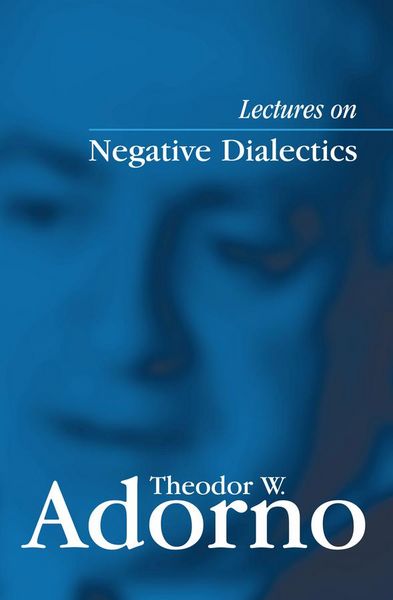
Lectures on Negative Dialectics Fragments of a Lecture Course 1965/1966
-
- Hardcover
- Taschenbuch
- eBook ausgewählt
-
Form:Einzelkauf Download
-
Sprache:Englisch
-
eBook Format:ePUB 3
- ePUB 3 19,99 € ausgewählt
- PDF 19,99 €
19,99 €
inkl. gesetzl. MwSt.Beschreibung
Produktdetails
Format
ePUB 3
Kopierschutz
Ja
Family Sharing
Nein
Text-to-Speech
Ja
Erscheinungsdatum
05.11.2014
Verlag
John Wiley & SonsSeitenzahl
(Printausgabe)
Dateigröße
711 KB
Auflage
1. Auflage
Sprache
Englisch
EAN
9780745694573
This volume comprises one of the key lecture courses leading up to
the publication in 1966 of Adorno's major work, Negative
Dialectics. These lectures focus on developing the concepts
critical to the introductory section of that book. They show Adorno
as an embattled philosopher defining his own methodology among the
prevailing trends of the time. As a critical theorist, he
repudiated the worn-out Marxist stereotypes still dominant in the
Soviet bloc - he specifically addresses his remarks to
students who had escaped from the East in the period leading up to
the building of the Berlin Wall in 1961. Influenced as he was by
the empirical schools of thought he had encountered in the United
States, he nevertheless continued to resist what he saw as their
surrender to scientific and mathematical abstraction. However,
their influence was potent enough to prevent him from reverting to
the traditional idealisms still prevalent in Germany, or to their
latest manifestations in the shape of the new ontology of Heidegger
and his disciples. Instead, he attempts to define, perhaps more
simply and fully than in the final published version, a
'negative', i.e. critical, approach to philosophy. Permeating
the whole book is Adorno's sense of the overwhelming power of
totalizing, dominating systems in the post-Auschwitz world.
Intellectual negativity, therefore, commits him to the stubborn
defence of individuals - both facts and people - who
stubbornly refuse to become integrated into 'the administered
world'.
These lectures reveal Adorno to be a lively and engaging
lecturer. He makes serious demands on his listeners but always
manages to enliven his arguments with observations on philosophers
and writers such as Proust and Brecht and comments on current
events. Heavy intellectual artillery is combined with a concern for
his students' progress.
the publication in 1966 of Adorno's major work, Negative
Dialectics. These lectures focus on developing the concepts
critical to the introductory section of that book. They show Adorno
as an embattled philosopher defining his own methodology among the
prevailing trends of the time. As a critical theorist, he
repudiated the worn-out Marxist stereotypes still dominant in the
Soviet bloc - he specifically addresses his remarks to
students who had escaped from the East in the period leading up to
the building of the Berlin Wall in 1961. Influenced as he was by
the empirical schools of thought he had encountered in the United
States, he nevertheless continued to resist what he saw as their
surrender to scientific and mathematical abstraction. However,
their influence was potent enough to prevent him from reverting to
the traditional idealisms still prevalent in Germany, or to their
latest manifestations in the shape of the new ontology of Heidegger
and his disciples. Instead, he attempts to define, perhaps more
simply and fully than in the final published version, a
'negative', i.e. critical, approach to philosophy. Permeating
the whole book is Adorno's sense of the overwhelming power of
totalizing, dominating systems in the post-Auschwitz world.
Intellectual negativity, therefore, commits him to the stubborn
defence of individuals - both facts and people - who
stubbornly refuse to become integrated into 'the administered
world'.
These lectures reveal Adorno to be a lively and engaging
lecturer. He makes serious demands on his listeners but always
manages to enliven his arguments with observations on philosophers
and writers such as Proust and Brecht and comments on current
events. Heavy intellectual artillery is combined with a concern for
his students' progress.
Noch keine Bewertungen vorhanden
Verfassen Sie die erste Bewertung zu diesem Artikel
Helfen Sie anderen Kundinnen und Kunden durch Ihre Meinung.
Kurze Frage zu unserer Seite
Vielen Dank für Ihr Feedback
Wir nutzen Ihr Feedback, um unsere Produktseiten zu verbessern. Bitte haben Sie Verständnis, dass wir Ihnen keine Rückmeldung geben können. Falls Sie Kontakt mit uns aufnehmen möchten, können Sie sich aber gerne an unseren Kund*innenservice wenden.
zum Kundenservice