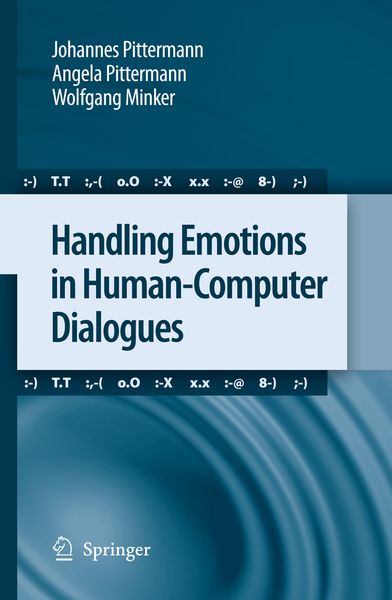
Handling Emotions in Human-Computer Dialogues
-
- Hardcover
- Taschenbuch ausgewählt
-
Sprache:Englisch
93,99 €
UVP
106,99 €
inkl. gesetzl. MwSt.,
Beschreibung
Produktdetails
Einband
Taschenbuch
Erscheinungsdatum
16.11.2014
Verlag
Springer NetherlandSeitenzahl
276
Maße (L/B/H)
23,5/15,5/1,6 cm
Gewicht
441 g
Auflage
2010
Sprache
Englisch
ISBN
978-94-007-9170-1
In this book, a novel approach that combines speech-based emotion recognition with adaptive human-computer dialogue modeling is described. With the robust recognition of emotions from speech signals as their goal, the authors analyze the effectiveness of using a plain emotion recognizer, a speech-emotion recognizer combining speech and emotion recognition, and multiple speech-emotion recognizers at the same time. The semi-stochastic dialogue model employed relates user emotion management to the corresponding dialogue interaction history and allows the device to adapt itself to the context, including altering the stylistic realization of its speech. This comprehensive volume begins by introducing spoken language dialogue systems and providing an overview of human emotions, theories, categorization and emotional speech. It moves on to cover the adaptive semi-stochastic dialogue model and the basic concepts of speech-emotion recognition. Finally, the authors show how speech-emotion recognizers can be optimized, and how an adaptive dialogue manager can be implemented. The book, with its novel methods to perform robust speech-based emotion recognition at low complexity, will be of interest to a variety of readers involved in human-computer interaction.
Noch keine Bewertungen vorhanden
Verfassen Sie die erste Bewertung zu diesem Artikel
Helfen Sie anderen Kundinnen und Kunden durch Ihre Meinung.
Kurze Frage zu unserer Seite
Vielen Dank für Ihr Feedback
Wir nutzen Ihr Feedback, um unsere Produktseiten zu verbessern. Bitte haben Sie Verständnis, dass wir Ihnen keine Rückmeldung geben können. Falls Sie Kontakt mit uns aufnehmen möchten, können Sie sich aber gerne an unseren Kund*innenservice wenden.
zum Kundenservice