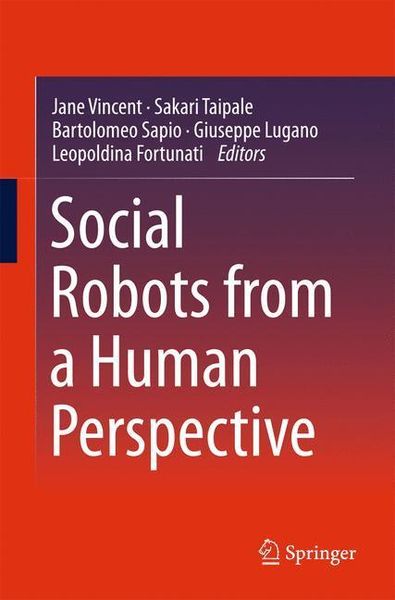
• Produktbild: Social Robots from a Human Perspective
  • Produktbild: Social Robots from a Human Perspective

Social Robots from a Human Perspective

98,99 €

inkl. gesetzl. MwSt., Versandkostenfrei


Beschreibung

Produktdetails

Einband

Taschenbuch

Erscheinungsdatum

27.05.2015

Abbildungen

XIII, 12 illus., schwarz-weiss Illustrationen

Herausgeber

Jane Vincent + weitere

Verlag

Springer

Seitenzahl

144

Maße (L/B/H)

23,5/15,5/0,9 cm

Gewicht

254 g

Auflage

2015

Sprache

Englisch

ISBN

978-3-319-15671-2

Beschreibung

Portrait

Jane Vincent, Ph.D., Jane Vincent is Senior Research Fellow at the LSE Media and Communications Department and Visiting Fellow with the Digital World Research Centre at the University of Surrey. She researches the social practices of mobile communications and ICT users. Her studies for industry and international academic organizations on the social shaping of technology, children’s and older peoples’ use of mobile phones are published widely and Jane’s work on emotions and mobile phones is published in English, German and Russian.

Sakari Taipale, Ph.D., is an Academy of Finland Research Fellow at the University of Jyväskylä, Finland. He is also an Adjunct Professor at the University of Eastern Finland. Presently, he is running a five-year research project on intergenerational relations in the digital societies. Taipale has published on the social aspects of new media technologies and mobilities in many high-ranked academic journals, such as British Journal of Sociology, New Media and Society, Information, Communication and Society, Social Science Research, Telecommunications Policy, European Journal of Communication, and Mobilities. He has also edited one book with Prof. Juho Saari and Dr. Sakari Kainulainen. Regarding robot research, Taipale has studied the Eurobarometer 382 “Public Attitudes towards Robots” data collected in 2012 and lectured on social robotics at international academic events.

Bartolomeo Sapio, Ph.D., holds a Doctor Laurea Degree in Electronic Engineering summa cum laude at the University of Rome “La Sapienza”. He is a senior researcher and project manager with Fondazione Ugo Bordon participating in several international projects. He has carried out methodological research in the field of scenario analysis, developing the original methods WISE, SEARCH and GIMMICKS, and applying them to multimedia, broadband networks, the Internet, mobile services and the convergence between fixed and mobile networks. He designedand implemented SIMULAB (Scenario-engineering Interactive Multimedia LABoratory), an advanced work environment to carry out research activities in the field of Scenario Engineering. He was Chairman of COST (COoperation in the field of Scientific and Technical research) Action 298 “Participation in the Broadband Society”, and a member in the Management Committees of COST Action IS0605 “A Telecommunications Economics COST Network – Econ@Tel” and COST Action A22 “Foresight methodologies – Exploring new ways to explore the future”, where he chaired the Working Group “Integrating Narratives and Numbers”. He is currently the coordinator of an EU-funded project carried out within the Seventh Framework Programme: CUMULUS (Certification infrastrUcture for MUlti-Layer cloUd Services).

Leopoldina Fortunati, Ph.D., is professor of Sociology of Communication at the Faculty of Education of the University of Udine. She has conducted several research projects in the field of gender studies, cultural processes and communication and information technologies. She is the author and editor of many books, is associate editor of the journal The Information Society and serves as referee for many outstanding journals. She is active at European level especially in COST networks and is the Italian representative in the COST Domain Committee (ISCH, Individuals, Societies, Cultures and Health). She is the co-chair with Richard Ling of the International Association "The Society for the Social Study of Mobile Communication" (SSSMC). Her works have been published in eleven languages: Bulgarian, Chinese, English, French, German, Italian, Japanese, Korean, Russian, Slovenian, and Spanish.

Giuseppe Lugano, Ph.D., works in Brussels as Science Officer for COST, the longest-running European framework for cooperation in science and technology. He holds a MSc degree in Computer Science and a PhD in Cognitive Science. His publications and research interests deal with theconceptual design of technologies and services for community and sustainable living.

Produktdetails

Einband

Taschenbuch

Erscheinungsdatum

27.05.2015

Abbildungen

XIII, 12 illus., schwarz-weiss Illustrationen

Herausgeber

Verlag

Springer

Seitenzahl

144

Maße (L/B/H)

23,5/15,5/0,9 cm

Gewicht

254 g

Auflage

2015

Sprache

Englisch

ISBN

978-3-319-15671-2

Herstelleradresse

Springer-Verlag KG
Sachsenplatz 4-6
1201 Wien
AT

Email: ProductSafety@springernature.com

Kundinnen und Kunden meinen

0 Bewertungen

Informationen zu Bewertungen

Zur Abgabe einer Bewertung ist eine Anmeldung im Konto notwendig. Die Authentizität der Bewertungen wird von uns nicht überprüft. Wir behalten uns vor, Bewertungstexte, die unseren Richtlinien widersprechen, entsprechend zu kürzen oder zu löschen.

Die Bewertungen sind nach Format, Anzahl Sterne und Datum sortiert.

Verfassen Sie die erste Bewertung zu diesem Artikel

Helfen Sie anderen Kund*innen durch Ihre Meinung

Kundinnen und Kunden meinen

0 Bewertungen filtern

Die Leseprobe wird geladen.
  • Produktbild: Social Robots from a Human Perspective
  • Produktbild: Social Robots from a Human Perspective
  • Introduction: Situating the Human in Social Robots.- Robot Shift from Industrial Production to Social Reproduction.- In the Company of Robots: Views of Acceptability of Robots in Social Settings.- Perception, Acceptance and the Social Construction of Robots - Exploratory Studies.- Social Robotics in Health Care Service: The Case of Rehabilitation Programmes in Hong Kong.- Intuitive Interaction between Humans and Robots in Work Functions at Industrial Environments: The Role of Social Robotics.- Minimizing the Human? Functional Reductions of Complexity in Social Robotics and their Cybernetic Heritage.- Open Sourcing Social Robotics: Humanoid Artifacts from the Viewpoint of Designers.- The Mobile Phone: An Emotionalised Social Robot.- The Technologicalization of Education in China: A Case Study of the Home-School Communication System.- Fashion Tech and Robotics.- Conclusions.