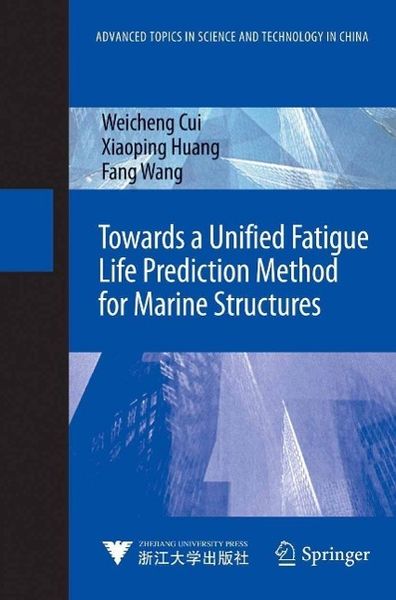
Towards a Unified Fatigue Life Prediction Method for Marine Structures
-
- Hardcover
- Taschenbuch
- eBook ausgewählt
-
Form:Einzelkauf Download
-
Sprache:Englisch
149,79 €
inkl. gesetzl. MwSt.Beschreibung
Produktdetails
Format
Kopierschutz
Nein
Family Sharing
Nein
Text-to-Speech
Nein
Erscheinungsdatum
04.11.2014
Verlag
SpringerSeitenzahl
281 (Printausgabe)
Dateigröße
13884 KB
Auflage
2015
Sprache
Englisch
EAN
9783642418310
In order to apply the damage tolerance design philosophy to design marine structures, accurate prediction of fatigue crack growth under service conditions is required. Now, more and more people have realized that only a fatigue life prediction method based on fatigue crack propagation (FCP) theory has the potential to explain various fatigue phenomena observed. In this book, the issues leading towards the development of a unified fatigue life prediction (UFLP) method based on FCP theory are addressed. Based on the philosophy of the UFLP method, the current inconsistency between fatigue design and inspection of marine structures could be resolved.
This book presents the state-of-the-art and recent advances, including those by the authors, in fatigue studies. It is designed to lead the future directions and to provide a useful tool in many practical applications. It is intended to address to engineers, naval architects, research staff, professionals and graduates engaged in fatigue prevention design and survey of marine structures, in fatigue studies of materials and structures, in experimental laboratory research, in planning the repair and maintenance of existing structures, and in rule development. The book is also an effective educational aid in naval architecture, marine, civil and mechanical engineering.
Prof. Weicheng Cui is the Dean of Hadal Science and Technology Research Center of Shanghai Ocean University, China. Dr. Xiaoping Huang is an associate professor of School of Naval Architecture, Ocean and Civil Engineering of Shanghai Jiao Tong University, China. Dr. Fang Wang is an associate professor of Hadal Science and Technology Research Center of Shanghai Ocean University, China.
Noch keine Bewertungen vorhanden
Verfassen Sie die erste Bewertung zu diesem Artikel
Helfen Sie anderen Kundinnen und Kunden durch Ihre Meinung.
Kurze Frage zu unserer Seite
Vielen Dank für Ihr Feedback
Wir nutzen Ihr Feedback, um unsere Produktseiten zu verbessern. Bitte haben Sie Verständnis, dass wir Ihnen keine Rückmeldung geben können. Falls Sie Kontakt mit uns aufnehmen möchten, können Sie sich aber gerne an unseren Kund*innenservice wenden.
zum Kundenservice