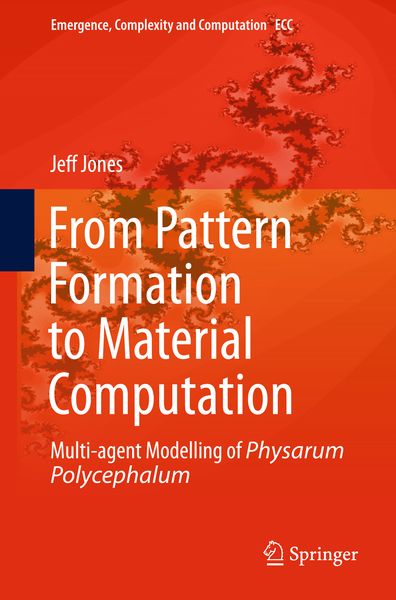
From Pattern Formation to Material Computation Multi-agent Modelling of Physarum Polycephalum
-
- Hardcover ausgewählt
- Taschenbuch
- eBook
-
Sprache:Englisch
129,99 €
UVP
149,79 €
inkl. gesetzl. MwSt.,
Beschreibung
Produktdetails
Einband
Gebundene Ausgabe
Erscheinungsdatum
01.06.2015
Abbildungen
XVI, 209 illus., 145 illus. in color., farbige Illustrationen, schwarz-weiss Illustrationen
Verlag
SpringerSeitenzahl
370
Maße (L/B/H)
24,1/16/2,7 cm
Gewicht
7037 g
Auflage
2015
Sprache
Englisch
ISBN
978-3-319-16822-7
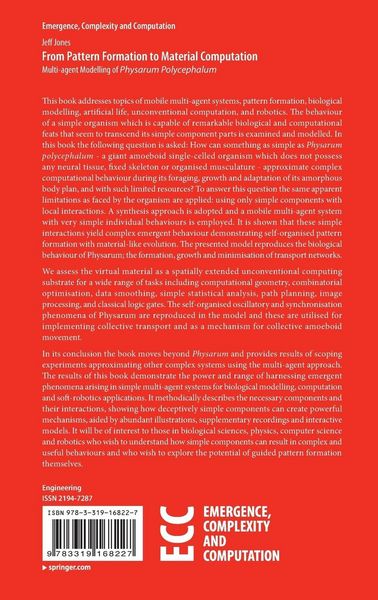
This book addresses topics of mobile multi-agent systems, pattern formation, biological modelling, artificial life, unconventional computation, and robotics. The behaviour of a simple organism which is capable of remarkable biological and computational feats that seem to transcend its simple component parts is examined and modelled. In this book the following question is asked: How can something as simple as Physarum polycephalum - a giant amoeboid single-celled organism which does not possess any neural tissue, fixed skeleton or organised musculature - can approximate complex computational behaviour during its foraging, growth and adaptation of its amorphous body plan, and with such limited resources? To answer this question the same apparent limitations as faced by the organism are applied: using only simple components with local interactions. A synthesis approach is adopted and a mobile multi-agent system with very simple individual behaviours is employed. It is shown their interactions yield emergent behaviour showing complex self-organised pattern formation with material-like evolution. The presented model reproduces the biological behaviour of Physarum; the formation, growth and minimisation of transport networks.
In its conclusion the book moves beyond Physarum and provides results of scoping experiments approximating other complex systems using the multi-agent approach. The results of this book demonstrate the power and range of harnessing emergent phenomena arising in simple multi-agent systems for biological modelling, computation and soft-robotics applications. It methodically describes the necessary components and their interactions, showing how deceptively simple components can create powerful mechanisms, aided by abundant illustrations, supplementary recordings and interactive models. It will be of interest to those in biological sciences, physics, computer science and robotics who wish to understand how simple components can result in complex and useful behaviours and who wish explore the potential of guided pattern formation themselves.
Noch keine Bewertungen vorhanden
Verfassen Sie die erste Bewertung zu diesem Artikel
Helfen Sie anderen Kundinnen und Kunden durch Ihre Meinung.
Kurze Frage zu unserer Seite
Vielen Dank für Ihr Feedback
Wir nutzen Ihr Feedback, um unsere Produktseiten zu verbessern. Bitte haben Sie Verständnis, dass wir Ihnen keine Rückmeldung geben können. Falls Sie Kontakt mit uns aufnehmen möchten, können Sie sich aber gerne an unseren Kund*innenservice wenden.
zum Kundenservice