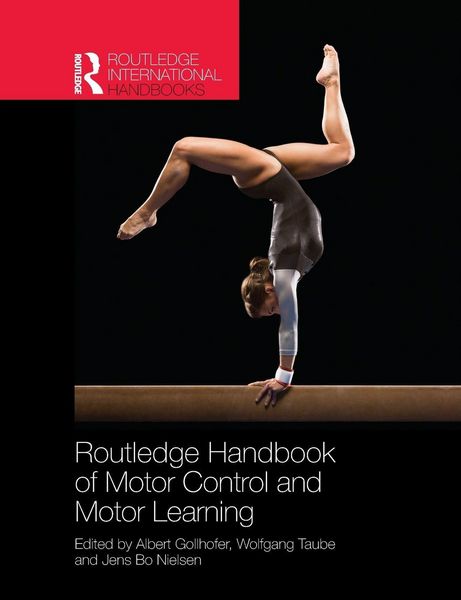
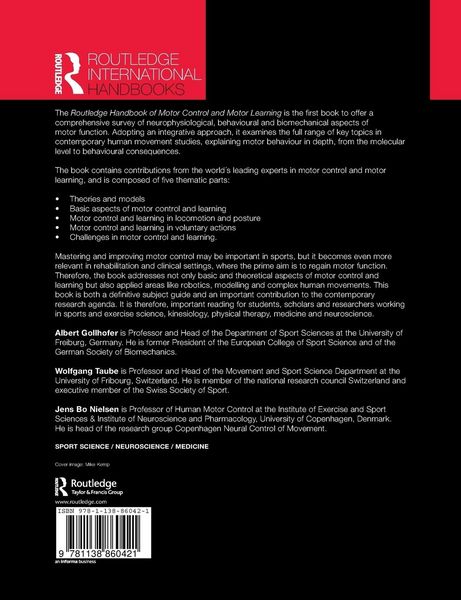
• Produktbild: Routledge Handbook of Motor Control and Motor Learning
  • Produktbild: Routledge Handbook of Motor Control and Motor Learning

Routledge Handbook of Motor Control and Motor Learning

107,99 €

inkl. gesetzl. MwSt., Versandkostenfrei


Beschreibung

Produktdetails

Einband

Taschenbuch

Erscheinungsdatum

04.03.2015

Herausgeber

Gollhofer Albert + weitere

Verlag

Taylor and Francis

Seitenzahl

432

Maße (L/B/H)

24,6/18,9/2,3 cm

Gewicht

800 g

Sprache

Englisch

ISBN

978-1-138-86042-1

Beschreibung

Produktdetails

Einband

Taschenbuch

Erscheinungsdatum

04.03.2015

Herausgeber

Verlag

Taylor and Francis

Seitenzahl

432

Maße (L/B/H)

24,6/18,9/2,3 cm

Gewicht

800 g

Sprache

Englisch

ISBN

978-1-138-86042-1

Herstelleradresse

Libri GmbH
Europaallee 1
36244 Bad Hersfeld
DE

Email: gpsr@libri.de

Kundinnen und Kunden meinen

0 Bewertungen

Informationen zu Bewertungen

Zur Abgabe einer Bewertung ist eine Anmeldung im Konto notwendig. Die Authentizität der Bewertungen wird von uns nicht überprüft. Wir behalten uns vor, Bewertungstexte, die unseren Richtlinien widersprechen, entsprechend zu kürzen oder zu löschen.

Die Bewertungen sind nach Format, Anzahl Sterne und Datum sortiert.

Verfassen Sie die erste Bewertung zu diesem Artikel

Helfen Sie anderen Kund*innen durch Ihre Meinung

Kundinnen und Kunden meinen

0 Bewertungen filtern

Die Leseprobe wird geladen.
  • Produktbild: Routledge Handbook of Motor Control and Motor Learning
  • Produktbild: Routledge Handbook of Motor Control and Motor Learning
  • Section 1: Theories and Models 1. Theoretical Models of Motor Control and Motor Learning 2. What Can We Learn from Animal Models 3. Postural Control by Disturbance Estimation and Compensation Through Long-Loop Responses 4. Motor Learning Explored with Myoelectric and Neural Interfaces 5. Biomechanical and Neuromechanical Concepts for Legged Locomotion: Computer models and robot validation Section 2: Basic Aspects of Motor Control and Learning 6. Visual Activation of Short Latency Reinforcement Mechanisms in the Basal Ganglia 7. The Role of Augmented Feedback in Human Motor Learning 8. Neuroscientific Aspects of Implicit Motor Learning in Sport 9. Mirror Neurons and Imitation Section 3: Motor Control and Learning in Locomotion and Posture 10. Neural Control of Walking 11. Adaptive Plasticity of Gait 12. Motor Control and Motor Learning in Stretch-Shortening Cycle Movements 13. Postural Control and Balance Training Section 4: Motor Control and Learning in Voluntary Actions 14. Body Schema, Illusions of Movement and Body Perception 15. Voluntary Movement: Limitations and consequences of the anatomy and physiology of motor pathways 16. Acute and Long-Term Neural Adaptations to Training Section 5: Challenges in Motor Control and Learning 17. Motor Control and Motor Learning under Fatigue Conditions 18. Movement Disorders: Implications for the understanding of motor control