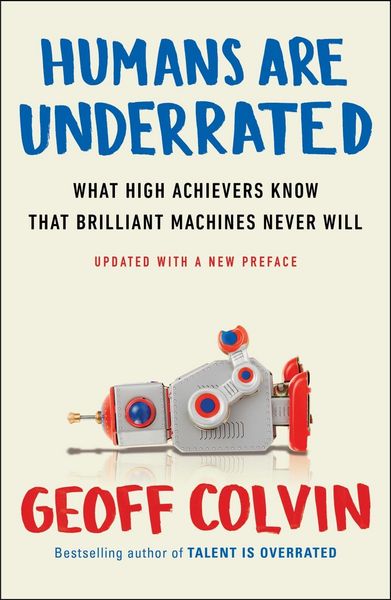
Humans Are Underrated What High Achievers Know That Brilliant Machines Never Will
-
- Taschenbuch
- eBook ausgewählt
-
Form:Einzelkauf Download
-
Sprache:Englisch
-
eBook Format:ePUB 3
- ePUB 3 9,99 € ausgewählt
- ePUB 3,99 €
9,99 €
inkl. gesetzl. MwSt.Beschreibung
Produktdetails
Format
ePUB 3
Kopierschutz
Ja
Family Sharing
Ja
Text-to-Speech
Ja
Erscheinungsdatum
04.08.2015
Verlag
Penguin Publishing GroupSeitenzahl
272 (Printausgabe)
Dateigröße
748 KB
Sprache
Englisch
EAN
9780698153653
As technology races ahead, what will people do better than computers? What hope will there be for us when computers can drive cars better than humans, predict Supreme Court decisions better than legal experts, identify faces, scurry helpfully around offices and factories, even perform some surgeries, all faster, more reliably, and less expensively than people? It's easy to imagine a nightmare scenario in which computers simply take over most of the tasks that people now get paid to do. While we'll still need high-level decision makers and computer developers, those tasks won't keep most working-age people employed or allow their living standard to rise. The unavoidable question-will millions of people lose out, unable to best the machine?-is increasingly dominating business, education, economics, and policy. The bestselling author of Talent Is Overrated explains how the skills the economy values are changing in historic ways. The abilities that will prove most essential to our success are no longer the technical, classroom-taught left-brain skills that economic advances have demanded from workers in the past. Instead, our greatest advantage lies in what we humans are most powerfully driven to do for and with one another, arising from our deepest, most essentially human abilities-empathy, creativity, social sensitivity, storytelling, humor, building relationships, and expressing ourselves with greater power than logic can ever achieve. This is how we create durable value that is not easily replicated by technology-because we're hardwired to want it from humans. These high-value skills create tremendous competitive advantage-more devoted customers, stronger cultures, breakthrough ideas, and more effective teams. And while many of us regard these abilities as innate traits-"he's a real people person," "she's naturally creative"-it turns out they can all be developed. They're already being developed in a range of far-sighted organizations, such as: • the Cleveland Clinic, which emphasizes empathy training of doctors and all employees to improve patient outcomes and lower medical costs; • the U.S. Army, which has revolutionized its training to focus on human interaction, leading to stronger teams and greater success in real-world missions; • Stanford Business School, which has overhauled its curriculum to teach interpersonal skills through human-to-human experiences. As technology advances, we shouldn't focus on beating computers at what they do-we'll lose that contest. Instead, we must develop our most essential human abilities and teach our kids to value not just technology but also the richness of interpersonal experience. They will be the most valuable people in our world because of it. Colvin proves that to a far greater degree than most of us ever imagined, we already have what it takes to be great.
Kundinnen und Kunden meinen
Verfassen Sie die erste Bewertung zu diesem Artikel
Helfen Sie anderen Kund*innen durch Ihre Meinung
Kurze Frage zu unserer Seite
Vielen Dank für Ihr Feedback
Wir nutzen Ihr Feedback, um unsere Produktseiten zu verbessern. Bitte haben Sie Verständnis, dass wir Ihnen keine Rückmeldung geben können. Falls Sie Kontakt mit uns aufnehmen möchten, können Sie sich aber gerne an unseren Kund*innenservice wenden.
zum Kundenservice