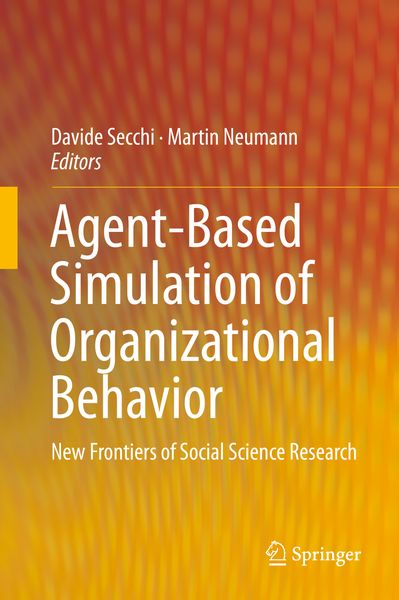
Agent-Based Simulation of Organizational Behavior New Frontiers of Social Science Research
-
- Hardcover ausgewählt
- Taschenbuch
- eBook
-
Sprache:Englisch
95,99 €
UVP
106,99 €
inkl. gesetzl. MwSt.,
Beschreibung
Produktdetails
Einband
Gebundene Ausgabe
Erscheinungsdatum
11.09.2015
Herausgeber
Davide Secchi + weitereVerlag
SpringerSeitenzahl
348
Maße (L/B/H)
24,1/16/2,4 cm
Gewicht
764 g
Auflage
1st edition 2016
Sprache
Englisch
ISBN
978-3-319-18152-3
The aim of this book is to demonstrate how Agent-Based Modelling (ABM) can be used to enhance the study of social agency, organizational behavior and organizational management. It derives from a workshop, sponsored by the Society for the Study of Artificial Intelligence and the Simulation of Behavior (AISB), held at Bournemouth University Business School in 2014 on “Modelling Organizational Behavior and Social Agency”. The contents of this book are divided into four themes: Perspectives, Modeling Organizational Behavior, Philosophical and Methodological Perspective, and Modeling Organized Crime and Macro-Organizational Phenomena.
ABM is a particular and advanced type of computer simulation where the focus of modeling shifts to the agent rather than to the system. This allows for complex and more realistic representations of reality, facilitating an innovative socio-cognitive perspective on organizational studies. The editors and contributing authors claim that the use of ABM may dramatically expand our understanding of human behavior in organizations. This is made possible because of (a) the computational power made available by technological advancements, (b) the relative ease of the programming, (c) the ability to borrow simulation practices from other disciplines, and (d) the ability to demonstrate how the ABM approach clearly enables a socio-cognitive perspective on organizational complexity.
Showcasing contributions from academics and researchers of various backgrounds and discipline, this volumes provides a global, interdisciplinary perspective.
Noch keine Bewertungen vorhanden
Verfassen Sie die erste Bewertung zu diesem Artikel
Helfen Sie anderen Kundinnen und Kunden durch Ihre Meinung.
Kurze Frage zu unserer Seite
Vielen Dank für Ihr Feedback
Wir nutzen Ihr Feedback, um unsere Produktseiten zu verbessern. Bitte haben Sie Verständnis, dass wir Ihnen keine Rückmeldung geben können. Falls Sie Kontakt mit uns aufnehmen möchten, können Sie sich aber gerne an unseren Kund*innenservice wenden.
zum Kundenservice