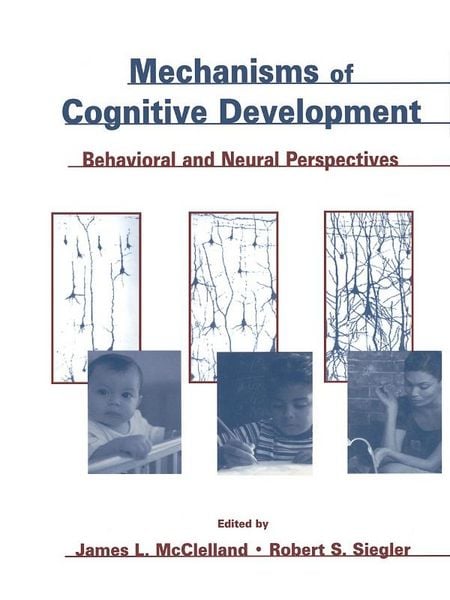
Mechanisms of Cognitive Development Behavioral and Neural Perspectives
-
- Taschenbuch
- eBook ausgewählt
-
Form:Einzelkauf Download
-
Sprache:Englisch
-
eBook Format:PDF
- PDF 92,49 € ausgewählt
- ePUB 92,49 €
92,49 €
inkl. gesetzl. MwSt.Beschreibung
Produktdetails
Format
Kopierschutz
Ja
Family Sharing
Nein
Text-to-Speech
Nein
Erscheinungsdatum
01.03.2001
Herausgeber
James L. Mcclelland + weitereVerlag
Taylor & Francis eBooksSeitenzahl
440 (Printausgabe)
Dateigröße
9517 KB
Sprache
Englisch
EAN
9781135706111
This volume considers how children's thinking evolves during development, with a focus on the role of experience in causing change. It brings together cutting-edge research by leaders in the psychology and neurobiology of child development to examine the processes by which children learn and those that make children ready and able to learn at particular points in development.
Behavioral approaches include research on the "microgenesis" of cognitive change over short time periods (e.g., several hour-long sessions) in specific task situations. Research on cognitive change over longer time scales (months and years) is also presented, as well as research that uses computational modeling and dynamical systems approaches to understand learning and development.
Neural approaches include the study of how neuronal activity and connectivity change during acquisition of cognitive skills in children and adults. Other investigations consider the possible emergence of cognitive abilities through the maturation of brain structures and the effects of experience on the organization of functions in the brain. Developmental anomalies, such as autism and attention deficit disorder are also examined as windows on normal development.
Four questions drive the volume:
*Why do cognitive abilities emerge when they do during development?
*What are the sources of developmental and individual differences, and of developmental anomalies in learning?
*What happens in the brain when people learn?
*How can experiences be ordered and timed to optimize learning?
The answers to these questions have strong implications for how we educate children and remediate deficits that have impeded the development of thinking abilities. These implications are explored in several chapters in the volume, as well as in the commentaries by leading discussants.
Kundinnen und Kunden meinen
Verfassen Sie die erste Bewertung zu diesem Artikel
Helfen Sie anderen Kund*innen durch Ihre Meinung
Kurze Frage zu unserer Seite
Vielen Dank für Ihr Feedback
Wir nutzen Ihr Feedback, um unsere Produktseiten zu verbessern. Bitte haben Sie Verständnis, dass wir Ihnen keine Rückmeldung geben können. Falls Sie Kontakt mit uns aufnehmen möchten, können Sie sich aber gerne an unseren Kund*innenservice wenden.
zum Kundenservice