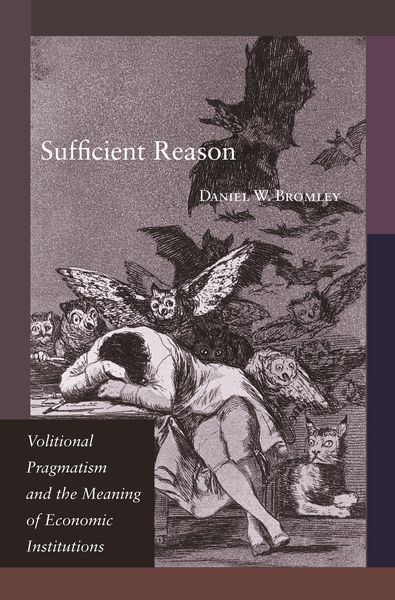
Sufficient Reason
-
- Taschenbuch
- eBook ausgewählt
-
Form:Einzelkauf Download
-
Sprache:Englisch
36,99 €
inkl. gesetzl. MwSt.Beschreibung
Produktdetails
Format
ePUB
Kopierschutz
Ja
Family Sharing
Ja
Text-to-Speech
Ja
Erscheinungsdatum
16.12.2010
Verlag
Princeton University PressSeitenzahl
256 (Printausgabe)
Dateigröße
913 KB
Sprache
Englisch
EAN
9781400832637
In the standard analysis of economic institutions--which include social conventions, the working rules of an economy, and entitlement regimes (property relations)--economists invoke the same theories they use when analyzing individual behavior. In this profoundly innovative book, Daniel Bromley challenges these theories, arguing instead for "volitional pragmatism" as a plausible way of thinking about the evolution of economic institutions. Economies are always in the process of becoming. Here is a theory of how they become.
Bromley argues that standard economic accounts see institutions as mere constraints on otherwise autonomous individual action. Some approaches to institutional economics--particularly the "new" institutional economics--suggest that economic institutions emerge spontaneously from the voluntary interaction of economic agents as they go about pursuing their best advantage. He suggests that this approach misses the central fact that economic institutions are the explicit and intended result of authoritative agents--legislators, judges, administrative officers, heads of states, village leaders--who volitionally decide upon working rules and entitlement regimes whose very purpose is to induce behaviors (and hence plausible outcomes) that constitute the sufficient reasons for the institutional arrangements they create.
Bromley's approach avoids the prescriptive consequentialism of contemporary economics and asks, instead, that we see these emergent and evolving institutions as the reasons for the individual and aggregate behavior their very adoption anticipates. These hoped-for outcomes comprise sufficient reasons for new laws, judicial decrees, and administrative rulings, which then become instrumental to the realization of desired individual behaviors and thus aggregate outcomes.
Kundinnen und Kunden meinen
Verfassen Sie die erste Bewertung zu diesem Artikel
Helfen Sie anderen Kund*innen durch Ihre Meinung
Kurze Frage zu unserer Seite
Vielen Dank für Ihr Feedback
Wir nutzen Ihr Feedback, um unsere Produktseiten zu verbessern. Bitte haben Sie Verständnis, dass wir Ihnen keine Rückmeldung geben können. Falls Sie Kontakt mit uns aufnehmen möchten, können Sie sich aber gerne an unseren Kund*innenservice wenden.
zum Kundenservice