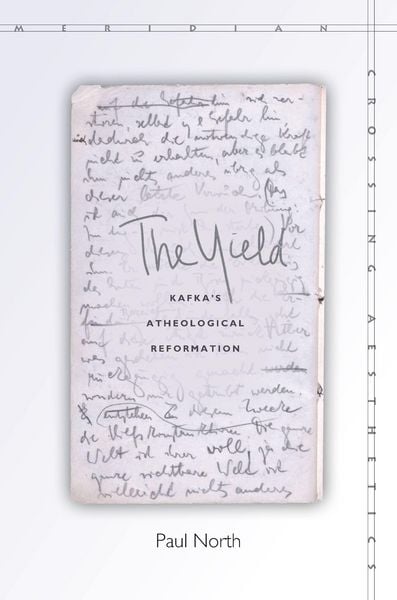
Produktbild: The Yield

The Yield Kafka's Atheological Reformation

29,99 €

inkl. gesetzl. MwSt., Versandkostenfrei


Beschreibung

Produktdetails

Einband

Taschenbuch

Erscheinungsdatum

30.09.2015

Verlag

Stanford University Press

Seitenzahl

400

Maße (L/B/H)

22,8/15,3/2,2 cm

Gewicht

550 g

Sprache

Englisch

ISBN

978-0-8047-9659-0

Beschreibung

Rezension

"Paul North's very rich meditation on Kafka's 'atheological' thought is epoch-making, a fully satisfying rebuttal of the vulgar claim that "we" do not understand Kafka. With an extraordinary lightness of touch, made possible by a wealth of philosophical and literary erudition, North takes us far more deeply into the heart of Kafka's thought than any scholar before him. He demonstrates that Kafka overturns every supposition on which traditional theologies have been built-a demolition that implicates the leading concepts of secular modernity, founded as they are on (the original confusions of!) theology. This book is a marvel of originality, the product of a gaia scienza of thought, as pleasurable to read as it is rewarding to understand."-Stanley Corngold, Princeton University "This is an excellent book and a true gem. It has accomplished what no Kafka critic has ever managed to do completely: to provide a clear, intelligent, and systematic account of the convoluted, contradictory, and counter-intuitive fragments written by Kafka during his Zürau retreat."-Jean-Michel Rabaté, University of Pennsylvania

Produktdetails

Einband

Taschenbuch

Erscheinungsdatum

30.09.2015

Verlag

Stanford University Press

Seitenzahl

400

Maße (L/B/H)

22,8/15,3/2,2 cm

Gewicht

550 g

Sprache

Englisch

ISBN

978-0-8047-9659-0

Herstelleradresse

Libri GmbH
Europaallee 1
36244 Bad Hersfeld
DE

Email: gpsr@libri.de

Kundinnen und Kunden meinen

0 Bewertungen

Informationen zu Bewertungen

Zur Abgabe einer Bewertung ist eine Anmeldung im Konto notwendig. Die Authentizität der Bewertungen wird von uns nicht überprüft. Wir behalten uns vor, Bewertungstexte, die unseren Richtlinien widersprechen, entsprechend zu kürzen oder zu löschen.

Die Bewertungen sind nach Format, Anzahl Sterne und Datum sortiert.

Verfassen Sie die erste Bewertung zu diesem Artikel

Helfen Sie anderen Kund*innen durch Ihre Meinung

Kundinnen und Kunden meinen

0 Bewertungen filtern

Die Leseprobe wird geladen.
  • Produktbild: The Yield


  • Contents and Abstracts


    Introduction: Introduction


    chapter abstract

    The introduction describes the historical and intellectual contexts for the composition of the "thoughts" Kafka wrote in the winter of 1917–18. It offers an analysis of the genre of these texts and locates Kafka's models for it. At a point in history when the category "Jew" had lost a lot of its meaning for those in Kafka's milieu, Kafka turned to the Book of Genesis to construct a new Judaism out of the contradictions in the originary legends. He does this, following the example of Pascal, in the format of "thoughts," though Kafka's aim not to console but to terrify. The thoughts are intricately interconnected such that they have to be read traversely.


    1
    Refutation of What Being Never Was


    chapter abstract

    Unlike Martin Heidegger ten years later, Kafka wants to eradicate "being" from our conceptual vocabulary. This division demonstrates Kafka's arguments for why being is equivalent to "having" in the Western tradition, and the division then gives Kafka's analysis a genealogy, tracing the hidden presence of "having" and "possession" in conceptualizations of being from Aristotle to Kant, paying special attention to the construction of tables of categories. It demonstrates how Kafka exposes the "possessive" undergirding of language and in the concepts of things and of the self.


    2
    Better Weapons Than Faith and Hope


    chapter abstract

    The set of "thoughts" treated in this division exposes the dependence of the sequential, directional time concept on the attitude of faith and proposes various experiments to lead us to drop our concept of time. Antinomies of the garden of Eden and of the messianic idea are presented in order to frustrate faith and lead to a milieu with no time.


    3
    The Problem of Our Art


    chapter abstract

    This division presents Kafka's claim that human beings never die—there is no evidence that they are finite, although this does not mean they are immortal. Kafka imagines a third alternative, an indefinite finitude. Kafka's critique of temporality challenges us to think of ways to live when life means something like "being indefinite," rather than being certainly defined by an ultimate limit, whether the other side is heaven or nothingness. Death is treated as an image, an illusion, and the rest of the chapter describes Kafka's critical techniques for working with images such as the image of death, in order that they lose their hypnotic power over human beings.


    4
    The Yield: On Forgoing Power


    chapter abstract

    This division presents Kafka's critique of the will, with reference to Nietzsche and also briefly to Schopenhauer. On one hand the division describes the ontological basis for a world without power. Kafka's cosmos has no room for any becoming; everything can be no more than it is, and so it cannot use power to become something it is not. On the other hand, for anything to be anything depends on a prior yielding. After a critique of Nietzsche's obsession with struggle and a critique of Heidegger's own critique of the will, the chapter describes Kafka's attempt to articulate how human beings come to yield and what a world of yielding beings looks like.