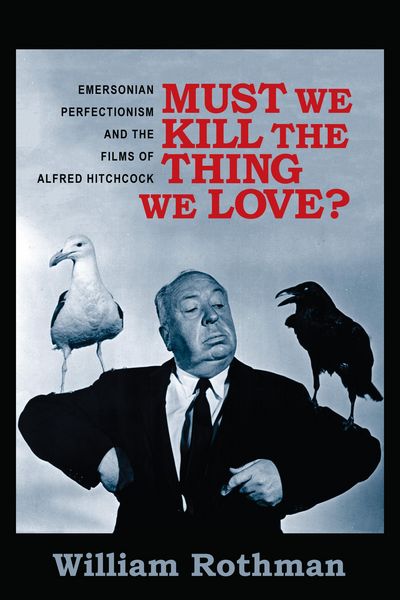
Must We Kill the Thing We Love? Emersonian Perfectionism and the Films of Alfred Hitchcock
-
- Einzelkauf Download ausgewählt
-
Sprache:Englisch
31,49 €
inkl. gesetzl. MwSt.Beschreibung
Produktdetails
Format
Kopierschutz
Nein
Family Sharing
Nein
Text-to-Speech
Nein
Erscheinungsdatum
25.03.2014
Verlag
Columbia University PressSeitenzahl
320 (Printausgabe)
Dateigröße
21422 KB
Sprache
Englisch
EAN
9780231537308
William Rothman argues that the driving force of Hitchcock's work was his struggle to reconcile the dark vision of his favorite Oscar Wilde quote, "Each man kills the thing he loves," with the quintessentially American philosophy, articulated in Emerson's writings, that gave classical Hollywood movies of the New Deal era their extraordinary combination of popularity and artistic seriousness.
A Hitchcock thriller could be a comedy of remarriage or a melodrama of an unknown woman, both Emersonian genres, except for the murderous villain and godlike author, Hitchcock, who pulls the villain's strings-and ours. Because Hitchcock believed that the camera has a murderous aspect, the question "What if anything justifies killing?," which every Hitchcock film engages, was for him a disturbing question about his own art. Tracing the trajectory of Hitchcock's career, Rothman discerns a progression in the films' meditations on murder and artistic creation. This progression culminates in Marnie (1964), Hitchcock's most controversial film, in which Hitchcock overcame his ambivalence and fully embraced the Emersonian worldview he had always also resisted.
Reading key Emerson passages with the degree of attention he accords to Hitchcock sequences, Rothman discovers surprising affinities between Hitchcock's way of thinking cinematically and the philosophical way of thinking Emerson's essays exemplify. He finds that the terms in which Emerson thought about reality, about our "flux of moods," about what it is within us that never changes, about freedom, about America, about reading, about writing, and about thinking are remarkably pertinent to our experience of films and to thinking and writing about them. He also reflects on the implications of this discovery, not only for Hitchcock scholarship but also for film criticism in general.
Noch keine Bewertungen vorhanden
Verfassen Sie die erste Bewertung zu diesem Artikel
Helfen Sie anderen Kundinnen und Kunden durch Ihre Meinung.
Kurze Frage zu unserer Seite
Vielen Dank für Ihr Feedback
Wir nutzen Ihr Feedback, um unsere Produktseiten zu verbessern. Bitte haben Sie Verständnis, dass wir Ihnen keine Rückmeldung geben können. Falls Sie Kontakt mit uns aufnehmen möchten, können Sie sich aber gerne an unseren Kund*innenservice wenden.
zum Kundenservice