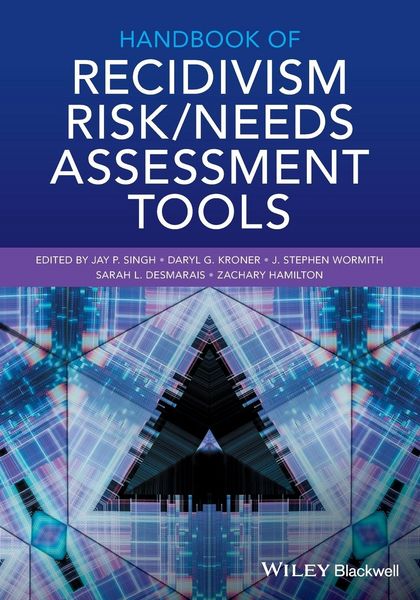
Handbook of Recidivism Risk / Needs Assessment Tools
-
- Taschenbuch ausgewählt
- eBook
-
Sprache:Englisch
68,99 €
inkl. gesetzl. MwSt.,
Beschreibung
Produktdetails
Einband
Taschenbuch
Erscheinungsdatum
02.02.2018
Herausgeber
Jay P. Singh + weitereVerlag
John Wiley & Sons IncSeitenzahl
352
Maße (L/B/H)
25,4/17,8/1,9 cm
Gewicht
648 g
Auflage
1. Auflage
Sprache
Englisch
ISBN
978-1-119-18429-4
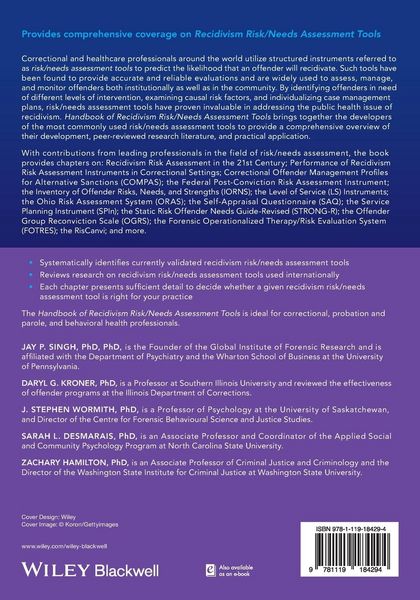
Correctional and healthcare professionals around the world utilize structured instruments referred to as risk/needs assessment tools to predict the likelihood that an offender will recidivate. Such tools have been found to provide accurate and reliable evaluations and are widely used to assess, manage, and monitor offenders both institutionally as well as in the community. By identifying offenders in need of different levels of intervention, examining causal risk factors, and individualizing case management plans, risk/needs assessment tools have proven invaluable in addressing the public health issue of recidivism. Recidivism Risk/Needs Assessment Tools brings together the developers of the most commonly-used risk/needs assessment tools to provide a comprehensive overview of their development, peer-reviewed research literature, and practical application.
Written by the leading professionals in the field of risk/needs assessment, the book provides chapters on: Recidivism Risk Assessment in the 21st Century; Performance of Recidivism Risk Assessment Instruments in Correctional Settings; Correctional Offender Management Profiles for Alternative Sanctions (COMPAS); the Federal Post-Conviction Risk Assessment Instrument; the Inventory of Offender Risks, Needs, and Strengths (IORNS); the Level of Service (LS) Instruments; the Ohio Risk Assessment System (ORAS); the Self-Appraisal Questionnaire (SAQ); the Service Planning Instrument (SPIn); the Static Risk Offender Needs Guide-Revised (STRONG-R); the Offender Group Reconviction Scale (OGRS); the Forensic Operationalized Therapy/Risk Evaluation System (FOTRES); the RisCanvi; and more.
* Systematically identifies currently-validated recidivism risk/needs assessment tools
* Reviews research on recidivism risk/needs assessment tools used internationally
* Each chapter presents sufficient detail to decide whether a given recidivism risk/needs assessment tool is right for your practice
Recidivism Risk/Needs Assessment Tools is ideal for correctional, probation and parole, and behavioral health professionals.
Noch keine Bewertungen vorhanden
Verfassen Sie die erste Bewertung zu diesem Artikel
Helfen Sie anderen Kundinnen und Kunden durch Ihre Meinung.
Kurze Frage zu unserer Seite
Vielen Dank für Ihr Feedback
Wir nutzen Ihr Feedback, um unsere Produktseiten zu verbessern. Bitte haben Sie Verständnis, dass wir Ihnen keine Rückmeldung geben können. Falls Sie Kontakt mit uns aufnehmen möchten, können Sie sich aber gerne an unseren Kund*innenservice wenden.
zum Kundenservice