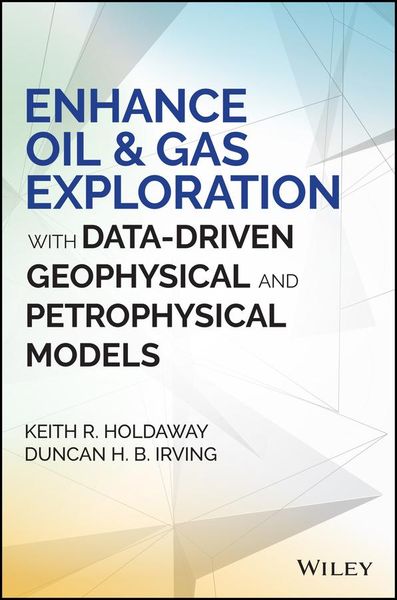
Produktbild: Enhance Oil and Gas Exploration with Data-Driven Geophysical and Petrophysical Models

Enhance Oil and Gas Exploration with Data-Driven Geophysical and Petrophysical Models Petrophysical Model

Aus der Reihe SAS Institute Inc

106,99 €

inkl. gesetzl. MwSt., Versandkostenfrei


Beschreibung

Produktdetails

Einband

Gebundene Ausgabe

Erscheinungsdatum

09.10.2017

Verlag

John Wiley & Sons Inc

Seitenzahl

368

Maße (L/B/H)

23,1/16/3,3 cm

Gewicht

567 g

Auflage

1. Auflage

Sprache

Englisch

ISBN

978-1-119-21510-3

Beschreibung

Produktdetails

Einband

Gebundene Ausgabe

Erscheinungsdatum

09.10.2017

Verlag

John Wiley & Sons Inc

Seitenzahl

368

Maße (L/B/H)

23,1/16/3,3 cm

Gewicht

567 g

Auflage

1. Auflage

Sprache

Englisch

ISBN

978-1-119-21510-3

Herstelleradresse

Libri GmbH
Europaallee 1
36244 Bad Hersfeld
DE

Email: gpsr@libri.de

Kundinnen und Kunden meinen

0 Bewertungen

Informationen zu Bewertungen

Zur Abgabe einer Bewertung ist eine Anmeldung im Konto notwendig. Die Authentizität der Bewertungen wird von uns nicht überprüft. Wir behalten uns vor, Bewertungstexte, die unseren Richtlinien widersprechen, entsprechend zu kürzen oder zu löschen.

Die Bewertungen sind nach Format, Anzahl Sterne und Datum sortiert.

Verfassen Sie die erste Bewertung zu diesem Artikel

Helfen Sie anderen Kund*innen durch Ihre Meinung

Kundinnen und Kunden meinen

0 Bewertungen filtern

Die Leseprobe wird geladen.
  • Produktbild: Enhance Oil and Gas Exploration with Data-Driven Geophysical and Petrophysical Models
  • Foreword xv

    Preface xxi

    Acknowledgments xxiii

    Chapter 1 Introduction to Data-Driven Concepts 1

    Introduction 2

    Current Approaches 2

    Is There a Crisis in Geophysical and Petrophysical Analysis? 3

    Applying an Analytical Approach 4

    What Are Analytics and Data Science? 5

    Meanwhile, Back in the Oil Industry 8

    How Do I Do Analytics and Data Science? 10

    What Are the Constituent Parts of an Upstream Data Science Team? 13

    A Data-Driven Study Timeline 15

    What Is Data Engineering? 18

    A Workflow for Getting Started 19

    Is It Induction or Deduction? 30

    References 32

    Chapter 2 Data-Driven Analytical Methods Used in E&P 34

    Introduction 35

    Spatial Datasets 36

    Temporal Datasets 37

    Soft Computing Techniques 39

    Data Mining Nomenclature 40

    Decision Trees 43

    Rules-Based Methods 44

    Regression 45

    Classification Tasks 45

    Ensemble Methodology 48

    Partial Least Squares 50

    Traditional Neural Networks: The Details 51

    Simple Neural Networks 54

    Random Forests 59

    Gradient Boosting 60

    Gradient Descent 60

    Factorized Machine Learning 62

    Evolutionary Computing and Genetic Algorithms 62

    Artificial Intelligence: Machine and Deep Learning 64

    References 65

    Chapter 3 Advanced Geophysical and Petrophysical Methodologies 68

    Introduction 69

    Advanced Geophysical Methodologies 69

    How Many Clusters? 70

    Case Study: North Sea Mature Reservoir Synopsis 72

    Case Study: Working with Passive Seismic Data 74

    Advanced Petrophysical Methodologies 78

    Well Logging and Petrophysical Data Types 78

    Data Collection and Data Quality 82

    What Does Well Logging Data Tell Us? 84

    Stratigraphic Information 86

    Integration with Stratigraphic Data 87

    Extracting Useful Information from Well Reports 89

    Integration with Other Well Information 90

    Integration with Other Technical Domains at the Well Level 90

    Fundamental Insights 92

    Feature Engineering in Well Logs 95

    Toward Machine Learning 98

    Use Cases 98

    Concluding Remarks 99

    References 99

    Chapter 4 Continuous Monitoring 102

    Introduction 103

    Continuous Monitoring in the Reservoir 104

    Machine Learning Techniques for Temporal Data 105

    Spatiotemporal Perspectives 106

    Time Series Analysis 107

    Advanced Time Series Prediction 108

    Production Gap Analysis 112

    Digital Signal Processing Theory 117

    Hydraulic Fracture Monitoring and Mapping 117

    Completions Evaluation 118

    Reservoir Monitoring: Real-Time Data Quality 119

    Distributed Acoustic Sensing 122

    Distributed Temperature Sensing 123

    Case Study: Time Series to Optimize Hydraulic Fracture Strategy 129

    Reservoir Characterization and Tukey Diagrams 131

    References 138

    Chapter 5 Seismic Reservoir Characterization 140

    Introduction 141

    Seismic Reservoir Characterization: Key Parameters 141

    Principal Component Analysis 146

    Self-Organizing Maps 146

    Modular Artificial Neural Networks 147

    Wavelet Analysis 148

    Wavelet Scalograms 157

    Spectral Decomposition 159

    First Arrivals 160

    Noise Suppression 161

    References 171

    Chapter 6 Seismic Attribute Analysis 174

    Introduction 175

    Types of Seismic Attributes 176

    Seismic Attribute Workflows 180

    SEMMA Process 181

    Seismic Facies Classification 183

    Seismic Facies Dataset 188

    Seismic Facies Study: Preprocessing 189

    Hierarchical Clustering 190

    k-means Clustering 193

    Self-Organizing Maps (SOMs) 194

    Normal Mixtures 195

    Latent Class Analysis 196

    Principal Component Analysis (PCA) 198

    Statistical Assessment 200

    References 204

    Chapter 7 Geostatistics: Integrating Seismic and Petrophysical Data 206

    Introduction 207

    Data Description 208

    Interpretation 210

    Estimation 210

    The Covariance and the Variogram 211

    Case Study: Spatially Predicted Model of Anisotropic Permeability 214

    What Is Anisotropy? 214

    Analysis with Surface Trend Removal 215

    Kriging and Co-kriging 224

    Geostatistical Inversion 229

    Geophysical Attribute: Acoustic Impedance 230

    Petrophysical Properties: Density and Lithology 230

    Knowledge Synthesis: Bayesian Maximum Entropy (BME) 231

    References 237

    Chapter 8 Artificial Intelligence: Machine and Deep Learning 240

    Introduction 241

    Data Management 243

    Machine Learning Methodologies 243

    Supervised Learning 244

    Unsupervised Learning 245

    Semi-Supervised Learning 245

    Deep Learning Techniques 247

    Semi-Supervised Learning 249

    Supervised Learning 250

    Unsupervised Learning 250

    Deep Neural Network Architectures 251

    Deep Forward Neural Network 251

    Convolutional Deep Neural Network 253

    Recurrent Deep Neural Network 260

    Stacked Denoising Autoencoder 262

    Seismic Feature Identification Workflow 268

    Efficient Pattern Recognition Approach 268

    Methods and Technologies: Decomposing Images into Patches 270

    Representing Patches with a Dictionary 271

    Stacked Autoencoder 272

    References 274

    Chapter 9 Case Studies: Deep Learning in E&P 276

    Introduction 277

    Reservoir Characterization 277

    Case Study: Seismic Profile Analysis 280

    Supervised and Unsupervised Experiments 280

    Unsupervised Results 282

    Case Study: Estimated Ultimate Recovery 288

    Deep Learning for Time Series Modeling 289

    Scaling Issues with Large Datasets 292

    Conclusions 292

    Case Study: Deep Learning Applied to Well Data 293

    Introduction 293

    Restricted Boltzmann Machines 294

    Mathematics 297

    Case Study: Geophysical Feature Extraction: Deep Neural Networks 298

    CDNN Layer Development 299

    Case Study: Well Log Data-Driven Evaluation for Petrophysical Insights 302

    Case Study: Functional Data Analysis in Reservoir Management 306

    References 312

    Glossary 314

    About the Authors 320

    Index 323