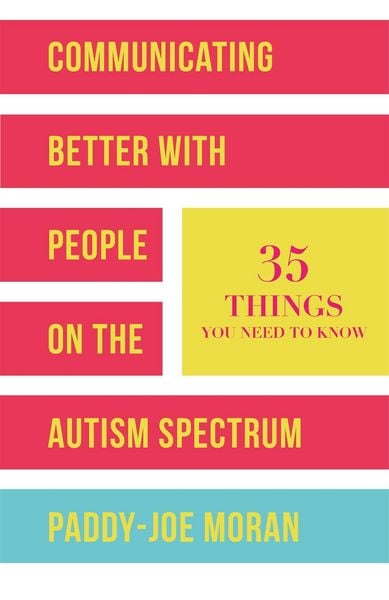
Produktbild: Communicating Better with People on the Autism Spectrum

Communicating Better with People on the Autism Spectrum 35 Things You Need to Know

18,99 €

inkl. gesetzl. MwSt., Versandkostenfrei


Beschreibung

Produktdetails

Einband

Taschenbuch

Erscheinungsdatum

18.08.2016

Verlag

Jessica Kingsley Publishers Ltd

Seitenzahl

96

Maße (L/B/H)

19,8/13,1/1,2 cm

Gewicht

118 g

Sprache

Englisch

ISBN

978-1-84905-708-0

Beschreibung

Produktdetails

Einband

Taschenbuch

Erscheinungsdatum

18.08.2016

Verlag

Jessica Kingsley Publishers Ltd

Seitenzahl

96

Maße (L/B/H)

19,8/13,1/1,2 cm

Gewicht

118 g

Sprache

Englisch

ISBN

978-1-84905-708-0

Herstelleradresse

Libri GmbH
Europaallee 1
36244 Bad Hersfeld
DE

Email: gpsr@libri.de

Kundinnen und Kunden meinen

0 Bewertungen

Informationen zu Bewertungen

Zur Abgabe einer Bewertung ist eine Anmeldung im Konto notwendig. Die Authentizität der Bewertungen wird von uns nicht überprüft. Wir behalten uns vor, Bewertungstexte, die unseren Richtlinien widersprechen, entsprechend zu kürzen oder zu löschen.

Die Bewertungen sind nach Format, Anzahl Sterne und Datum sortiert.

Verfassen Sie die erste Bewertung zu diesem Artikel

Helfen Sie anderen Kund*innen durch Ihre Meinung

Kundinnen und Kunden meinen

0 Bewertungen filtern

Die Leseprobe wird geladen.
  • Produktbild: Communicating Better with People on the Autism Spectrum
  • Introduction. 1. Person first language - to use it or not? 2. Use non-patronising language. 3. Use age-appropriate language. 4. Use neutral language. 5. Let yourself be guided on preferred terminology. 6. Don't use the word normal. 7. There is nothing `mild` about Asperger syndrome. 8. Say `on the spectrum`. 9. Address the person directly. 10. Refer to parents by name. 11. Adapting your language and the way you speak. 12. You will be taken literally. 13. Sarcasm. 14. The use of functioning labels. 15. Non-verbal vs pre-verbal. 16. Pre-conceived ideas. 17. Appearances can be deceptive. 18. Triad of Impairments. 19. Giftedness is not a given. 20. Autism is a neurological condition. 21. Autistic person, not patient. 22. No need to grieve. 23. Puzzling. 24. Facial expressions. 25. Body language. 26. Environment. 27. Physical contact. 28. Have a time limit on the session. 29. Offer breaks during sessions. 30. Explain what will be happening, and when. 31. Stick to the plan. 32. Ask specific rather than open-ended questions. 33. Pace your speech. 34. Alternatives to non-verbal communication. 35. Things to consider when offering food. Conclusion.